The real estate market in the northern Gyeonggi region is drawing attention as a series of major developments in metropolitan transportation networks have emerged as significant positive factors. This area was previously regarded as a "blind spot" in terms of public transportation due to the lack of infrastructure connecting surrounding regions. Recently, however, the construction of metropolitan transportation networks such as railways and expressways has revitalized the local economy and brought noticeable changes to the real estate market.
Metropolitan transportation networks, which connect urban spaces quickly and efficiently, are considered key factors in boosting real estate value. The GTX (Great Train Express), metropolitan railways, and expressways are prime examples. These networks connect people, cities, and regions rapidly. As living radii expand and floating populations increase, local areas become more vibrant and the regional economy is revitalized. This, in turn, drives up local real estate prices and leads to a surge of prospective buyers in the pre-sale market. This explains why local residents are so eager to see transportation networks expanded.
Yangju City in Gyeonggi Province is rapidly emerging as a central hub for metropolitan transportation in the northern Gyeonggi region. Projects to establish metropolitan transportation facilities such as GTX, subways, expressways, and BRT (Bus Rapid Transit) are progressing rapidly. Once completed, these facilities will enable quick access to central Seoul as well as major hubs in the surrounding Gyeonggi area.
The most anticipated metropolitan transportation line is the GTX-C line. This route connects Deokjeong Station in Yangju to Samsung Station and Suwon Station, spanning 74.2 kilometers. Once operational, it is expected to take approximately 27 minutes from Deokjeong to Samsung Station and about 26 minutes from Suwon to Samsung Station. This will drastically reduce north-south travel times in the Seoul metropolitan area, amounting to what can be called a "transportation revolution."
The expressway network is also becoming denser. The Second Ring Expressway of the Seoul metropolitan area, which will serve as the "main artery" of the region, is scheduled to open in phases by 2029. This 263.4-kilometer road will connect Yangju, Pocheon, Namyangju, Yangpyeong, Icheon, Osan, Hwaseong, Ansan, Incheon, Gimpo, Paju, and back to Yangju. Once open, it will provide rapid connections not only between major cities in Gyeonggi Province but also to key areas in Seoul. Notably, the northern Gyeonggi region will be able to access the south quickly without passing through central Seoul. The Paju-Yangju section opened on December 19, 2024.
The Sejong-Pocheon Expressway, stretching approximately 176.3 kilometers from Sejong Special Self-Governing City to Pocheon in Gyeonggi Province, was planned to alleviate traffic on the Gyeongbu and Jungbu Expressways. The Guri-Pocheon section has been operational since June 2017, and the Anseong-Guri section opened on January 1, 2024. The Sejong-Anseong section is currently under construction and is scheduled for completion at the end of 2026.
The extension of Subway Line 7 is also gaining momentum. Aimed at improving transportation convenience in the northern and western metropolitan areas, the Dobongsan-Okjeong section (Phase 1 of the Dobongsan-Pocheon Line) will connect Dobongsan Station to Okjeong District in Yangju, spanning about 15.3 kilometers. Construction began in December 2019, with the goal of opening in 2026.
Additionally, BRT (Bus Rapid Transit), known as the "subway above ground," is being introduced. The Deokjeong-Nambang BRT will provide rapid service between Deokjeong Station, Okjeong, Goeup, and Yangju Station, with the aim of opening in 2026. The Seoul-Yangju expressway is also being pursued, targeting completion by 2030.
The real estate market in areas that have benefited from the establishment of new metropolitan transportation networks has heated up significantly. Yangju, located in northern Gyeonggi Province, has attracted considerable attention in the real estate market in recent years due to various development projects and population growth.
In 2024, apartment sale prices in Yangju turned upward. According to the Korea Real Estate Board, prices rose by 0.07% in August 2024 compared to the previous month, and the increase widened to 0.2% in September. In the pre-sale market, thousands of people have visited model homes, indicating robust activity.
From early 2024 through August, the total number of apartment transactions in Yangju and the northern Gyeonggi region reached 21,911, an increase of about 30% compared to the same period last year. This surge is attributed to the progress of the GTX project, the outer ring expressway, and the development of various industrial complexes.
The steady increase in Yangju's population in recent years is also a positive factor for the real estate market. As of November 30, 2024, the total population of Yangju was 288,273, up about 22% from three years earlier (236,302).
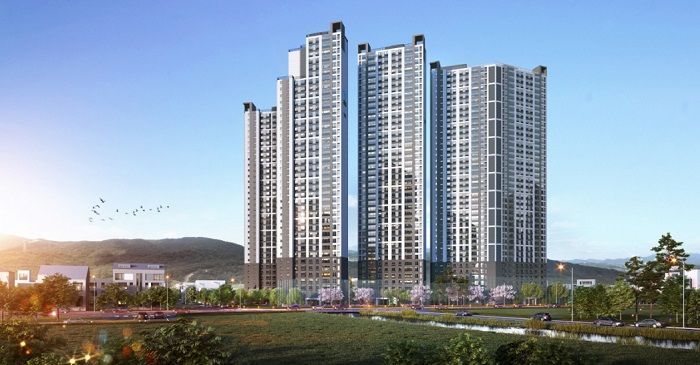
From this perspective, the "Yangju Deokjeong Station Apit" development, set to be offered for sale in Hoejeong-dong, Yangju next month, is worth noting. This apartment complex will be located near Deokjeong Station, the terminus of the GTX-C line and Seoul Subway Line 1. The development will consist of four buildings ranging from three basement levels to 39 above-ground floors, comprising a total of 427 units: 184 units of 84㎡ Type A, 64 units of 84㎡ Type B, 114 units of 78㎡ Type A, and 65 units of 78㎡ Type B (all based on exclusive area).
Hoejeong-dong in Yangju is close to the new towns of Hoecheon and Okjeong, allowing residents to enjoy the well-established amenities of these areas. Once the Yangju New Town development, now in its final stages, is completed, the region-including Okjeong and Hoecheon districts-will become the largest new town in the northeastern Seoul metropolitan area, with about 70,000 households and 177,000 residents.
In particular, Hoejeong-dong in Yangju is attracting attention from homebuyers due to the positive impact of the extensive metropolitan transportation network. The GTX-C line will open, and a new Hoecheon Central Station will be established between Deokjeong and Deokgye stations on Seoul Subway Line 1. This will further improve accessibility to Seoul via rail and subway.
The area also boasts abundant development prospects. Projects such as the development of Yangju and Hoecheon New Towns, the establishment of Yangju Technovalley and Hoecheon Advanced Industrial Complex, and the Yangju Station Area Development Project are all underway. Once these new towns and industrial complexes are completed, the influx of high-income professionals is expected to bring additional benefits.
The educational environment is also excellent. Hoejeong Elementary School, which is within walking distance of the complex, as well as kindergartens and elementary and middle schools, are located nearby, providing a superior educational environment. The area is also adjacent to new towns, ensuring well-developed living infrastructure. The Yangju Police Station and Yangju City Hoam Site Museum are also close by.
© The Asia Business Daily(www.asiae.co.kr). All rights reserved.
![Clutching a Stolen Dior Bag, Saying "I Hate Being Poor but Real"... The Grotesque Con of a "Human Knockoff" [Slate]](https://cwcontent.asiae.co.kr/asiaresize/183/2026021902243444107_1771435474.jpg)
















