Big Tech Pushes Back Against Biden's AI Chip Export Controls
U.S. Tech Leadership at Risk vs. Blocking China’s Workarounds
As U.S. President Joe Biden approaches the end of his term, the technology industry has collectively pushed back against his move to more strictly control the export of artificial intelligence (AI) semiconductors. Locally, there is speculation that this regulation will act as a catalyst intensifying the conflict between big tech companies entangled in business with China and the hardline faction against China.
According to the New York Times (NYT) and the Wall Street Journal (WSJ) on the 9th (local time), the Biden administration is expected to announce as early as the 10th measures to restrict AI chip exports by categorizing countries worldwide into three tiers. A select few allies such as South Korea and Japan will be allowed to freely purchase U.S.-made AI chips, but semiconductor exports to adversarial countries like China and Russia will be blocked. For most other countries, semiconductor purchase volumes will be capped and only lifted upon compliance with security requirements demanded by the U.S. government.
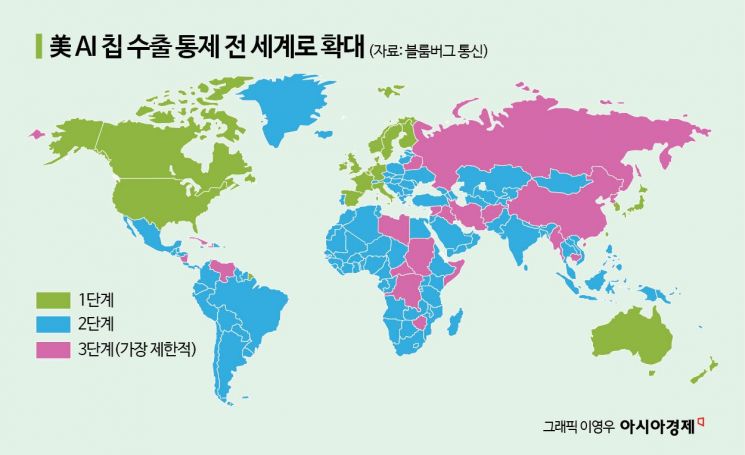
The Biden administration holds the position that AI is the key to national security that will change the landscape of future warfare, and thus AI development capabilities should be concentrated only in countries the U.S. trusts. There is concern that if AI data centers are established in Southeast Asian or Middle Eastern countries that are not U.S. allies, China could acquire AI technology through these countries' data centers.
However, companies strongly oppose this, arguing that losing the large Chinese market could directly hit their sales and lead to side effects such as losing technological dominance to other countries. Countries blocked from importing U.S. semiconductors are likely to import AI semiconductors and related technologies from China, which could ultimately result in the growth of China's AI industry catching up to the U.S.
Ken Glueck, Vice Chairman of Oracle, strongly criticized in a blog post, calling it "the most destructive regulation ever recorded to hit the U.S. tech industry." Nvidia pointed out, "Most of the rules tightening exports until the very end do not reduce the risk of abuse," adding, "This will be a major policy shift threatening economic growth and U.S. leadership." Additionally, the Information Technology Industry Council (ITIC), representing major companies such as Google, Microsoft (MS), and Amazon, also criticized the Biden administration for not consulting with businesses.
The tech industry questions whether President Biden, on the verge of leaving office, should decide on regulations with such significant economic impact, and they are looking hopefully toward the Donald Trump administration, which will take office on the 20th. However, it is uncertain whether the regulations will be withdrawn. Elon Musk, Tesla CEO and Trump’s "first buddy," counts China as his largest customer, and his son-in-law Jared Kushner has business interests in Middle Eastern countries, but the hardline faction against China controlling the administration’s diplomatic and security lines may block any rollback.
The WSJ stated, "Biden’s AI chip regulations have brought to the surface a rare conflict between big tech and the China hawks," and noted, "It is unusual that such a clash occurred at the end of Biden’s term, but it is also quite unprecedented that a Democratic president and Republicans have formed a joint front against Silicon Valley."
© The Asia Business Daily(www.asiae.co.kr). All rights reserved.
![Clutching a Stolen Dior Bag, Saying "I Hate Being Poor but Real"... The Grotesque Con of a "Human Knockoff" [Slate]](https://cwcontent.asiae.co.kr/asiaresize/183/2026021902243444107_1771435474.jpg)
















