Establishment of Unified Standards for Deferred Integration, Promotion of Legal Amendments
Free Education for 5-Year-Olds "Supplementary Budget Negotiations Underway"
Strengthening Student-Customized Support, Expanding Support for Migrant Background Students
Establishment of Medical Education Support Officer to Foster Excellent Talent
The Ministry of Education is preparing integration standards and related legal amendments to promote the integration of early childhood education and care, known as 'Yubotonghap,' this year. Additionally, to strengthen student-tailored support, it is preparing system linkages with other ministries and pushing for legal amendments to support students with migration backgrounds. The Neulbom School, which started last year, will be expanded to include up to 2nd grade in elementary school this year, and full-scale field application will begin with the implementation of the high school credit system and the 5-grade internal evaluation system.
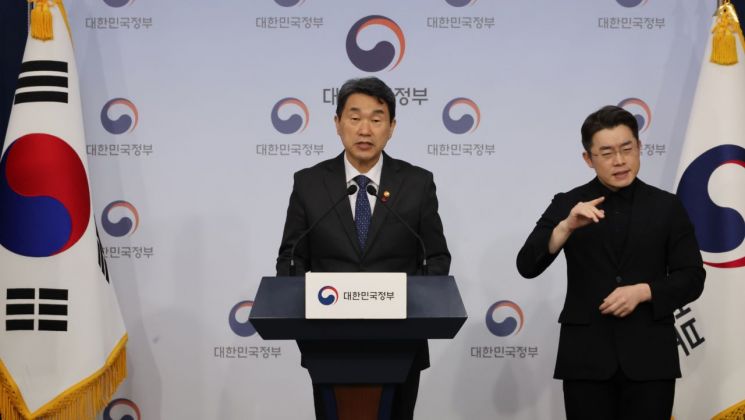
On the morning of the 10th at 10 a.m., Lee Ju-ho, Deputy Prime Minister for Social Affairs and Minister of Education, held a briefing at the Government Seoul Office and announced the '2025 Major Policy Implementation Plan of the Ministry of Education.'
The Ministry of Education set this year's policy directions into five categories: ▲Equal starting line ▲Reduction of private education and entrance exam burdens ▲Strengthening tailored support ▲Resolving regional disparities ▲Supporting youth growth.
First, institutional improvements to prepare for Yubotonghap will be actively promoted this year. In line with the Yubotonghap implementation plan announced last year, integration standards for kindergartens and daycare centers will be established, and legal amendments will be prepared to unify local-level management systems. In particular, the target for additional support for early childhood education fees and childcare fees will be expanded from the existing 5-year-olds to include 4-year-olds, and the budget has been increased from approximately 173.5 billion KRW to about 327.1 billion KRW to support this.
Previously, the Ministry of Education decided to effectively provide full tuition support for 5-year-olds starting this year and to expand free education benefits to 3- and 4-year-olds by 2027. Regarding this, Nam Jeom-soon, Head of the Early Childhood Policy Division at the Ministry of Education, explained, "This time, the childcare budget was not directly reflected, but the basis for allocating it as a contingency fund under our preliminary budget general provisions has been established," adding, "Whether to include it in the supplementary budget is under consultation with the financial authorities."
In addition, about 50 new hub-type care centers will be newly opened this year to provide tailored education and care services. They will operate morning, evening, vacation, care, and Saturday care programs.
The Neulbom School, which was implemented for 1st graders in elementary school last year, will be expanded to include 2nd graders this year. Furthermore, collaboration with 16 ministries and agencies will develop sector-specific programs, and public and private institutions will cooperate to expand various programs. Approximately 1,500 Neulbom support officers will be deployed this year, and at least one Neulbom staff member will be assigned per school.
Measures to reduce the burden of private education and entrance exams will continue. A 'Self-Directed Learning Support Center (tentative name)' in the form of a managed reading room will be established for students from elementary to high school. An online platform where students can independently design their curriculum and receive career, college admission, and learning strategy consulting from active teachers will also be built and operated starting January this year.
Moreover, starting in March this year, AI (Artificial Intelligence) digital textbooks will be introduced in schools to realize individualized education for students. Teacher incentives will be actively expanded to encourage the creation of teaching content and instructional design using these resources.
In line with the high school credit system implemented this year, the internal evaluation system will be restructured from 9 grades to 5 grades starting from 10th grade. Universities will be provided with both absolute evaluation grades for the entire high school curriculum and relative evaluation 5-grade scales.
Measures to strengthen student-tailored support have also been expanded. Plans to build a 'Student Tailored Integrated Support Information System' linked with other ministries' systems have been prepared, and a survey will be conducted. Enforcement decrees, enforcement rules, and ordinances will also be prepared. To expand tailored educational support for students with migration backgrounds, a special law will be enacted. Tailored education will be strengthened considering Korean language proficiency and residency status, including early adaptation, career guidance, and employment, and educational support centered on elementary school will be expanded to middle and high schools, early childhood, and parents.
The status of complaint response conditions, such as school complaint response teams, will be checked, and support will be provided to improve the expertise of those in charge. Competency indicators for self-capacity diagnosis will be developed to establish a system that can serve as a standard for teacher training, appointment, evaluation, and competency development in the future. To promote student health, universal social-emotional education, a mental health education program, will be introduced in all schools, and the number of emergency support teams of mental health professionals will be expanded from 36 last year to 47 this year.
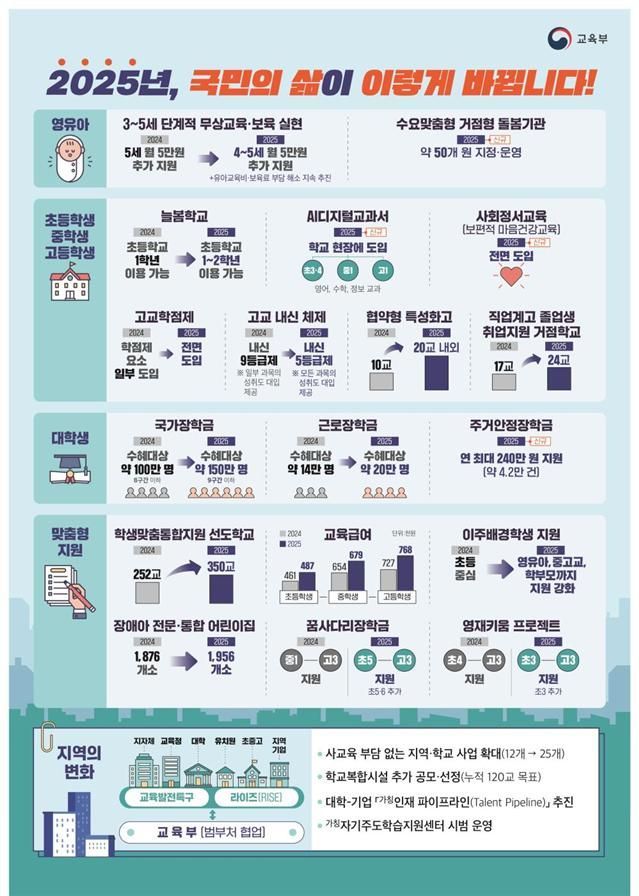
To alleviate the housing cost burden for university students, a housing stability scholarship will be newly established for low-income university students, providing up to 400,000 KRW per year. A budget of 34.435 billion KRW has been allocated for this. Construction of four joint dormitories, which began last year, will proceed to provide quality housing environments with affordable monthly rents.
The 'Talent Pipeline (tentative name)' between universities and companies will be promoted to expand the participation of small and medium-sized enterprises in designing and operating university curricula. This aims to connect graduates from universities with the talents needed by companies, including recruitment by small and medium-sized enterprises after graduation.
Also, to smoothly support the planned increase in medical school admissions this year, the Ministry of Education will establish and operate a dedicated organization for medical school education called the 'Medical School Education Support Officer.' Comprehensive support for education, academic affairs, and infrastructure improvements will be provided to nurture excellent medical personnel.
To increase research opportunities for research personnel, support such as research incentives will be expanded for graduate students and postdoctoral researchers at the entry stage of their research careers. For the humanities and social sciences, a research incentive for master's students will be newly established, providing 12 million KRW annually. For science and engineering, research incentives for master's and doctoral students will be significantly increased. Additionally, university research institutes will be supported through HK 3.0 (humanities and social sciences) and University Research Innovation Projects (science and engineering).
© The Asia Business Daily(www.asiae.co.kr). All rights reserved.
![Clutching a Stolen Dior Bag, Saying "I Hate Being Poor but Real"... The Grotesque Con of a "Human Knockoff" [Slate]](https://cwcontent.asiae.co.kr/asiaresize/183/2026021902243444107_1771435474.jpg)
















