Standard Construction Cost for Rental Housing at 54% of Basic Type
Stable Since February 2023, Raised 3 Times Since 2005
Government Hesitant to Raise Due to Concerns Over Vulnerable Groups' Housing Burden
Private Builders Avoid Rental Housing Amid Housing Supply Instability
Causes of Poor Construction and Quality Decline, Revision Needed Including Linked Proportional Rates
Amid growing concerns over housing supply instability, there have been calls to actualize the 'standard construction cost' to ensure smooth supply of rental housing. The construction cost serves as the basis for cost calculation when building or purchasing rental housing, but it has been frozen for 1 year and 10 months, acting as an obstacle to rental housing supply. If actualizing the standard construction cost is difficult, it has been suggested to consider using the 'basic construction cost,' which is used as the foundational data for calculating construction costs of private sale apartments.
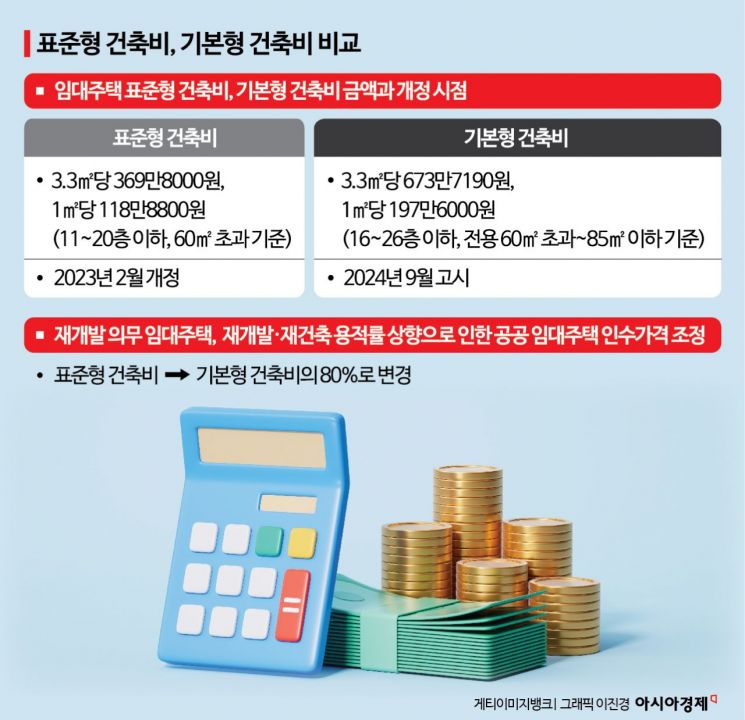
Standard Construction Cost for Rental Housing is 54% of Construction Cost for Sale Housing
According to the construction industry on the 10th, the most recently announced standard construction cost for rental housing is 3,698,000 KRW per 3.3㎡. It has remained unchanged since February 2023 and has only increased three times since 2005. This is just 54% of the basic construction cost for sale apartments, which has continuously reflected inflation and stands at 6,737,190 KRW per 3.3㎡.
The government has not raised the standard construction cost out of concern that the housing foundation for vulnerable groups could deteriorate. The standard construction cost is used as the rent calculation standard for public rental housing before the introduction of integrated public rental housing, which combines types such as permanent, public rental, and Happy Housing. It also affects the sale conversion prices of 5-year rental housing built before the introduction of the Private Rental Housing Act, as well as the purchase prices of purchased rental housing.
On the other hand, the housing industry has continuously requested an increase in the standard construction cost. A housing industry official stated, "Although the construction cost is the same, only one (the basic type) has been continuously increased following the construction cost index." He added, "Some 5-year rental housing supplied 10 years ago must be converted to sale based on the standard construction cost, but since this standard is so low, there are rare cases where the rental entity actually pays residents to convert the house to sale."
"Standard Construction Cost Blocking Rental Housing Supply"
Recently, the market analysis suggests that the unrealistic construction cost has intensified private construction companies' reluctance to build rental housing. It acts as an obstacle to rental housing supply and further exacerbates housing supply and demand instability. Seo Jong-dae, CEO of the Housing Industry Research Institute, said at a recent seminar, "If private supply decreases, the public sector must secure more long-term rental units, but construction companies cannot build because they try to convert to sale using the standard construction cost," adding, "While the basic construction cost applied to private sales has been raised 34 times, the standard construction cost has only been raised 3 times."
There are also concerns that the unrealistic standard construction cost could lead to poor construction or quality degradation of rental housing. In particular, rental housing purchased under contract-type purchase rental also applies the standard construction cost to determine the purchase price. The larger the gap with the basic construction cost, the greater the possibility that the quality of purchased rental housing will decline or supply will become difficult.
This year, the number of apartment move-ins nationwide is 266,022 households, about 100,000 fewer than last year (363,921 households). Compared to the 10-year average annual move-in volume (2014?2023) of 350,724 households, it is also about 90,000 fewer. The Housing Industry Research Institute analyzed that a supply shortage of more than 500,000 households will accumulate from the start of the Yoon Seok-yeol administration until the end of this year.
As it became difficult for the government to purchase rental housing in reconstruction and redevelopment projects based on the standard construction cost, the purchase price standard was changed to 80% of the basic construction cost from the end of July last year. Previously, purchases were based on the standard construction cost, which caused dissatisfaction among redevelopment project associations. LH also planned to purchase rental housing based on the standard construction cost from 2023 but changed the standard to 90% of the re-procurement cost after 10 months due to inability to buy houses. LH's purchase rental housing purchase performance in 2023 was 4,610 households, only 23% of the target (20,476 households).
Industry Calls for Linking to Basic Construction Cost
Since many private rental housing projects are indirectly or directly affected by the standard construction cost, there are opinions that institutional improvements are necessary. Currently, private rental housing built with support from the Housing and Urban Fund receives construction cost support based on the 'standard construction cost' announced by Woori Bank, but this construction cost is also influenced by the standard construction cost.
An industry official said, "Although there is a fund support limit, sometimes even that limit is not supported because the standard construction cost-influenced standard construction cost has not been actualized," adding, "Legal amendments are needed to regularly announce the standard construction cost linked to the basic construction cost at a certain ratio."
No Hee-soon, head of the Industrial and Urban Research Department at the Housing Industry Research Institute, explained, "If construction costs are not actualized, building will inevitably decrease because it results in losses, and if houses have to be sold cheaper than the input costs, the overall quality will be lowered to reduce costs, causing a decline in overall housing quality," adding, "To encourage private participation and increase rental supply, the standard construction cost must be actualized."
© The Asia Business Daily(www.asiae.co.kr). All rights reserved.
![Clutching a Stolen Dior Bag, Saying "I Hate Being Poor but Real"... The Grotesque Con of a "Human Knockoff" [Slate]](https://cwcontent.asiae.co.kr/asiaresize/183/2026021902243444107_1771435474.jpg)















