Expansion of Domestic Stock Proportion Including the 'Big 3' in the Distribution Industry
Top 2 in Shareholding Increase: PNH Tech and Cosmax
Isu Petasys, Controversial in Capital Increase, Leads in Proportion Reduction
It has been revealed that the National Pension Service (NPS) significantly increased the proportion of 'domestic consumption stocks' in its domestic equity portfolio during the fourth quarter of last year. Domestic consumption stocks refer to sectors closely related to consumption, such as essential consumer goods and distribution.
According to the electronic disclosure system on the 9th, from the 1st to the 8th, the NPS disclosed changes in shareholding ratios for 106 out of 262 large-scale holdings with a stake of 5% or more. Among these, 68 increased and 38 decreased. Among the top 10 stocks with the largest increase in shareholding ratio, four were domestic consumption stocks: Emart, Orion, Cheil Worldwide, and Hyundai Department Store.
The NPS is obligated to disclose changes in shareholding ratios for 'general investment' stocks in the month following the quarter in which the change occurred, and for 'simple investment' stocks in the month following the month of change. In months where disclosures for both general and simple investments overlap (January, April, July, October), over 100 disclosures are released. The number of disclosures in the fourth quarter of last year slightly decreased compared to the third quarter's 130 disclosures.
All Shares of the 'Big 3' in Domestic Distribution Increased
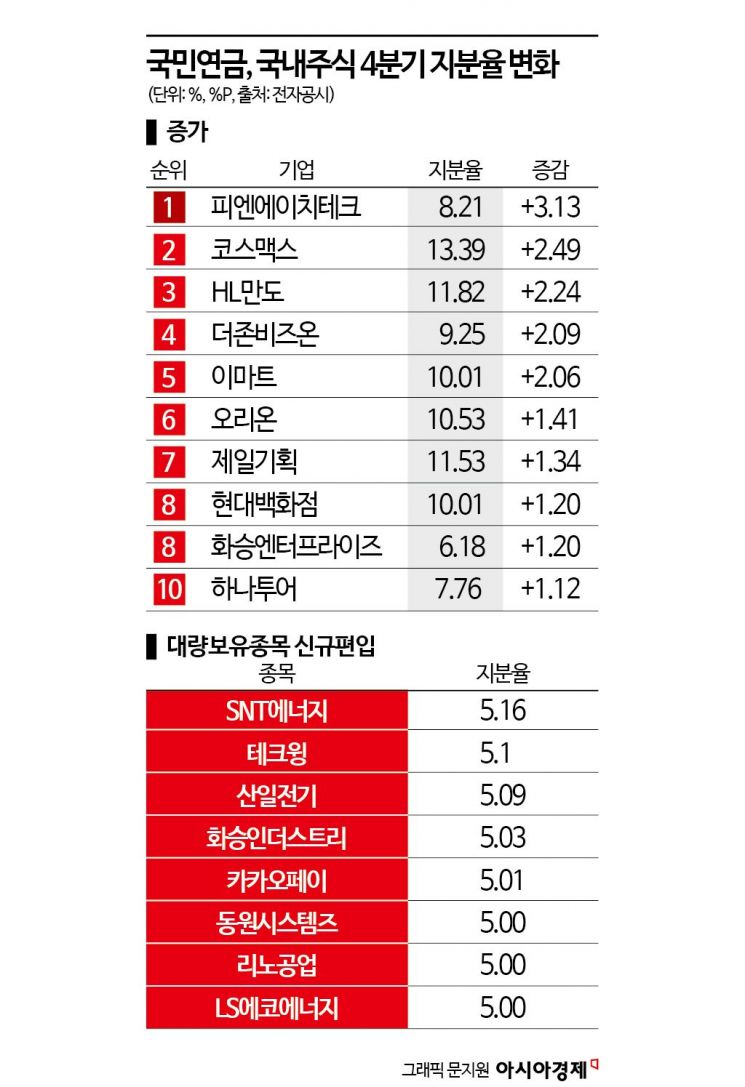
Based on the increase in shareholding ratio, Emart (7.95→10.01%) ranked 5th, Orion (9.12→10.53%) 6th, Cheil Worldwide (10.19→11.53%) 7th, and Hyundai Department Store (8.81→10.01%) 8th. Although not in the top 10, Lotte Shopping (5.99→7.01%), also classified as a domestic consumption stock, increased its holding by more than 1 percentage point. This means that the traditional 'Big 3' in the distribution industry?Lotte Shopping, Shinsegae·Emart, and Hyundai Department Store?all increased their stakes. This appears related to expectations that domestic consumption stocks will benefit from a new government launch and economic stimulus measures if an early presidential election is held. Eight years ago, after the impeachment incident, when the Moon Jae-in administration took office, domestic consumption activation was also prioritized as a key pledge, drawing attention to related stocks.
The stock with the largest increase in shareholding ratio was PNHTech, which rose from 5.08% to 8.21%, an increase of 3.13 percentage points. It is a company specializing in organic light-emitting diode (OLED) materials. It is expected to benefit from the Trump administration's second term moves to regulate Chinese OLEDs. The next largest increase was in Cosmax (10.9→13.39%), the world's number one cosmetics original design manufacturer (ODM). Domestic cosmetics attracted attention last year by recording the highest export value ever.
Other companies with significant increases in shareholding ratio include automotive parts manufacturer HL Mando (9.58→11.82%), enterprise resource planning (ERP) service company Douzone Bizon (7.16→9.25%), Adidas shoe manufacturer Hwasung Enterprise (4.98→6.18%), and Korea's top travel agency Hanatour (6.63→7.76%).
Reduced Stakes in Companies with Controversial Capital Increases and Management Disputes
On the other hand, Shinsegae International's shareholding ratio decreased significantly from 8.01% to 2.89%, a drop of 5.12%. Isu Petasys (10.74→7.43%), Korea Zinc (7.49→4.51%), Hyundai Marine & Fire Insurance (9.67→7.36%), and Jahwa Electronics (7.05→4.91%) also decreased by more than 2 percentage points. Shinsegae International, a fashion company, has experienced a downward trend in performance since 2023, and Isu Petasys was embroiled in controversy over a 'surprise paid-in capital increase.' Korea Zinc appears to have disposed of shares following a sharp rise in stock price due to a management rights dispute.
Meanwhile, as of the end of October 2024, the NPS has recorded a -0.87% return on domestic stocks. It is the only one among the five major asset classes managed by the NPS to show a negative return. Among asset classes, overseas stocks recorded the highest return at 26.52%, and the overall fund return was 11.52%. From January to October last year, cumulative profits amounted to 120.3 trillion KRW, with the fund size at 1,170.554 trillion KRW. The provisional annual return and profit for 2024 are scheduled to be disclosed at the end of February.
© The Asia Business Daily(www.asiae.co.kr). All rights reserved.
![Clutching a Stolen Dior Bag, Saying "I Hate Being Poor but Real"... The Grotesque Con of a "Human Knockoff" [Slate]](https://cwcontent.asiae.co.kr/asiaresize/183/2026021902243444107_1771435474.jpg)















