"At This Rate, Everyone Will Die" Rush of Tuition Fee Decisions
University Budgets Decline After Introduction of Tuition Fee Cap
53% of Private Universities Plan Tuition Fee Increase This Year
Parents and Students Face Inevitable Tuition Burden
With university tuition fees frozen for 17 years since 2009, universities have started raising tuition fees despite the government's request for restraint. Sogang University and Kookmin University have decided to increase tuition fees by 4.85% and 4.97% respectively this year, and Yonsei University and Korea University are also reviewing tuition fee increase plans.
According to the 'Legislative Impact Analysis on Tuition Fee Increase Rate Restriction Regulations' report by the National Assembly Legislative Research Office on the 8th, budgets for private universities' research expenses, laboratory practice costs, book purchases, and land and building acquisitions have continuously decreased since 2011, when the tuition fee increase rate was restricted.
After the 2008 global financial crisis, universities voluntarily froze tuition fees from 2009 to 2011, and in 2011, a legal cap on tuition fees was introduced. The government set a condition that only universities that froze or lowered tuition fees would receive national scholarships (Type II), effectively maintaining tuition fees in a frozen state.
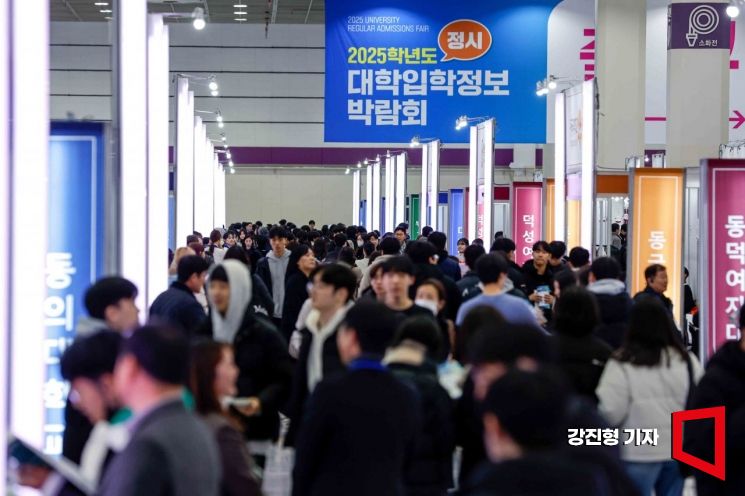 On December 19 last year, the '2025 College Admission Information Fair' held at COEX in Gangnam-gu, Seoul, was crowded with examinees and parents seeking college admission counseling. Photo by Kang Jin-hyung
However, as high inflation and a declining school-age population continue, universities are complaining of worsening financial difficulties. According to the Legislative Research Office's data, the budget private universities spent on research decreased every year from 540.1 billion KRW in 2011 to 442.9 billion KRW in 2022.
Accordingly, in the 'Survey Analysis on University Issues' conducted by the Korean Council of Private University Presidents targeting 151 member university presidents, 75.9% of responding private university presidents identified 'university tuition fee increase' as the top university issue. In particular, 53.3% of the responding private university presidents said they plan to raise tuition fees for the 2025 academic year, while 42.2% responded that it is 'still under discussion.'
If universities independently raise tuition fees, rendering the tuition fee cap meaningless, the burden on parents and students is expected to increase. On the afternoon of the same day, Deputy Minister of Education Oh Seok-hwan plans to hold a video conference with presidents of flagship national universities to discuss the tuition fee issue.
© The Asia Business Daily(www.asiae.co.kr). All rights reserved.
![Clutching a Stolen Dior Bag, Saying "I Hate Being Poor but Real"... The Grotesque Con of a "Human Knockoff" [Slate]](https://cwcontent.asiae.co.kr/asiaresize/183/2026021902243444107_1771435474.jpg)















