As the Supreme Court has begun drafting concise and easy-to-understand judgments mainly for civil and family cases involving increased claims and small claims, it has been identified that from the end of May to December last year, 550 sample judgments were collected from about 108 trial divisions conducting the pilot program. Following last year, the Supreme Court plans to continue the pilot implementation of judgment optimization this year and is considering providing incentives to trial divisions that contribute to optimization starting next year. The legal community is paying attention to whether the expansion of easy-to-understand judgments will enable parties to comprehend judgments more easily and lead to faster dispute resolution.
Omission of Basic Facts Reduces Drafting Burden
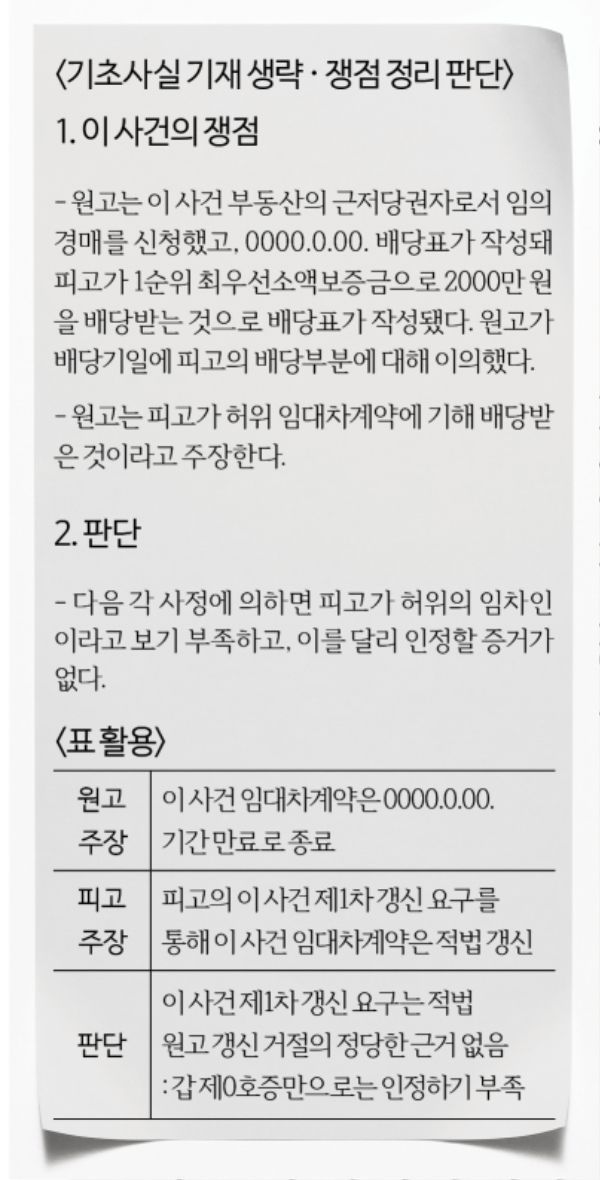
According to the '2024 Midterm Report on Judgment Optimization' obtained by Legal Times, judgments from trial divisions across the country participating in last year's pilot program included cases such as △building delivery and demolition △lease disputes △loan claims △purchase price and goods price △claim denial and third-party denial △fraudulent conveyance cancellation △damages △construction payment △others (civil) △family cases.
The overall drafting method of optimized judgments is focused on 'issues.' This is the most commonly shared format among trial divisions implementing optimization. It is an effective method that reduces the actual burden of drafting judgments. It is characterized by omitting the description of basic facts and directly organizing the issues and the court's rulings on those issues. Depending on the case, the course of the dispute, the cause of claim, and the opposing party's arguments are summarized and then the judgment on the issues is made.
Sample appellate judgments were submitted consisting of the gist of the appeal reasons and the court's rulings. If there is no substantial dispute over the cause of claim, an appendix is used, and judgments only addressing the defendant's arguments are also included. When the cause of claim includes several detailed items, these are replaced by an appendix, and the judgment specifies which items are accepted or dismissed. Facts unrelated to the essential elements or minimally relevant facts are omitted or minimized in the judgment.
Additionally, sentences were drafted in bullet or list form to reduce the burden of writing, and tables were used when there were various claims. The tables summarized the plaintiff's and defendant's claims respectively, and the court's rulings were organized into four sentences. Especially in cases with disputes over detailed items such as lease restoration or defect repairs, where judgments tend to be longer, the submitted judgments were concisely written with △each item number △contract period △key evidence △claimed service fees △court's ruling to aid easy understanding.
Judgments that recorded only the key evidence were also cited as examples. In divorce cases, objective evidence such as family investigator reports or bank statements, which both parties did not dispute, were omitted.
A judge participating in the pilot program said, “Since the parties are well aware of the basic facts, omitting them will not cause significant backlash. Rather, if the basic facts are incorrect, the overall credibility of the judgment decreases, which is one of the time-consuming parts. Omitting basic facts and clarifying the issues more distinctly will have a positive effect both for those drafting and those receiving the judgment.”
Pilot Program Until This Year, Full Implementation Next Year
In the legal community, voices are emerging that reducing the time judges spend drafting judgments will help expedite trials, and parties will be able to understand the judgment content more easily. A chief judge at a district court said, “The number of cases increases every year, but the number of judges has not significantly increased, so many probably felt burdened by the time-consuming judgment drafting. Writing all judgments concisely is not the goal; rather, writing concisely when necessary depending on the case, and writing in detail when legal research is needed or the case requires lengthy explanation, is the right direction.”
A judge at a district court stated, “To write concisely, one must identify what the parties are most curious about and what the important issues are, so the time spent drafting judgments may not necessarily decrease absolutely. After this method is organized for each case, the number of cases announced on a single day increased by about 20%.”
However, there are concerns that some parties may not be satisfied with optimized judgments because they require detailed reasoning in the judgment regardless of whether their claims are accepted.
Another chief judge said, “Writing concisely allows faster drafting, but if explanations are shortened, many parties may not accept the court's rulings.”
One judge explained, “Compared to traditional drafting methods, this allows us to consider what the most important parts of the case are and what the most effective drafting methods are. Optimization does not mean simply writing in a simple or abbreviated way, but rather involves various discussions on how to convey the judgment more effectively.”
The Court Administration Office plans to operate trial divisions implementing judgment optimization this year in a manner similar to last year, as sufficient case collection regarding optimization methods and drafting examples has not yet been achieved.
Based on this, starting next year, the Court Administration Office plans to form research groups on judgment optimization by regional high courts nationwide to promote the spread and stable establishment of judgment optimization in courts at all levels.
Reporter Suhyun Han, Legal Times
※This article is based on content supplied by Law Times.
© The Asia Business Daily(www.asiae.co.kr). All rights reserved.
![Clutching a Stolen Dior Bag, Saying "I Hate Being Poor but Real"... The Grotesque Con of a "Human Knockoff" [Slate]](https://cwcontent.asiae.co.kr/asiaresize/183/2026021902243444107_1771435474.jpg)















