70s Male Transferred to Hospital Due to Choking... Ultimately Passed Away
Media and Fire Agency Urge Caution While Explaining Emergency Response
An elderly person in Japan choked and died while eating rice cake on New Year's Day, marking another such incident. Japanese media warned that January is the month when choking accidents among the elderly occur most frequently and urged caution.
NHK reported that on January 1 this year, a man in his 70s in Itabashi Ward, Tokyo, choked and died while eating rice cake at home. His family members, who lived with him, quickly called 119, and he was taken to the hospital but ultimately passed away.
In response, the Fire and Disaster Management Agency warned that choking accidents related to New Year's rice cakes occur frequently. January is the month with the highest number of choking incidents in Japan throughout the year. The cause is attributed to the large elderly population and the increased consumption of rice cakes during the New Year, such as eating 'Ozoni,' which is similar to Korea's rice cake soup. Last year, on January 1 alone in Tokyo, 19 people aged between 40 and 90 were transported to hospitals due to choking related to rice cakes, and one of them died.
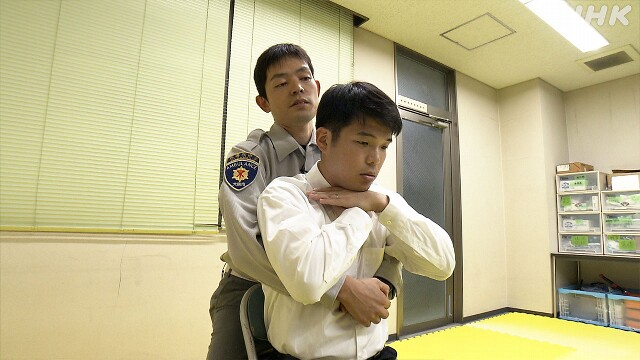 A firefighter performing the Heimlich maneuver assuming a choking accident caused by rice cake. NHK.
The Consumer Affairs Agency of Japan also stated that related accidents are concentrated during this period. According to the Consumer Affairs Agency, over the two years of 2018 and 2019, 661 elderly people aged 65 and over died from choking on rice cakes, with January accounting for 282 cases (43%) by month. The Ministry of Health, Labour and Welfare estimated that about 3,500 deaths from choking on rice cakes occur annually, with 2,500 of these cases involving elderly people aged 80 and above.
Accordingly, Japanese media and the Fire and Disaster Management Agency continue to introduce preventive measures and emergency treatments that can be performed at home. The Tokyo Fire Department advised that a caregiver should always be present when elderly people eat rice cakes, and urged people to "drink tea or soup before eating rice cakes to moisten the throat first," and to "cut the rice cake into bite-sized pieces, chew slowly, and then swallow."
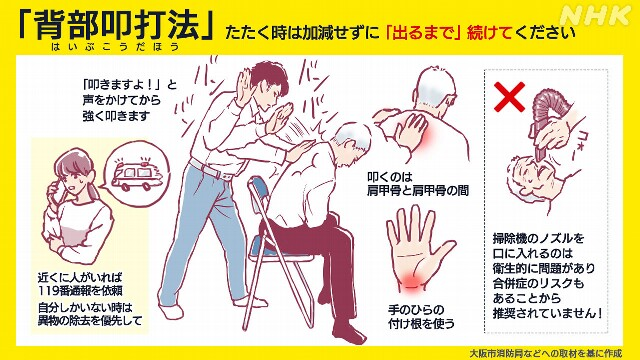 NHK distributed emergency treatment for choking accidents. It explained the method of firmly striking the back with the palm. NHK.
They also emphasized that if there is no voice or cough, it is a sign of choking and emergency measures should be taken. The first step is to perform back blows, using the bony part between the palm and wrist to firmly strike between the person's shoulder blades. NHK explained that it is important to strike several times without hesitation until the rice cake is expelled. They also noted that sometimes people try to use vacuum cleaners or similar devices to remove the rice cake, but this is not recommended as it may cause complications.
The Heimlich maneuver, widely known as an emergency treatment for airway obstruction, is attempted if the rice cake does not come out after several back blows. This involves standing behind the person, placing one fist above the navel, grasping it with the other hand, and quickly pulling upward. NHK added, "This method should not be used on pregnant women or infants, and even if the rice cake is expelled using this method, medical examination is absolutely necessary due to the risk of internal injuries."
© The Asia Business Daily(www.asiae.co.kr). All rights reserved.
![Clutching a Stolen Dior Bag, Saying "I Hate Being Poor but Real"... The Grotesque Con of a "Human Knockoff" [Slate]](https://cwcontent.asiae.co.kr/asiaresize/183/2026021902243444107_1771435474.jpg)
















