Lotte Card's Maturity Scale Largest at 2.55 Trillion Won
"Mass Issuance Volume Nears Maturity Amid Legoland Incident"
Performance Clouded by Consumer Downturn and Card Fee Reduction
Credit card companies are expected to repay about 13 trillion won in corporate bonds in the first half of next year alone. Amid a gloomy outlook for core business performance due to the economic downturn and reduced card fees, funding costs are also expected to rise going forward.
According to statistics from the Korea Securities Depository on the 31st, the amount of corporate bonds maturing between January 1 and June 30 next year is 12.81 trillion won. The scale of corporate bond maturities in the first half of each year has steadily increased: 8.1 trillion won in 2021, 8.6 trillion won in 2022, 11.5 trillion won in 2023, and 12.9 trillion won this year. The first half of next year is expected to maintain a similar level to this year. However, the total corporate bond maturity amount for next year is 22.795 trillion won, a 19.8% decrease compared to this year’s 28.45 trillion won.
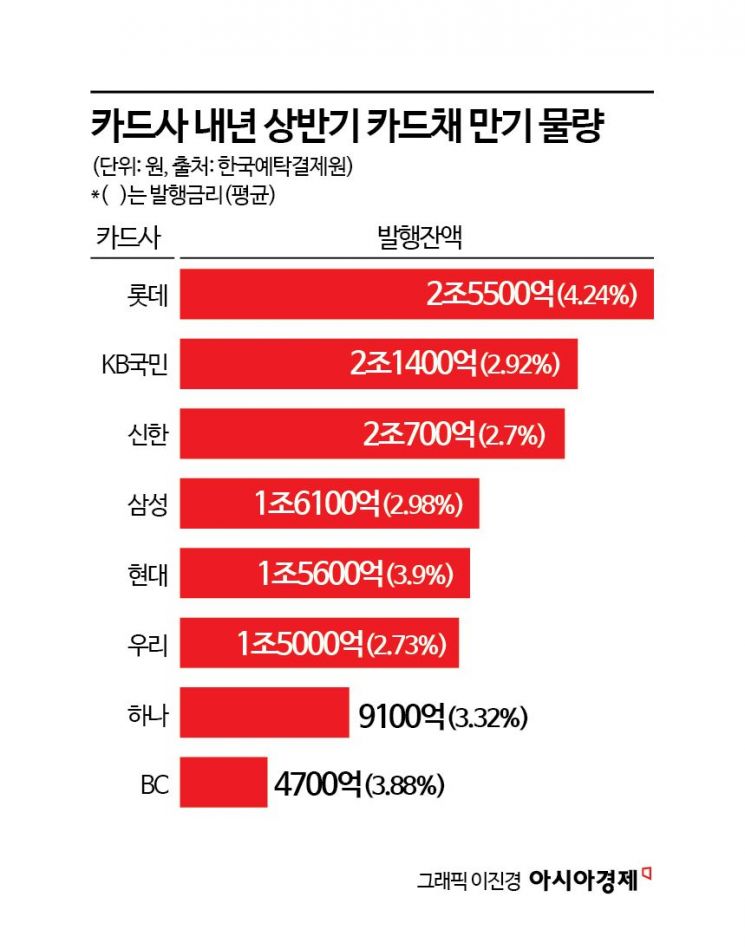
Looking at the volume of corporate bonds maturing in the first half of next year by card company, Lotte Card had the largest amount at 2.55 trillion won. This was followed by KB Kookmin Card (2.14 trillion won), Shinhan Card (2.07 trillion won), and Samsung Card (1.61 trillion won). Lotte Card borrowed money at the highest average issuance interest rate among all card companies, at 4.24%. Next were Hyundai Card (3.9%), BC Card (3.88%), and Hana Card (3.32%), with non-bank affiliated card companies generally having higher average issuance interest rates. A card industry official explained, "The Lego Land incident in November 2022 and the subsequent interest rate hikes increased funding demand," adding, "A significant portion of the bonds issued at that time will mature next year."
Unlike banks, card companies do not have deposit-taking functions and secure business funds by issuing bonds and asset-backed securities (ABS). Among these, corporate bonds account for more than 60% of their funding. When corporate bonds approach maturity, card companies issue new bonds (refinance) to repay them. The problem is that the interest rates at the time of new issuance are higher than those at the time of the original issuance, increasing the interest expenses that card companies must bear.
According to statistics from the Korea Financial Investment Association as of the 27th, the interest rate for 3-year asset-backed securities (AA+, unsecured, average of five rating agencies) is 3.206% per annum. This is a slight increase compared to 3.043% on the 2nd. Among the corporate bonds maturing in the first half of next year, 43% (5.55 trillion won) were issued at interest rates in the 1-2% range. Although funds were borrowed cheaply in the past low-interest-rate environment, there is a growing possibility that higher interest will have to be paid going forward.
Although funding costs are expected to increase next year, profits from card companies’ core card business are expected to decline. This is due to frozen consumption caused by the emergency martial law situation and impeachment political turmoil. According to data received by Kim Hyun-jung, a member of the National Assembly’s Political Affairs Committee from the Democratic Party of Korea, from Shinhan, KB Kookmin, Samsung, and Hyundai Card, combined sales of the four card companies from the 1st to the 20th of this month totaled 28.2045 trillion won, a 2% decrease compared to the same period last month (28.7997 trillion won). Due to the impact of the emergency martial law, year-end parties and gatherings decreased, reducing sales at restaurants and entertainment establishments. In the consumer sentiment survey released by the Bank of Korea on the 24th, the Consumer Confidence Index (CCSI) for this month was 88.4, down 12.3 points from the previous month, marking the largest decline since the COVID-19 pandemic.
To make matters worse, merchant card fees will also decrease next year. The Financial Services Commission estimated this month that the potential reduction in fee burden for the card industry is about 300 billion won annually and announced a 2025 card fee reform plan to reduce credit and check card fee rates by 0.05 to 0.1 percentage points. Card fees have continuously declined 15 times over 17 years since 2007. The credit card fee rate for small and medium-sized merchants, which was about 4.5% in 2007, has dropped to 0.4%. The reduced card fee rates will be applied starting February 14 next year. A financial sector official said, "Although interest rates are expected to decrease further next year, there are talks about slowing the pace of rate cuts recently, so the funding market situation will not be easy," adding, "Card companies have no choice but to cut costs, including reducing benefits."
© The Asia Business Daily(www.asiae.co.kr). All rights reserved.
![Clutching a Stolen Dior Bag, Saying "I Hate Being Poor but Real"... The Grotesque Con of a "Human Knockoff" [Slate]](https://cwcontent.asiae.co.kr/asiaresize/183/2026021902243444107_1771435474.jpg)















