Largest Increase Since the 2008 Global Financial Crisis
Possibility of Reaching 1500 Won Soon if Political Instability Deepens
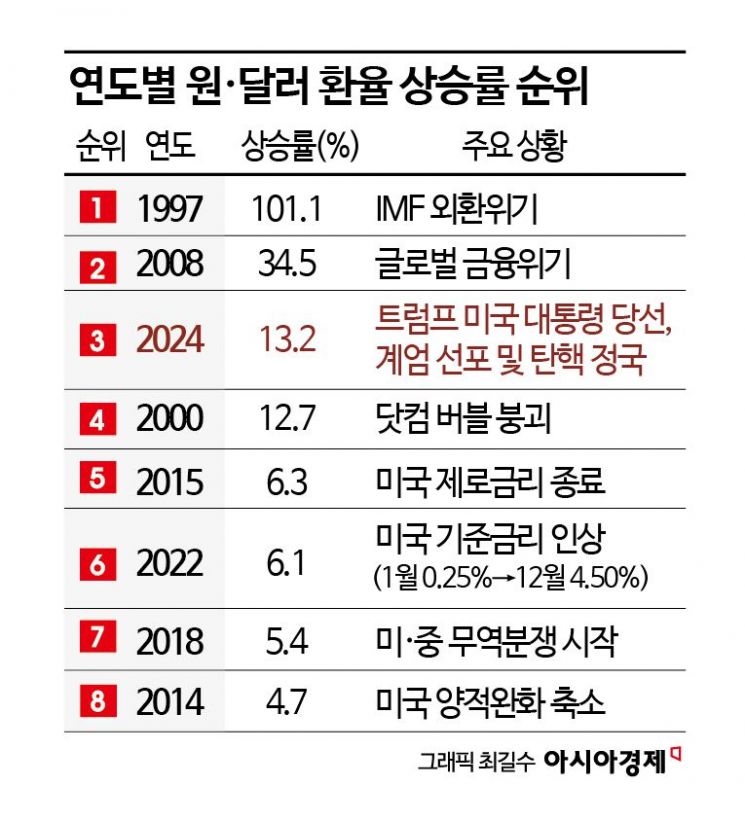
The won-dollar exchange rate's increase this year recorded the largest rise in 16 years since the 2008 global financial crisis. Domestic and international adverse factors, including concerns over the U.S.'s strengthened protectionism and political and economic instability at home, overlapped, causing a sharp decline in the won's value in the second half of the year. Domestic and foreign research institutions expect this trend to continue next year, with the exchange rate likely to keep rising.
This Year's Exchange Rate Increase of 13.2%, Highest Since 2008
According to the Seoul foreign exchange market on the 31st, the won-dollar exchange rate rose by about 13.2% from the first trading day to the last trading day this year. This increase was steeper compared to last year's 1.2% and the year before's 6.1%. It is also the third-highest figure after 101.1% during the 1997 IMF foreign exchange crisis and 34.5% during the 2008 global financial crisis.
The won-dollar exchange rate, which was around 1,300 won at the beginning of the year, surged to 1,472 won by the end of the year. The quarterly average exchange rate, which was 1,329.4 won in the first quarter, soared to 1,398.8 won in the fourth quarter. This is the highest level in 15 years and 9 months since the first quarter of 2009 during the financial crisis. Although it dropped to the low 1,300 won range at the end of September, it surged by more than 160 won in just three months.
In November, the global dollar strength became prominent as former U.S. President Donald Trump won re-election, and in December, the exchange rate surged further due to the emergency martial law incident involving President Yoon Seok-yeol. Other factors contributing to the rise in the won-dollar exchange rate included the Bank of Korea's consecutive base rate cuts amid domestic economic slowdown and export concerns, fears of protectionism under Trump's second administration, and the U.S.'s pace adjustment in lowering the base interest rate.
Moon Jeong-hee, Chief Economist at KB Kookmin Bank, analyzed, "The impact of the Trump trade following Donald Trump's election as U.S. president, the emergency martial law followed by presidential impeachment, and the Bank of Korea's base rate cuts were factors that fueled the exchange rate increase."
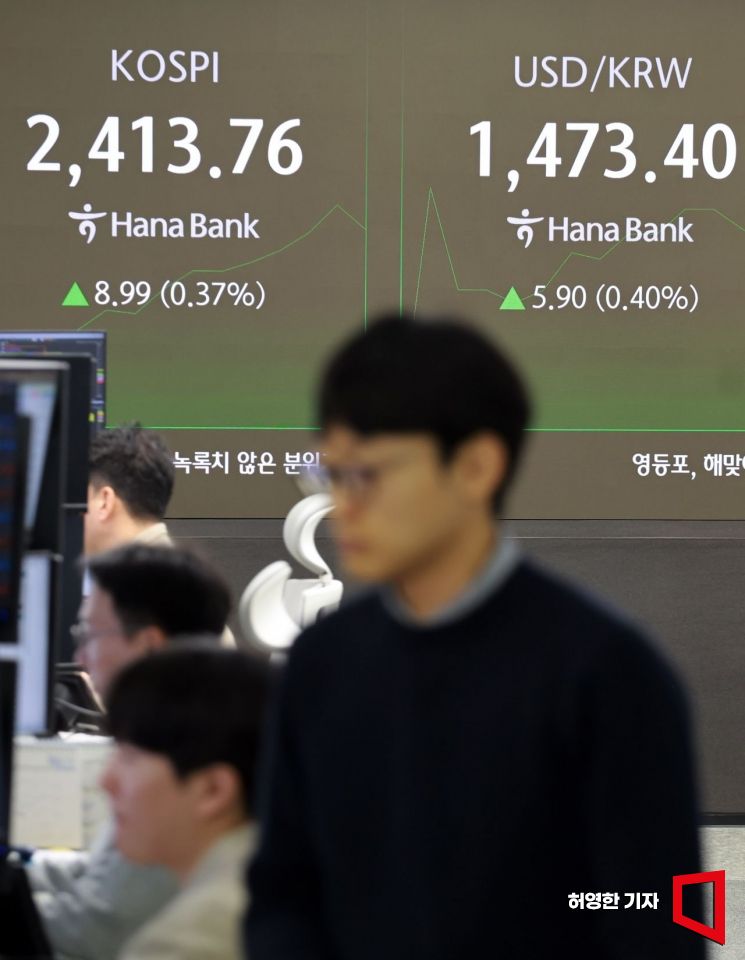 On the last trading day of this year, the won-dollar exchange rate rose to the 1470 won level on the 30th. Employees are working in the dealing room at the Hana Bank headquarters in Euljiro, Seoul. Photo by Heo Young-han
High Exchange Rate Likely to Continue Next Year
Experts predict that the won-dollar exchange rate's upward trend could continue at least until the first half of next year. This is because Trump's second administration's tariff policies are expected to be fully implemented in the first half of next year, potentially raising inflation concerns, and the U.S. Federal Reserve's (Fed) pace of base rate cuts is expected to slow, sustaining the dollar's strength.
The Bank of Korea's foreign exchange operations department released a report the day before, stating, "Next year, the dollar will show strength due to renewed inflation concerns arising from the implementation of major policies such as tariffs, immigration, and tax cuts by the Trump administration. The relatively robust U.S. economy compared to other countries, combined with economic sluggishness in China and Europe, will also be factors supporting the dollar's strength."
With the global dollar strength phenomenon and domestic political instability continuing, domestic and foreign research institutions also forecast that the won-dollar exchange rate could reach 1,500 won in the first half of next year.
Global investment bank Nomura Securities expects that Korea's political uncertainty will persist until next year and predicts the won-dollar exchange rate will rise to 1,500 won by the second quarter of next year.
The Korea Development Institute (KDI), a government research institute, also stated in materials submitted to Rep. Lee In-young of the Democratic Party of Korea, "A 3-4% exchange rate fluctuation is generally possible, so the possibility of the won-dollar exchange rate reaching 1,500 won cannot be excluded." NH Investment & Securities also predicted, "If political instability intensifies, the exchange rate could quickly surpass 1,500 won," adding, "The average exchange rate in the first half of next year could rise to the low 1,400 won range."
Park Sang-hyun, Senior Advisor at iM Securities, explained, "With various domestic and international adverse factors expected to increase additional upward pressure on the exchange rate, and the government likely to strengthen market intervention, exchange rate volatility is also expected to increase."
© The Asia Business Daily(www.asiae.co.kr). All rights reserved.
![Clutching a Stolen Dior Bag, Saying "I Hate Being Poor but Real"... The Grotesque Con of a "Human Knockoff" [Slate]](https://cwcontent.asiae.co.kr/asiaresize/183/2026021902243444107_1771435474.jpg)
















