KCC Announces Survey Results on Broadcasting Media Usage
Smartphones Recognized as Essential Media 3.3 Times More Than TV
Teenagers Decrease TV Usage, Seniors in Their 70s Increase Smartphone Usage
The proportion of people who watch TV five or more days a week has dropped to the 60% range among all broadcast media users. While TV usage rates have declined, the proportion of people who frequently use smartphones and recognize them as essential media has increased.
The Korea Communications Commission and the Korea Information and Communication Promotion Association announced the results of the '2024 Broadcast Media Usage Behavior Survey' on the 30th. The survey was conducted through face-to-face interviews with 8,316 men and women aged 13 and older nationwide.
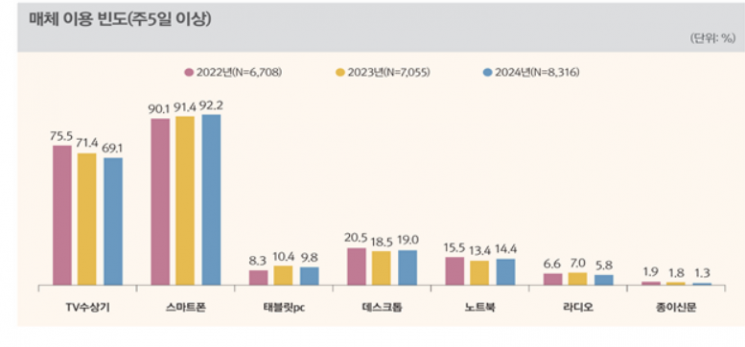
The proportion of people using TV five or more days a week was 69.1%, down from 71.4% the previous year. The rate of watching live broadcasts using TV receivers also decreased to 82.2% from 84.4% the previous year. In particular, the decline in live viewing via TV receivers was significant among teenagers (69.9% → 53.8%).
The TV ownership rate among all households was 94.9%. The TV ownership rate in single-person households was 88.9%, lower than that of all households, and the younger the age group, the lower the TV ownership rate. On the other hand, smartphone ownership increased by 0.5 percentage points from the previous year to 95.3%, with a 6.5 percentage point increase among those aged 70 and older.
The proportion of people using smartphones five or more days a week rose by 0.8 percentage points from the previous year to 92.2%. Those aged 60 and under used smartphones more than 90% of the time over five days a week, while 64.4% of those aged 70 and older reported using them.
The recognition rate of essential media in daily life increased by 5.3 percentage points for smartphones to 75.3%, while TV decreased by 4.6 percentage points to 22.6%, widening the gap to more than 3.3 times.
The proportion of people who recognize smartphones as essential media was over 90% among those in their teens to 30s and over 80% among those in their 40s and 50s. It is steadily increasing among those aged 60 and above, indicating that the influence of smartphones is spreading to older age groups.
For single-person households, the average daily TV viewing time was 2 hours and 15 minutes, a decrease of 12 minutes from the previous year, while smartphone usage time was 2 hours and 27 minutes, an increase of 10 minutes from the previous year.
The usage rate of online video services (OTT) via smartphones was 91.2%, up 4.9 percentage points from the previous year, suggesting that OTT is contributing to increased smartphone usage time.
Additionally, the average daily OTT usage time for all users was 1 hour and 10 minutes, while for single-person households it was 1 hour and 23 minutes, indicating relatively higher usage among single-person households. The OTT usage time for single-person household heads has increased annually from 1 hour and 11 minutes in 2022 to 1 hour and 21 minutes in 2023, and 1 hour and 23 minutes this year.
However, the subscription rate for paid broadcasting services continued to decline, standing at 91.9%. The subscription rate for paid broadcasting in single-person households was 83.4%, down 0.5 percentage points from the previous year.
With the activation of OTT usage, live broadcast program viewing has decreased, while viewing via OTT and VOD services has increased. The proportion of users who watched live broadcast programs in the past week was 86.5%, down from the previous year, whereas catch-up viewing increased to 45.2%.
This report will be made available through the Korea Communications Commission and the Broadcast Statistics Portal website.
© The Asia Business Daily(www.asiae.co.kr). All rights reserved.
![Clutching a Stolen Dior Bag, Saying "I Hate Being Poor but Real"... The Grotesque Con of a "Human Knockoff" [Slate]](https://cwcontent.asiae.co.kr/asiaresize/183/2026021902243444107_1771435474.jpg)















