Concrete Structure Inside an Earthen Mound
Observed Explosion After Collision with Passenger Plane
"Installation of Mound at Muan Airport Is Close to a Crime"
"Such a Structure Should Not Be There"
"Never Seen Anywhere in the World"... Expert Criticism
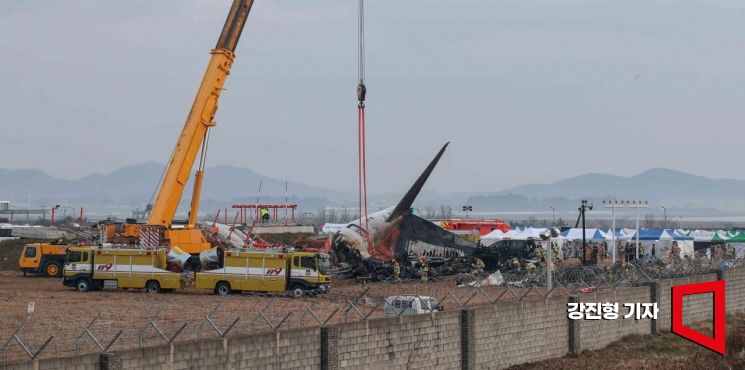 Firefighters are searching for belongings at the site of the Jeju Air passenger plane collision and explosion accident that occurred at Muan International Airport, Jeonnam, 30 days ago.
Regarding the Jeju Air passenger plane that crashed at Jeonnam Muan International Airport, colliding with an embankment and resulting in the deaths of 178 passengers, overseas experts have analyzed that "the embankment exacerbated the accident." They pointed out, "The explosion occurred as the aircraft hit the embankment before touching the outer wall," and "especially, the concrete structure on the embankment worsened the damage." Embankments designed to assist aircraft landing are usually made of structures that easily break upon collision, but Muan Airport piled soil walls on top of concrete structures, which instead increased the damage.
On the 30th (Korean time), David Learmount, a British Air Force veteran and aviation expert, stated in an interview with Sky News UK that "the installation of the embankment at Muan Airport is close to a criminal act." David said, "The plane was traveling at a speed of 200 miles per hour (321 km/h) during landing. It slid off the runway, and until then, there was almost no damage to the aircraft. That was until it hit the embankment." He added, "Considering the situation the pilot was in, I believe the best possible landing was made. At the end of the landing roll, the aircraft had no major damage and no fire had broken out. However, when the aircraft collided with the embankment and caught fire, the passengers lost their lives."
The embankment David referred to is the structure where the localizer antenna (a facility guiding aircraft landing) is installed. Localizers are usually installed at the same height as the runway, but at Muan Airport, they were installed on a concrete structure atop a mound of soil. David criticized, "Such a structure should not be there," and said, "The localizer antenna is in its proper location, but it should not be embedded in such a solid structure." He further emphasized, "Beyond the embankment is flat terrain. There was enough space for the aircraft to continue running, reduce speed, and stop. If that had happened, everyone would have survived. I have never seen an embankment like that just 200 meters from the runway anywhere else in the world."
 On the 29th, when the Jeju Air passenger plane disaster occurred at Muan International Airport, this is the scene of Jeju Air's Seoul branch in Gangseo-gu, Seoul.
Denys Davydov, a pilot from Ukraine, also pointed to the embankment as the cause of this tragedy. Denys operates a Boeing 737, the same model as the crashed aircraft. In a video posted on YouTube on the 29th, he expressed disbelief, saying, "I see a wall with a localizer, and it is ridiculously large. I don't know who designed it, but it's excessive. Why is something like that needed at the end of the runway?" He suggested that the embankment was likely installed out of concern that the aircraft might leave the airport and hit nearby houses. However, he noted that the airport has outer walls and the houses are far from the runway, emphasizing, "Even without the embankment, the aircraft would have stopped before leaving the airport."
According to Article 25 of the Ministry of Land, Infrastructure and Transport's detailed guidelines on aviation obstacle management, types of airport equipment and installations that could become obstacles, such as localizer antennas, must be designed to cause minimal damage if an aircraft collides with them. They must maintain structural integrity and robustness under normal conditions but be installed to break, deform, or bend with minimal risk to the aircraft when subjected to greater impact. Supporting facilities should be mounted on easily breakable mounts. The localizer is part of the instrument landing system used to assist aircraft landings. A Ministry of Land, Infrastructure and Transport official explained during a briefing on the Muan Airport accident the previous day, "The aircraft fuselage collided with the localizer and then hit the wall, causing an explosion."
© The Asia Business Daily(www.asiae.co.kr). All rights reserved.
![Clutching a Stolen Dior Bag, Saying "I Hate Being Poor but Real"... The Grotesque Con of a "Human Knockoff" [Slate]](https://cwcontent.asiae.co.kr/asiaresize/183/2026021902243444107_1771435474.jpg)
















