Crying Out to Resolve the 'Korea Discount'
Political Risks Highlighted by Martial Law
Only Increasing Stock Market Volatility
This year, the domestic stock market in Korea cannot be discussed without mentioning 'Policonomy,' a phenomenon where the economy is swayed by politics. In the securities industry, when global stock market volatility, including Korea's, sharply increased in August, some analysts diagnosed that the feared Policonomy risk had materialized. Cooperation disappeared from the political arena, which should stabilize the economy and lead it in a better direction, and with confrontation and conflict highlighted, the KOSPI has remained near the bottom globally, falling from 2,613.50 at the beginning of the year (January 2) to 2,404.77 at the end of the year (December 27). Ultimately, the Korean stock market this year is expected to close within a box range of 2,400 to 2,500, showing a pattern of rising early in the year and falling later.
At the beginning of this year, the domestic stock market started with expectations fueled by President Yoon Seok-yeol's remarks on resolving the 'Korea Discount.' Unusually, President Yoon attended the stock market opening ceremony held at the Korea Exchange building in Seoul on January 2 and stated, "I will resolve the Korea Discount through deregulation of the capital market during my term." The statement about abolishing the Financial Investment Income Tax (FIIT) also came at this time. However, the index hovered between 2,500 and 2,440 throughout January, and with the announcement of detailed plans for the 'Corporate Value-Up Program' in February, it began to rise gradually. On the back of expectations for the value-up policy, the index surpassed 2,700 for the first time in March (closing price on the 14th), and there were forecasts that the KOSPI would exceed 3,000, driven by the performance of semiconductor stocks like Samsung Electronics.
However, on August 5, the stock market plunged sharply due to concerns about a U.S. economic recession and the unwinding of the yen carry trade (a method of borrowing yen at Japan's low interest rates to invest in high-interest assets in countries like the U.S.). On that day alone, the KOSPI dropped 8.77%, and the KOSDAQ fell 11.3%, after which domestic and global stock markets continued to experience volatile trading. Analysts pointed out that one of the main reasons for the global stock market crash and rebound from July to August, as well as the sharp volatility in the foreign exchange market, was the realization of Policonomy risk.
Park Sang-hyun, a researcher at iM Securities, said in a report, "There is much debate about the causes of the global stock market crash, rebound, and sharp volatility, but it seems that the feared Policonomy risk has materialized," adding, "The Policonomy phenomenon is intensifying and causing significant shocks to the economy and financial markets."
He also interpreted the 'Trump Trade' phenomenon in financial markets following the shooting of U.S. presidential candidate Donald Trump in July as a kind of Policonomy phenomenon. Park said, "As confirmed in Trump's campaign pledges, the strengthening of major countries' nationalism or protectionism is likely to be fertile ground for spreading the Policonomy phenomenon," and added, "If the economy faces recession risks amid the intensification of Policonomy, it is hard to rule out experiencing unprecedented financial market volatility."
The stock market was swayed by politics again in November this year. Due to increased downward pressure on the domestic stock market from the Trump Trade aftermath, both the KOSPI and KOSDAQ plunged nearly 3% on November 13. The KOSPI's market capitalization fell below 2,000 trillion won, returning to levels seen during the Black Monday crisis in August. The KOSPI's decline accelerated after former President Trump secured victory in the U.S. presidential election. From November 5, when his election was virtually assured, to November 13, the KOSPI index fell a total of 6.82%, and market capitalization shrank to 1,970.6632 trillion won.
The abolition of the FIIT, which the president had pledged, also became a case where political disagreements between the ruling and opposition parties increased policy uncertainty and affected the stock market. The amendment to the Income Tax Act, which included the abolition of FIIT and a two-year deferral of virtual asset taxation, faced ups and downs until it passed the National Assembly plenary session on the 10th. The government and ruling party argued for abolishing FIIT, citing potential capital outflows, but the opposition Democratic Party reversed its stance on deferral and supplementary implementation. Eventually, the controversy ended when Lee Jae-myung, the Democratic Party leader, agreed to abolish FIIT. Following the decision to abolish FIIT, the KOSPI closed higher on November 4, continuing a four-day consecutive rise. At that time, Kang Jin-hyuk, a researcher at Shinhan Investment Corp., analyzed, "The market welcomed the resolution of the uncertainty over whether FIIT would be implemented."
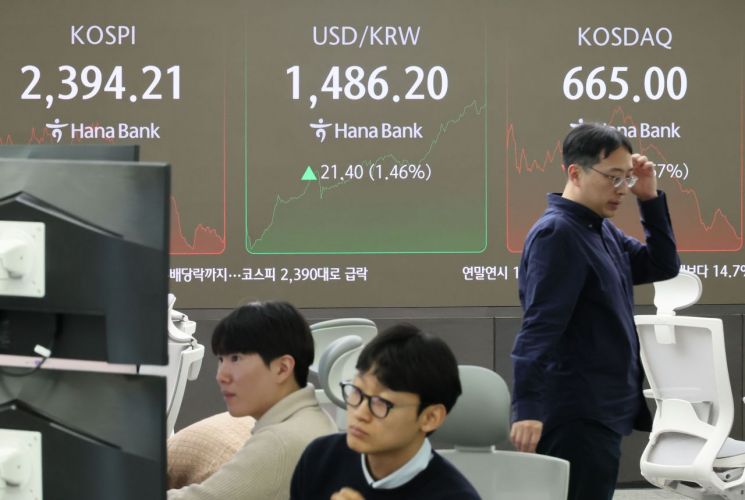
The peak of Policonomy was the martial law incident. On December 3, President Yoon declared emergency martial law, and through a series of processes in which the National Assembly nullified it, the Korean stock market slid to the 2,400 level and entered a zero-sum state. Foreign investors sold more than 1 trillion won in just three days, and even individual investors who had bought during the August 5 market crash turned away. The president's remarks about resolving the Korea Discount ironically resulted in discounting the stock market itself. As political risk intensified, the won-dollar exchange rate soared to 1,480 won, and the expected effects of policies such as FIIT abolition and value-up were no longer anticipated.
The problem is that the market outlook for next year is not bright either. In January next year, the era of the second Trump administration, which brought the Trump shock, will begin. Experts emphasize that attention should be paid to what President Trump will say after his inauguration scheduled for January 20 next year. Yang Il-woo, a researcher at Samsung Securities, pointed out, "If Trump mentions anything beyond the already anticipated repeal of the Inflation Reduction Act (IRA), tariffs on automobiles from Mexico, Europe, and China, or the deportation of illegal immigrants, it could affect the stock market."
© The Asia Business Daily(www.asiae.co.kr). All rights reserved.
![Clutching a Stolen Dior Bag, Saying "I Hate Being Poor but Real"... The Grotesque Con of a "Human Knockoff" [Slate]](https://cwcontent.asiae.co.kr/asiaresize/183/2026021902243444107_1771435474.jpg)















