15% Decrease in Korean Visitors... 20 Million Target Fails
17 Million Also Missed, Restoring Global Trust is Key
As the government adjusted its 2024 target for inbound tourists from 20 million to 17 million in the second half of the year, the recent martial law situation and political turmoil have severely impacted the tourism market, putting the original plan at risk. The Korean tourism market had recovered to 94% of pre-COVID-19 levels by October, but the number of visitors to Korea sharply declined in December, making it unlikely to meet the year-end target of 17 million. The final estimate for this year stands at 16.3 million, showing a significant gap from the record high of 17.5 million in 2019.
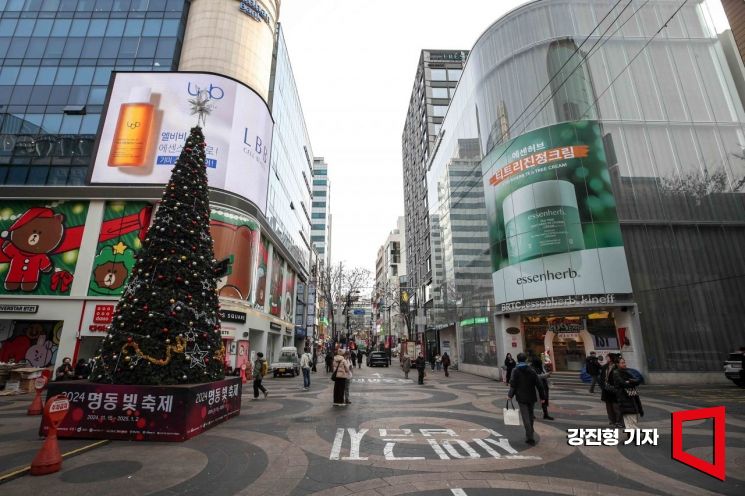 On the 13th, Myeongdong Street in Jung-gu, Seoul, is showing a quiet scene amid concerns that the influx of foreign tourists will decrease due to the chaotic political situation, including the president's announcement of martial law. Photo by Kang Jin-hyung
The political aftermath of President Yoon's martial law declaration has dealt a severe blow to South Korea's national image in the international community. The willingness of foreign tourists to visit Korea has also been greatly dampened. Consequently, voices within the domestic tourism industry are growing louder, calling for this crisis to be turned into an opportunity for a new leap forward.
The Korean tourism market, which had been on an upward trend from January to October, faced a sudden crisis after the martial law, as travel advisories against Korea were issued by major countries. The current situation is spreading negative effects not only through the decline in inbound tourists but also across the tourism industry and the regional economy as a whole.
The decrease in inbound tourists goes beyond mere numerical decline; it leads to reduced sales in local tourism businesses, job cuts, and an overall contraction of related industries, negatively impacting the entire tourism ecosystem.
To respond to the contraction of the inbound tourism market, the government has prepared multifaceted measures. At the 9th National Tourism Strategy Meeting held on the 26th, it was decided to expedite the execution of approximately 940 billion KRW in tourism budgets during the first half of the year. This aims to facilitate a swift market recovery and a new takeoff.
Improving visa policies is also a key measure. The government is considering allowing visa-free entry for Chinese group tourists and extending exemptions for the electronic travel authorization system (K-ETA). These policies are expected to further promote the influx of tourists from the Asian region. Alongside this, promotional activities will be intensified to attract overseas tourists by leveraging large-scale international events such as the Osaka Expo and the Korea Grand Sale (January to February 2025), providing an opportunity to re-highlight Korea's appeal in the Asian and global tourism markets.
Enhancing tourism convenience is also being addressed as an important task. Plans include providing free travel insurance to foreign tourists and expanding multilingual guidance systems as well as reservation and payment services. These improvements in convenience are expected to increase foreign tourists' satisfaction and boost repeat visitation rates.
Additionally, the government plans to support the recovery of the tourism industry with financial assistance amounting to 536.5 billion KRW and special loans of 50 billion KRW. The 'Travel Month' will be moved forward from June to March to stimulate domestic travel demand earlier, and transportation networks connecting regional airports and major tourist destinations will be strengthened.
 On the afternoon of the 26th, when strong winds blew and severe cold returned, tourists were moving in thick clothing on Sejong-daero, Jongno-gu, Seoul. The Korea Meteorological Administration forecasted that temperatures would drop sharply from the afternoon, with the morning temperature tomorrow falling to minus 7 degrees Celsius, bringing severe cold. Photo by Jo Yong-jun
The decline in inbound tourists is not merely a numerical reduction. According to the Korea Culture and Tourism Institute, the tourism industry accounts for about 5% of the Gross Domestic Product (GDP) and generates an economic ripple effect of approximately 90 trillion KRW annually. The decrease in inbound tourists could lead to an annual loss of about 10 trillion KRW in tourism revenue and affect around 150,000 related jobs. Particularly, tourism-dependent small cities are experiencing shaken livelihoods and stagnation in local commercial districts due to the drop in tourists.
In this context, diversification and qualitative growth of the tourism market are essential. Currently, Korea's tourism industry heavily depends on traditional major markets such as China and Japan. To break away from this, there is a growing need to expand into high value-added markets like Europe and North America. Marketing strategies emphasizing Korea's traditional culture and cuisine may be effective in the European market, while leveraging modern content such as K-pop and K-drama could work well in the North American market.
Data-driven policies are also important. The Korea Culture and Tourism Institute's '2024 Tourism Industry Recovery Strategy Report' emphasizes analyzing tourists' preferences using big data and providing personalized tourism products. Creating an environment where foreigners can easily make reservations and payments through digital platforms and expanding multilingual support are key to enhancing tourist convenience.
Moreover, applying sustainable tourism models is an essential element for the long-term growth of Korea's tourism industry. By developing local experiential content based on ecotourism and coexistence with local residents, deeper experiences can be offered to tourists. This strategy goes beyond merely increasing tourist numbers and leads to mutual growth with the regional economy.
The government aims to stabilize the tourism market through marketing linked to international events, improving tourism infrastructure, and restoring trust among foreign tourists. However, the effectiveness of these policies can only be maximized when political stability and national image improvement are achieved simultaneously.
Experts emphasize cooperation between the government and the private sector for long-term improvement of the tourism ecosystem beyond short-term results. They also suggest that Korea's tourism competitiveness should be revitalized through international trust recovery, enhancing foreign tourist satisfaction, and strengthening global promotion.
Prime Minister Han Duck-soo, acting president, stressed, "We must translate the world's interest in Korean culture into inbound tourism," adding, "The government will make every effort to stabilize the tourism market and prepare for a new leap forward."
© The Asia Business Daily(www.asiae.co.kr). All rights reserved.
![Clutching a Stolen Dior Bag, Saying "I Hate Being Poor but Real"... The Grotesque Con of a "Human Knockoff" [Slate]](https://cwcontent.asiae.co.kr/asiaresize/183/2026021902243444107_1771435474.jpg)

















