Legislation including the Artificial Intelligence (AI) Basic Act and the Act on Improvement of Terminal Distribution Structure (DanTongLaw) repeal bill passed the National Assembly plenary session on the 26th.
On the afternoon of the same day, the National Assembly held a plenary session and passed the "Basic Act on AI Development and Trust Foundation" with 260 votes in favor, 1 against, and 3 abstentions out of 264 members present.
The AI Basic Act stipulates the grounds and foundation for the government to support the development of the AI industry. South Korea became the second country in the world, following the European Union (EU), to enact related legislation. The government will establish and operate a presidential-level "National AI Committee," and the Ministry of Science and ICT must create an "AI Basic Plan" every three years based on the resolutions of the National AI Committee.
The DanTongLaw, introduced in 2014, was also repealed after 10 years. This is expected to enable competition for subscriber acquisition and lead to a reduction in communication costs. In addition, the following bills were also passed: △ the amendment to the Elementary and Secondary Education Act defining AI digital textbooks as educational materials △ the partial amendment to the Framework Act on Education △ the Special Act on the Establishment and Operation of Urban Campuses △ the partial amendment to the Private School Act.
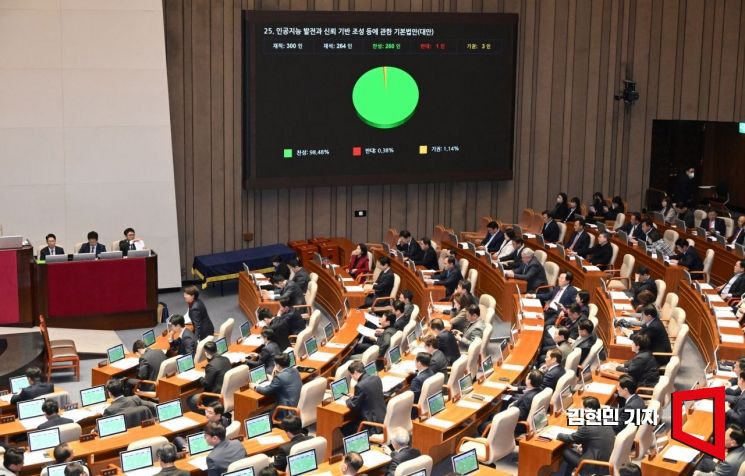 On the 26th, the 'Basic Act on the Development of Artificial Intelligence and the Establishment of a Trust-Based System (AI Basic Act)' was passed in the National Assembly plenary session. Photo by Kim Hyun-min
By legally defining the status of AI digital textbooks as "educational materials," schools nationwide are no longer obligated to adopt these materials. It was determined that AI textbooks do not hold the status of official textbooks. E-books are defined as recordings, videos, or electronic media containing textbook content, published so that students can read, watch, or listen using computers or other information processing devices. Furthermore, the decision to use AI textbooks is left to the discretion of school principals, not the Minister of Education.
The Framework Act on Education, primarily proposed by Kang Kyung-sook of the Innovation Party for Justice, includes provisions to strengthen the protection of teachers' authority in student education and guidance. According to Representative Kang, there have been cases where teachers suffered from complaints and excessive interference from parents during student guidance and educational activities.
Accordingly, it is stipulated that the protection of teachers' educational activities and authority over student guidance at schools must be guaranteed according to laws and school regulations, enabling teachers to devote themselves to educational activities with a sense of mission.
However, the amendment to the Depositor Protection Act and the Act on Loan Business were not submitted to the plenary session on this day. The amendment to the Depositor Protection Act aims to raise the depositor protection limit per financial institution from the current 50 million won to 100 million won.
© The Asia Business Daily(www.asiae.co.kr). All rights reserved.
![Clutching a Stolen Dior Bag, Saying "I Hate Being Poor but Real"... The Grotesque Con of a "Human Knockoff" [Slate]](https://cwcontent.asiae.co.kr/asiaresize/183/2026021902243444107_1771435474.jpg)















