The Supreme Court has ruled that the state must compensate for failing to guarantee access rights for people with disabilities.
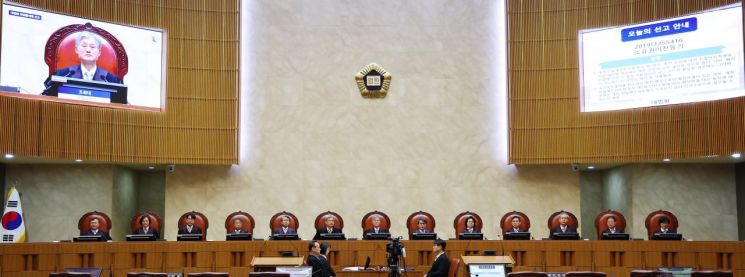 Chief Justice Cho Hee-dae and other Supreme Court justices entered and took their seats in the Grand Courtroom of the Supreme Court in Seocho-gu, Seoul on the afternoon of the 19th for the plenary session ruling. Photo by Yonhap News
According to the legal community on the 20th, the Supreme Court en banc (Presiding Justice Lee Suk-yeon) overturned the lower court's partial ruling in favor of the plaintiffs in a discrimination relief lawsuit filed by Kim and two others against the state, and made this ruling yesterday. The Supreme Court annulled and reversed part of the lower court's decision and ordered "the payment of 100,000 won in consolation damages to each of the disabled plaintiffs." Annulment and reversal means the Supreme Court overturns the lower court's ruling and issues a direct judgment without remanding the case to a lower court.
The plaintiffs claimed damages, arguing that their access rights were violated because the Enforcement Decree of the former Act on Convenience Promotion for Persons with Disabilities, which imposed the obligation to install convenience facilities only on small retail stores with a total floor area of 300㎡ or more, had not been amended for over 24 years since its enforcement date.
The Supreme Court pointed out, "Exempting most small retail stores from the obligation to install convenience facilities for persons with disabilities, and the 'administrative legislative inaction' of not amending the contested provision for over 24 years since its enforcement in April 1998, renders the access rights of persons with disabilities guaranteed by the Constitution and laws meaningless and is unlawful." It added, "This corresponds to an act of a public official 'violating laws or regulations intentionally or negligently' as stipulated in the State Compensation Act."
The Supreme Court stated, "Due to the defendant government's administrative legislative inaction, the suffering of persons with disabilities, whose human dignity and value have been routinely denied, has continued. Compensating for that suffering serves as a means to urge the state to promptly fulfill its administrative legislative duties and actively implement policies protecting persons with disabilities." It concluded, "The defendant is obligated to pay consolation damages to the disabled plaintiffs." The consolation damages were set at 100,000 won per plaintiff.
However, the Supreme Court dismissed the claim filed by a citizen who frequently uses a baby stroller but is not disabled.
This ruling is the first case in which the Supreme Court recognized access rights for persons with disabilities as a constitutional fundamental right. Furthermore, as the Supreme Court proactively acknowledged the state's liability for legislative inaction, it is expected to influence future policies related to socially vulnerable groups, including persons with disabilities. There is also a possibility of continued lawsuits demanding improvements against facility operators who fail to install mandatory or recommended facilities under relevant laws.
© The Asia Business Daily(www.asiae.co.kr). All rights reserved.
![Clutching a Stolen Dior Bag, Saying "I Hate Being Poor but Real"... The Grotesque Con of a "Human Knockoff" [Slate]](https://cwcontent.asiae.co.kr/asiaresize/183/2026021902243444107_1771435474.jpg)















