Although economic uncertainty has increased due to the declaration of martial law and impeachment, demands for win-win finance toward the financial sector are expected to pour in once again. Within the financial sector preparing for 'Win-Win Finance Season 2,' concerns are growing that such social contribution pressures could be repeated every year and with every administration.
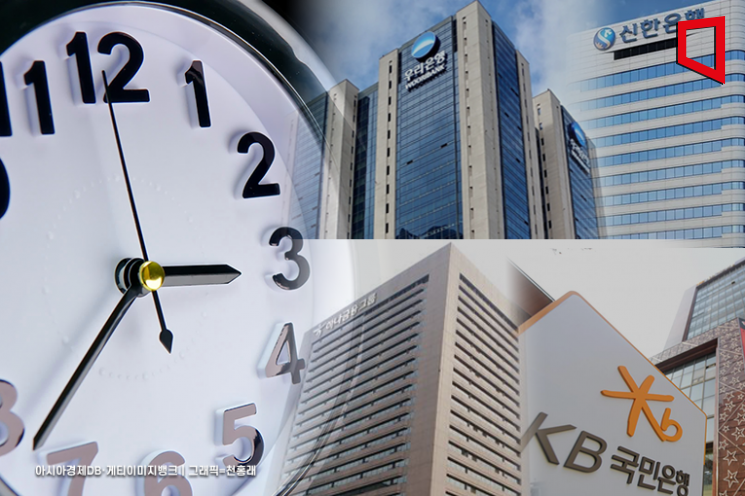
According to the financial sector on the 20th, the banking sector formed a 'Banking Sector Task Force (TF) for Establishing Sustainable Customized Support Measures for Small Business Owners' centered around the Korea Federation of Banks earlier this month, and has been discussing support measures for self-employed and small business owners from the first meeting through the end of the year.
The blueprint for Win-Win Finance Season 2 was revealed at the Small Business Owners and Local Commercial District Livelihood Forum held on the 2nd. At the forum, discussions included ▲ customized debt adjustment ▲ low-interest long-term installment repayment programs ▲ win-win guarantee and loan programs for small business owners. While Season 1 focused on 'interest refunds,' Season 2 appears to concentrate on 'debt repayment and forgiveness.'
The scale of support in Season 2 is expected to be similar to or exceed that of Season 1 (2.1 trillion KRW) at the end of last year. This is because the banking sector is predicted to achieve record-high performance this year. According to financial information analysis firm FnGuide, the annual net profit forecast for the four major domestic financial holding companies (KB, Shinhan, Hana, Woori) is expected to reach a record high of 16.9245 trillion KRW, an 11.8% increase from the previous year (15.1367 trillion KRW).
Within the industry, there are concerns that the scale of win-win finance support could become a 'burden.' Currently, the level of social contribution by the banking sector is not low. According to the financial sector, the proportion of social contribution amount (1.6 trillion KRW) to the banking sector’s annual net profit (21.3 trillion KRW) last year reached 7.5%, up 1.0 percentage point from the previous year (6.5%). The trend, which had been declining from 9.2% (2019) → 8.6% (2020) → 6.9% (2021), has turned upward again. Considering that the proportion of social contribution to net profit at major overseas banks is around 1-2%, a significant amount is already being invested in social contributions.
This also affects actual soundness indicators such as the Common Equity Tier 1 (CET1) ratio of banks. CET1 is the ratio of risk-weighted assets (RWA) to common equity capital and indicates the loss absorption capacity of financial holding companies. Financial authorities recommend maintaining this above 13%, and each company uses this as a standard for shareholder returns.
According to the financial sector, major financial holding companies typically see their CET1 ratio fluctuate by about ±0.4 percentage points for every 1 trillion KRW of net profit or loss. By reverse calculation, the livelihood finance support amount of the four major financial companies last year (275.8 billion to 372.1 billion KRW) is estimated to have reduced each company’s CET1 by approximately 0.1 to 0.15 percentage points.
As of the end of the third quarter, the CET1 ratios of the four major financial companies were: Woori Financial Group 11.96%, Shinhan Financial Group 13.13%, Hana Financial Group 13.17%, and KB Financial Group 13.85%. For some companies, such win-win finance support amounts could become obstacles to maintaining soundness indicators. This also implies potential conflicts with the authorities’ other goal of expanding shareholder returns based on corporate value enhancement (value-up) plans.
In particular, the banking sector is deeply concerned that such win-win finance could become a 'regularized' step rather than a one-time event during high-interest periods. In 2022, President Yoon Suk-yeol criticized banks’ profitability during high-interest periods as 'interest profiteering,' leading to the establishment of win-win finance support programs twice consecutively last year and this year. At the end of last year, an additional burden of 2.1 trillion KRW was incurred solely through interest refunds for self-employed and small business owners.
To make matters worse, with the political situation at a standstill due to martial law and impeachment, a power struggle over so-called 'ownerless money' is reportedly underway. If impeachment is accepted, an early presidential election phase will unfold, meaning that forces aiming for the next presidency may not be pleased with immediate win-win finance measures being introduced.
A financial sector official said, "I think it is natural to expand social contribution-related support amounts as net profits increase due to high interest rates," but added, "In recent years, large costs have been incurred before elections due to win-win finance and Hong Kong ELS (Equity-Linked Securities) compensation, and I worry whether this kind of 'levy' on win-win finance in different ways every year and every administration will become regularized."
© The Asia Business Daily(www.asiae.co.kr). All rights reserved.
![Clutching a Stolen Dior Bag, Saying "I Hate Being Poor but Real"... The Grotesque Con of a "Human Knockoff" [Slate]](https://cwcontent.asiae.co.kr/asiaresize/183/2026021902243444107_1771435474.jpg)















