CF Yeonhap International Conference Held
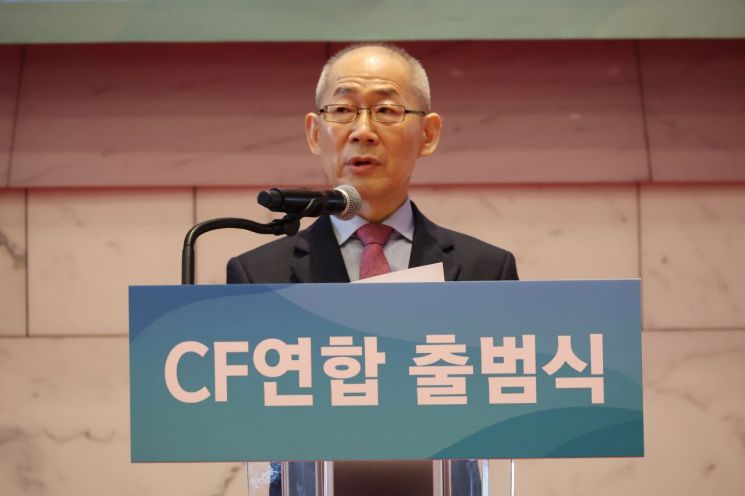 On the morning of the 27th, at the Korea Chamber of Commerce and Industry in Jung-gu, Seoul, Lee Hoe-sung, Chairman of the Carbon Free Alliance (CF Alliance), is delivering a commemorative speech at the launch ceremony of the CF Alliance attended by Prime Minister Han Duck-soo. 2023.10.27 Photo by Yonhap News
Experts have expressed the view that the ability to secure carbon-free energy (.CFE), a concept that includes renewable energy, nuclear power, hydrogen, and carbon capture, utilization, and storage (CCUS), will be a key factor determining future national competitiveness.
At the '2024 CF Alliance International Conference' held on the 18th at The Plaza Hotel Seoul, experts attending agreed that the CFE initiative is advantageous for companies in terms of supply stability and cost-effectiveness, especially as electricity demand is rapidly increasing due to artificial intelligence (AI) and advanced industries.
The event, co-hosted by the Korea Chamber of Commerce and Industry and the CF Alliance and sponsored by the Ministry of Trade, Industry and Energy, saw the participation of numerous domestic and international experts in climate, energy, and industry fields, including Andukgeun, Minister of Trade, Industry and Energy; Lee Hoeseong, Chairman of the CF Alliance; Nobuo Tanaka, former Executive Director of the International Energy Agency (IEA); and David Sandalow, former U.S. Department of Energy (DOE) Deputy Assistant Secretary.
The CFE initiative is a technology-neutral campaign aimed at achieving 'carbon reduction' (purpose) rather than focusing on a 'specific energy source' (means), which Korea proposed to the international community last September. Conference participants shared the view that since it comprehensively recognizes carbon-free transition achievements in industrial processes (Scope 1) as well as electricity use (Scope 2), it is appropriate for Korea, with its many manufacturing industries and carbon-intensive sectors, to lead global norms.
In his opening remarks, Lee Hoeseong, Chairman of the CF Alliance, emphasized, "The CFE initiative is a campaign aiming for the decarbonization of the entire economic system. It is a practical implementation tool to overcome carbon regulations that act as trade barriers and a platform to promote cooperation between developed and developing countries in responding to the climate crisis."
Minister Andukgeun explained in his congratulatory speech, "In the year since Korea proposed the ‘CFE initiative’ to the international community, remarkable achievements have been made, including gaining support from 12 countries and international organizations and launching the CFE Global Task Force involving five countries and organizations (Korea, Japan, UAE, Czech Republic, and IEA)."
Through discussions and debates, Nobuo Tanaka, former IEA Executive Director; David Sandalow, former DOE Deputy Assistant Secretary; and Eric Gibbs, Vice President of the U.S. Clean Energy Buyers Association (CEBA), stressed that "considering the decarbonization of the global energy consumption structure and the pace of development in advanced industries such as AI, the extent to which the supply capacity of various carbon-free power sources such as renewables and nuclear power can be expanded will be a key factor determining future national competitiveness." Additionally, Henri Paier, Head of Economic Analysis at the International Atomic Energy Agency (IAEA), emphasized that "low-cost clean power, including nuclear power, is an essential element for achieving carbon neutrality by 2050."
The event was attended by companies such as Microsoft (MS), Samsung Electronics, and POSCO, which presented carbon neutrality measures for advanced industries. The U.S. National Renewable Energy Laboratory (NREL) introduced U.S. power decarbonization plans, the Korea Energy Economics Institute presented early utilization plans for clean hydrogen, and Professor Kwon Ikyun from Kongju National University introduced ways to utilize Korea’s CCUS potential.
Meanwhile, the Ministry of Trade, Industry and Energy and the CF Alliance plan to establish a CFE certification system for Scope 2 and Scope 1 sectors through a global task force next year. They also plan to expand the CFE initiative worldwide, leveraging the APEC Summit and the Clean Energy Ministerial (CEM) to be held in Korea next year.
© The Asia Business Daily(www.asiae.co.kr). All rights reserved.
![Clutching a Stolen Dior Bag, Saying "I Hate Being Poor but Real"... The Grotesque Con of a "Human Knockoff" [Slate]](https://cwcontent.asiae.co.kr/asiaresize/183/2026021902243444107_1771435474.jpg)















