Improvement Plan for Biomass Fuel and Power Generation Market Structure
Related Market Grew Rapidly but Dominated by Imports
Government Reduces Support for Imported Fuel to Lower Price Competitiveness
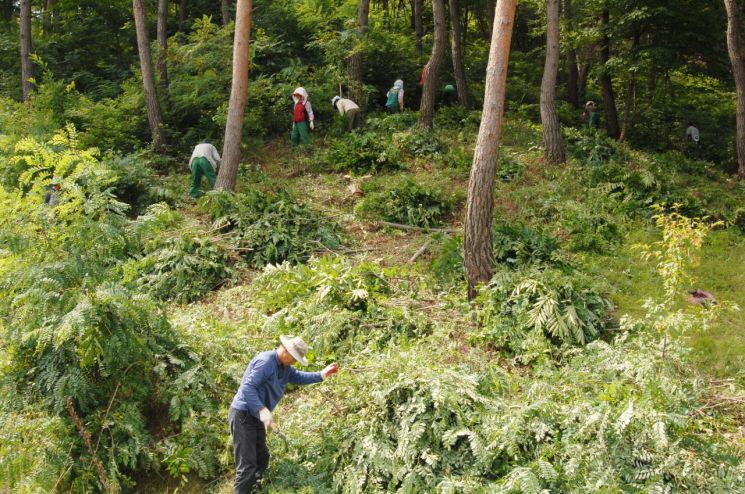
The government is set to improve the ‘biomass’ market, which is considered a core sector of the eco-friendly energy industry. As the price competitiveness of domestically produced biomass raw materials has plummeted, support for imported raw materials will be reduced. To prevent side effects in this rapidly growing market, supervision and management of illegal activities will also be strengthened.
The Ministry of Trade, Industry and Energy, the Korea Forest Service, and the Ministry of Environment announced the ‘Biomass Fuel and Power Generation Market Structure Improvement Plan’ containing these details on the 18th. Biomass refers to energy resources made from biological resources. It is regarded as an effective means to reduce coal-fired power plants and increase eco-friendly energy. Last year, 2.7GW of facilities were in operation, accounting for 20% of renewable power generation.
However, despite the rapidly growing market, the price competitiveness of domestic biomass is relatively weak. For example, wood-based fuel usage was about 3.4 million tons last year, of which 98% was imported from countries such as Vietnam, Russia, and Indonesia. The annual import value approaches 700 billion KRW.
The government plans to reduce the use of imported fuel and encourage the utilization of domestic resources. To this end, it will use the Renewable Energy Certificate (REC) system. REC is a certificate received by businesses supplying renewable energy. When submitted to the Korea Power Exchange, costs are compensated according to the weighting factor. The higher the weighting, the lower the cost burden, improving price competitiveness; conversely, a lower weighting weakens price competitiveness.
The Ministry of Trade, Industry and Energy plans to adjust the weighting of imported fuels downward and retroactively. For example, facilities supplying wood fuel currently receive an REC weighting of 0.5 to 1.5. The government intends to lower this weighting to 0 to 0.5. By reducing the weighting of excessively cheap imported fuels and weakening their price competitiveness, the use of domestic fuels is expected to increase. In the case of lignocellulosic biomass using wood or plants, market entry of power generation facilities will be completely restricted.
Regulations on unused forest biomass have also been revised to better utilize the added value of wood. Unused forest biomass refers to energy collected from leftover branches and the like abandoned in the mountains, used as fuel for thermal power plants. The supply target for unused forest biomass was 1.5 million tons by 2030, but this was already exceeded last year, indicating a rapidly growing market. The Korea Forest Service will set priorities and usage scopes for unused forest biomass and strengthen supervision and management of illegal activities.
Additionally, the government will improve the classification system for waste wood generated at construction sites. Until now, although wood could be recycled in various ways, it was all classified as waste furniture and used only as fuel for power generation. Accordingly, the Ministry of Environment will change the system to first classify wood suitable for power generation, and if unsuitable, to allow reuse and recycling.
© The Asia Business Daily(www.asiae.co.kr). All rights reserved.
![Clutching a Stolen Dior Bag, Saying "I Hate Being Poor but Real"... The Grotesque Con of a "Human Knockoff" [Slate]](https://cwcontent.asiae.co.kr/asiaresize/183/2026021902243444107_1771435474.jpg)















