444 Cases of Damage Relief Received Over 3 Years
Refund Refused Considering Formal Contract
Contract Deposit Induced Using Free Gifts as Bait
Recently, Kim (33), a prospective bride who visited a wedding expo, signed a contract with jewelry company A and paid a deposit of 300,000 KRW. She was enticed by the company's promise to provide a 30% discount coupon if the deposit was paid on-site that day. A week later, Kim visited the company again but, finding no jewelry she liked, requested a refund of the deposit. However, the company responded that they could not return the deposit, citing a no-refund clause in the contract.
There have been repeated incidents where companies participating in wedding expos induce customers to pay a certain deposit and then refuse refunds. They argue that once the consumer pays the deposit, a formal contract is considered concluded, thus maintaining a no-refund stance.
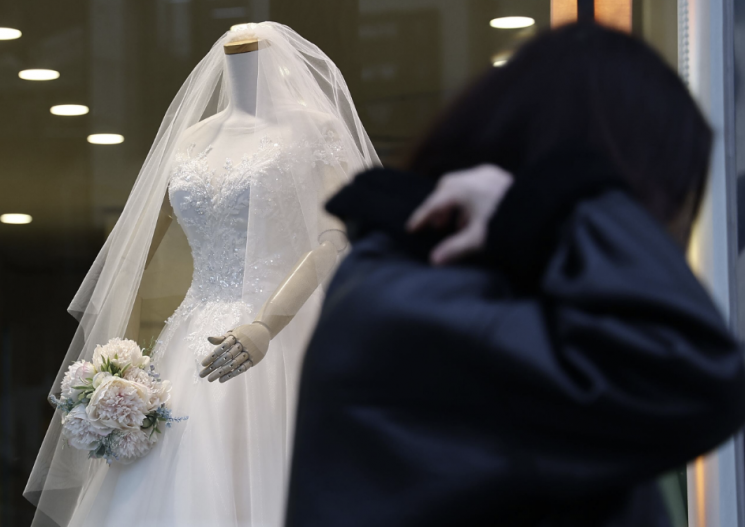 A citizen is passing by a mannequin dressed in a wedding dress on Wedding Street in Ahyeon-dong, Mapo-gu, Seoul. Photo by Yonhap News
According to data released by the Korea Consumer Agency last September, from 2022 until July of this year, a total of 444 damage relief applications related to wedding expos were recorded. The most common reason for relief requests was refusal of contract withdrawal at 46.8% (208 cases), followed by refusal of contract cancellation and excessive penalty charges at 43% (191 cases). By item, wedding preparation agency services accounted for 48.2% (214 cases), rental of wedding attire and hanbok made up 20.5% (91 cases), and contracts for jewelry and other wedding items recorded 14.6% (65 cases).
In fact, among prospective newlyweds preparing for marriage, numerous cases have occurred where refunds were refused after signing contracts with jewelry and wedding attire companies through wedding expos. They lament that they were impulsively led to sign contracts on the spot, enticed by gifts.
Prospective groom Park (34) said, "The wedding attire company promised to provide handmade shoes worth tens of thousands of won as a service if the deposit was paid on-site," adding, "When the company displayed the gifts right in front of customers, customers naturally feel that buying the products at full price would be a loss."
The problem lies in the difficulty of getting the deposit back if the customer later changes their mind and cancels the contract. These companies maintain that since the formal contract is concluded the moment the deposit is paid, refunds cannot be given. They also include no-refund clauses in the contracts.
Choi (29), a prospective bride scheduled to marry next December, was unable to recover her deposit from the jewelry company and ultimately proceeded with the purchase as planned. Choi lamented, "The company refused to return the deposit, citing the no-refund clause in the contract," adding, "I ended up buying the wedding ring reluctantly because I didn’t want to waste the money I had already paid."
However, consumer industry experts point out that the refusal of refunds by wedding companies may be illegal. Contracts made through wedding expos are considered sales conducted by business owners outside their usual place of business, so refund regulations under the Act on Door-to-Door Sales, etc. (Door-to-Door Sales Act) should apply.
A representative from the Korea Consumer Agency explained, "According to the Door-to-Door Sales Act, consumers can request contract withdrawal or deposit refunds within 14 days," adding, "If a company refuses a refund, consumers can apply for damage relief through the Korea Consumer Agency, and if the business refuses, mediation procedures can be pursued through the Consumer Dispute Mediation Committee."
© The Asia Business Daily(www.asiae.co.kr). All rights reserved.
![Clutching a Stolen Dior Bag, Saying "I Hate Being Poor but Real"... The Grotesque Con of a "Human Knockoff" [Slate]](https://cwcontent.asiae.co.kr/asiaresize/183/2026021902243444107_1771435474.jpg)















