South Korean Economy Hits Lowest Point Amid Emergency Martial Law Aftermath
Appropriate Fiscal Policy Needed Amid Domestic Demand Slump and Economic Slowdown
Key to Fill Policy Gap Until Q2 Next Year
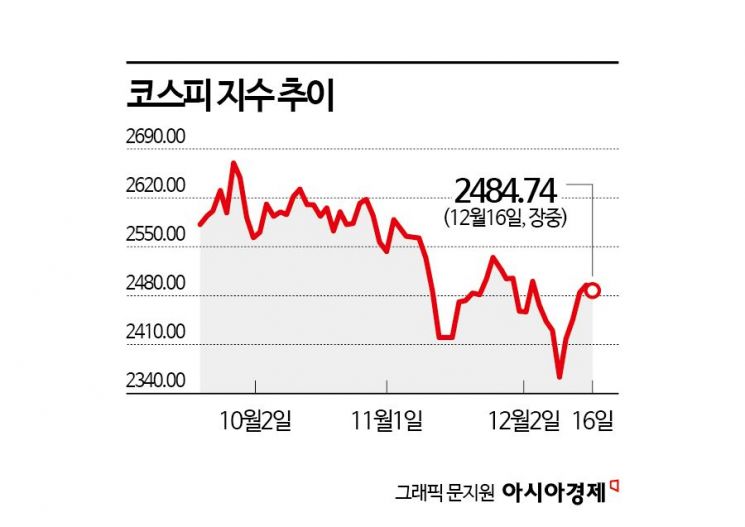
The South Korean economy, which hit rock bottom following the aftermath of the emergency martial law, is striving for normalization. As the impeachment motion against President Yoon Seok-yeol passed the National Assembly plenary session and the formal impeachment trial process began, there are expectations that the domestic financial and capital markets will regain overall stability. There is a growing call to quickly resolve the political turmoil and continue policies that can revitalize the market, such as value-up and venture investment.
Venture Industry: "The Real Start Is Now... We Must Quickly Escape the Stagnation"
Yoon Geon-su, Chairman of the Korea Venture Capital Association, said, "Some uncertainties have been resolved, but now is just the beginning," adding, "From the market’s perspective, this phase must end quickly. We hope the Constitutional Court will reach a swift conclusion."
Since the Constitutional Court is expected to decide on the acceptance of the impeachment within 180 days of receiving the case, and if accepted, a presidential election will be held within 60 days, the schedule outline has been established, providing the market with a basis to respond accordingly.
The venture industry has been discussing policies such as the introduction of Business Development Companies (BDC), venture investment through retirement pensions, and deregulation of Corporate Venture Capital (CVC). However, these policy discussions were somewhat deprioritized during the impeachment political turmoil.
Experts emphasize that the political situation must normalize quickly so that policy discussions can resume, and especially for startup support, the government should not back down from planned projects or institutional improvements. Chairman Yoon stated, "The atmosphere where we cannot do what needs to be done and cannot follow the path we must take must be resolved as soon as possible."
Domestic Demand Slump, Economic Slowdown, Trump Variables Pressure Amid Regime Vacuum... Prompt Fiscal Policy Needed
There are also calls for bipartisan cooperation to fill the gap until the impeachment decision and regime stabilization are achieved. It is advised that measures to revitalize the economy through coordination of monetary and fiscal policies be implemented swiftly.
A chief investment officer (CIO) of a domestic A pension fund said, "It is fortunate that political uncertainty has cleared, but the issues facing our economy and financial markets remain," adding, "In November, the Bank of Korea officially mentioned economic slowdown at the Monetary Policy Committee meeting, and in December, the Ministry of Strategy and Finance removed the phrase about economic recovery from its economic diagnosis." He explained, "There are many pressure factors such as domestic demand slump, export slowdown, an industrial structure heavily dependent on certain sectors, and Trump policy variables."
There are limits to monetary policy alone, such as interest rate cuts, and active cuts are difficult due to exchange rate volatility. Therefore, more proactive fiscal policy implementation and supplementary budgets (Chugyeong) are needed next year. The A pension fund CIO expressed concern, saying, "Assuming the presidential election is held around mid-next year, competitive expansionary fiscal pledges may emerge then, but starting discussions at that time would be somewhat late."
Filling the 'Policy Gap' Until Q2 Next Year... Rapid Budget Execution by Each Ministry Announced
The key issue is how to fill the policy gap until the second quarter of next year. On the first working day after the impeachment motion passed, the 16th, major ministries held executive meetings to discuss prompt fiscal input for stabilizing people’s livelihoods.
Kim Byung-hwan, Chairman of the Financial Services Commission, held the first expanded executive meeting after the impeachment motion against President Yoon Seok-yeol was approved and requested that measures to ease market stability, such as the timing of introducing stress buffer capital, be announced within this week. He also asked for support to pass various livelihood-related bills pending in the National Assembly, including the Loan Business Act (improving illegal private financing systems), the Electronic Financial Transactions Act (preventing Time Fraud), and the Depositor Protection Act (raising deposit protection limits).
The Ministry of Trade, Industry and Energy plans to swiftly execute the 2025 budget from the beginning of the year, given the significant concerns about domestic demand contraction due to weakened consumer sentiment, and will explore ways to strengthen the role of public institutions in stimulating domestic demand. Additionally, it will closely monitor trends in the distribution sector, prepare export support measures such as trade insurance for emergency external situations, and promote stable power supply management and securing oil and gas reserves in preparation for the winter season.
The Ministry of SMEs and Startups will also mobilize all means to resolve difficulties faced by small and medium-sized enterprises (SMEs), ventures, and small business owners. With the 2025 budget finalized, the ministry plans to swiftly establish projects and policies targeting small business owners, ventures, startups, and SMEs, and inject funds early to focus policy efforts on stabilizing small business management and supporting exports of SMEs and ventures.
© The Asia Business Daily(www.asiae.co.kr). All rights reserved.
![Clutching a Stolen Dior Bag, Saying "I Hate Being Poor but Real"... The Grotesque Con of a "Human Knockoff" [Slate]](https://cwcontent.asiae.co.kr/asiaresize/183/2026021902243444107_1771435474.jpg)















