The First Domestic Living Donor Liver Transplant Recipient Lee Ji-won
Partial Liver Transplant from Father at Seoul Asan Medical Center in 1994
Seoul Asan Medical Center, World's Largest Number of Living Donor Liver Transplants... 98% Survival Rate
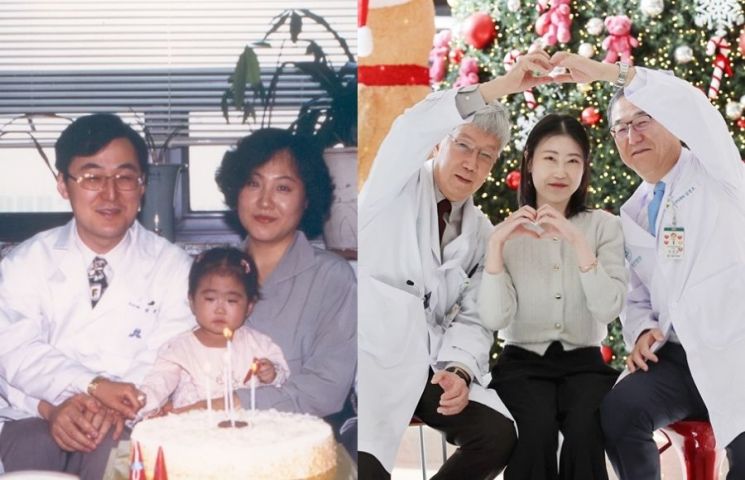 In May 1995, Professor Kim Kyung-mo, the attending physician, and medical staff celebrated the discharge of Lee Ji-won, who was 15 months old at the time. On the right is a photo of Lee with Professor Kim and Professor Lee Seung-gyu commemorating the 30th anniversary. Provided by Seoul Asan Hospital.
An infant who was given a terminal diagnosis before turning one due to cirrhosis caused by congenital biliary atresia 30 years ago has grown into a 30-year-old adult after undergoing the country's first living-donor liver transplant.
According to Seoul Asan Medical Center on the 16th, Mr. Lee received a partial liver transplant from his father on December 8, 1994, and grew up healthy. Mr. Lee's surgery was the first living-donor liver transplant in South Korea. Seoul Asan Medical Center has since given a new life to a total of 7,392 patients through living-donor liver transplants, including 7,032 adults and 360 children. This is also a world record.
A living-donor liver transplant involves transplanting a portion of a living person's liver. From the patient's perspective, there is no need to wait for an organ from a brain-dead donor. This allows for prompt action before the condition worsens. There is also no risk of liver damage that can occur during the brain death process. However, the surgery is more complex than brain-dead donor liver transplants, and the risk of complications is higher, so the survival rate is known to be lower.
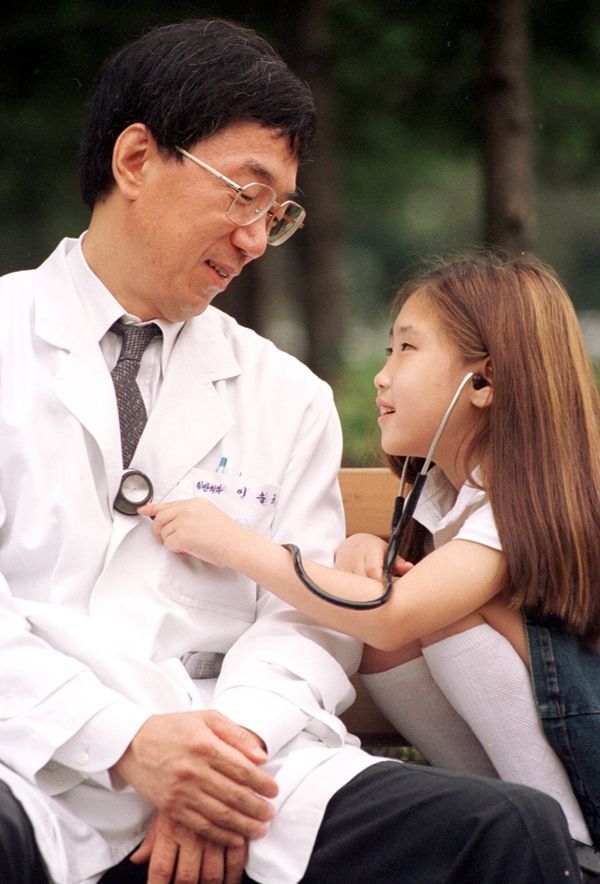 Lee Ji-won, who was a kindergarten student in 1998, is taking a photo in the park with Professor Lee Seung-gyu, who was the surgeon. Photo by Seoul Asan Medical Center
Despite most cases being high-difficulty living-donor liver transplants, Seoul Asan Medical Center's overall liver transplant survival rates are very high: 98% at 1 year, 90% at 3 years, and 89% at 10 years. Considering that the 1-year survival rate for liver transplants at the University of Pittsburgh Medical Center and the University of California San Francisco Medical Center in the U.S., where liver transplant history is longer than in Korea, averages 92%, the hospital explains that this is an excellent result. The hospital also announced that the survival rate for pediatric living-donor liver transplants performed over the past 10 years is nearly 100%. An analysis of 93 pediatric patients who received living-donor liver transplants from 2012 to 2020 showed survival rates of 100% at 1 year and 98.6% at 5 years.
The high survival rates are supported by an advanced multidisciplinary collaboration and intensive care system before and after surgery. Experts from various fields?including liver transplant and hepatobiliary surgery, pediatric surgery, pediatric gastroenterology and nutrition, anesthesiology and pain medicine, and intensive care units?collaborate organically to pre-plan for possible complications before surgery and thoroughly manage patient conditions after surgery.
Seung-gyu Lee, Chair Professor of Liver Transplant and Hepatobiliary Surgery at Ulsan University College of Medicine, Seoul Asan Medical Center, said, "The living-donor liver transplant that saved a 9-month-old baby in December 1994 became a meaningful milestone in our liver transplant journey," adding, "The miracle was made possible by the transplant team medical staff united by a spirit of challenge and passion to save critically ill patients, and by the patients who have shown remarkable vitality and live their daily lives after surgery."
Kyung-mo Kim, Professor of Pediatric Gastroenterology and Nutrition at Ulsan University College of Medicine, Seoul Asan Medical Center, said, "The 30 years represent not only the dedication and efforts of the medical staff but also the continuous efforts of transplant patients and their families who trusted and followed the medical team well," adding, "The infant who received the country's first living-donor liver transplant entering kindergarten like a miracle, going through an ordinary school life, and now growing into an adult fulfilling their role in society is a symbolic case demonstrating the success of transplant medicine." He continued, "If post-transplant care is thorough, patients can live healthily beyond 30 years, even for a lifetime. The successful lives of transplant patients are valuable evidence that gives great hope to children and families who will receive transplants in the future."
© The Asia Business Daily(www.asiae.co.kr). All rights reserved.
![Clutching a Stolen Dior Bag, Saying "I Hate Being Poor but Real"... The Grotesque Con of a "Human Knockoff" [Slate]](https://cwcontent.asiae.co.kr/asiaresize/183/2026021902243444107_1771435474.jpg)
















