Survey of CEOs from 22 Distribution and Food Companies
More than Half Express "Concerns Over National Credit Rating Decline"
As the impeachment crisis, triggered by President Yoon Seok-yeol's declaration of martial law, intensified, the distribution industry was thrown into turmoil. Although the presidential duties were suspended following the passage of the impeachment motion against President Yoon in the National Assembly, political risks such as the impeachment trial and early presidential election remain, raising concerns that the decline in external credibility could negatively impact overseas exports of 'K-brands,' including K-Food, which has captivated global tastes. With prolonged high inflation continuing, the already weakened consumer market is expected to worsen further as the surge in exchange rates caused by the martial law situation leads to increased import raw material costs, resulting in higher prices and deeper consumption stagnation.
On the 16th, a survey conducted by Asia Economy targeting CEOs of 22 major domestic distribution and food companies found that more than half, 12 CEOs, cited a decline in external credibility as an impact of the current impeachment crisis. One food company CEO said, "It is cautious to mention the impact at this point," but added, "The longer the political uncertainty lasts, the more it is expected to negatively affect external credibility."
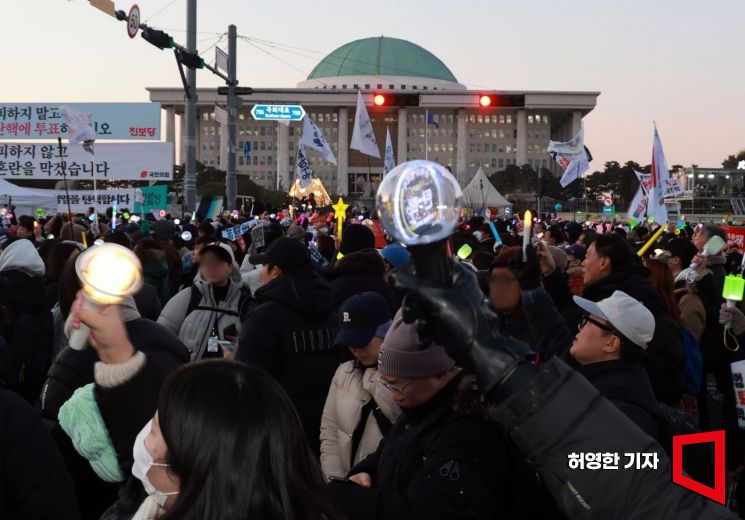 After the impeachment motion against President Yoon Suk-yeol was passed in the second impeachment vote, participants gathered in front of the National Assembly building in Yeouido, Seoul, cheered and danced. Photo by Heo Young-han
In particular, the food industry, which recently opened the door to K-Food exports, sees that if Korea's national credibility falls due to the impeachment crisis, damage to brand image in the global market will be inevitable. According to the Ministry of Agriculture, Food and Rural Affairs, Korea's food export value exceeded $8.1 billion cumulatively through October this year, marking a record high. With overseas popularity of products like frozen gimbap and Buldak Bokkeum Myun, the export growth rate during this period reached 8.7%. However, if national credibility declines due to the impeachment crisis, the competitiveness of K-brands will weaken, eventually leading to sluggish exports of Korean food products.
Another food company CEO expressed concern, saying, "The prolongation of the impeachment crisis will lead to export sluggishness due to the international decline in national credibility," and added, "Recently, during the declaration and lifting of martial law, the possibility of a localized conflict on the Korean Peninsula was mentioned. If Korea's geographical characteristics are perceived as a potential war zone in the global market, it will negatively affect trade reliability."
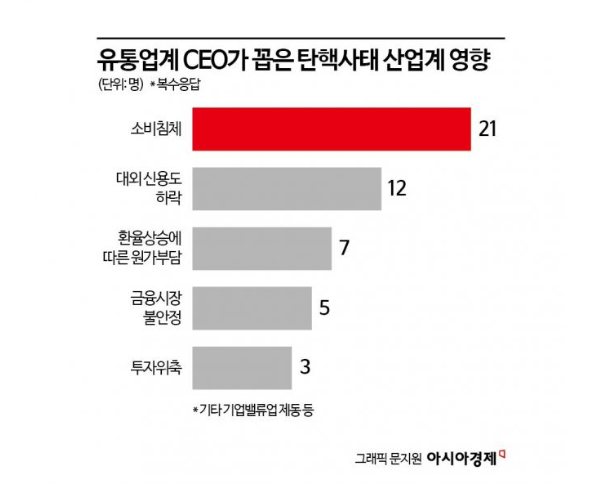
The decline in Korea's external credibility directly translates into a decrease in the number of foreign tourists visiting Korea, leading to expectations that not only the duty-free industry but the entire distribution sector could be severely impacted. Especially, the majority of CEOs in the distribution and food industries responded that the impeachment crisis would further shrink consumer sentiment, potentially prolonging the domestic economic downturn. One CEO said, "Various issues that cause public anxiety are likely to ultimately dampen consumer sentiment," adding, "If consumer sentiment worsens, shopping and dining out will decrease, directly affecting distribution companies."
Above all, food manufacturers are concerned about increased cost burdens as the value of the Korean won falls and the won-dollar exchange rate soars due to the impeachment crisis. In fact, right after President Yoon's declaration of martial law on the 3rd, the foreign exchange market plunged to 1,442 won per dollar. The high exchange rate raises prices when importing food raw materials, increasing burdens on companies, and soaring import prices could further fuel consumption contraction.
In fact, during the 2016 impeachment of former President Park Geun-hye, the Consumer Sentiment Index dropped sharply from 102.7 in October to 96 in November, shortly after the tablet PC controversy alleging Choi Soon-sil's involvement in state affairs surfaced. The index further fell to 94.3 in December when the impeachment motion was passed in the National Assembly and plunged to 93.3 in January of the following year. The Consumer Sentiment Index comprehensively reflects consumers' economic outlook, with values below 100 indicating a negative economic assessment.
A CEO of a major food company said, "Negative impacts such as domestic consumption sentiment contraction are expected due to this crisis, especially with a significant adverse effect on the exchange rate," adding, "We are closely monitoring the situation as cost burdens may intensify." A CEO from the alcoholic beverage industry also stated, "The rise of the US dollar will hit exports, plunging the national economy into difficulty, and this will extend to the domestic economy, making the economic situation even more chaotic."
Another food company CEO predicted, "Domestic consumption stagnation and increased raw material import costs due to the depreciation of the won will increase manufacturing cost burdens, and the contraction of investment sentiment among domestic and foreign investors will negatively affect corporate value enhancement."
However, some CEOs forecast that while macroeconomic impacts such as the decline in national credibility and rising exchange rates are inevitable, they will not necessarily lead to decreased sales of individual products.
© The Asia Business Daily(www.asiae.co.kr). All rights reserved.
![Clutching a Stolen Dior Bag, Saying "I Hate Being Poor but Real"... The Grotesque Con of a "Human Knockoff" [Slate]](https://cwcontent.asiae.co.kr/asiaresize/183/2026021902243444107_1771435474.jpg)
















