Bank of Korea-Korea Economic Development Association Joint Symposium
'Analysis of the Impact of Climate Risk on the Macroeconomy'
Extreme Climate Acts as Upward Pressure on Prices
A study has found that extreme weather conditions such as heatwaves and cold waves have driven up prices in South Korea. Since the 2000s, the frequency and intensity of extreme weather have increased, causing greater price volatility in agricultural, livestock, and fishery products, as well as energy price shocks, thereby acting as a pressure to raise inflation.
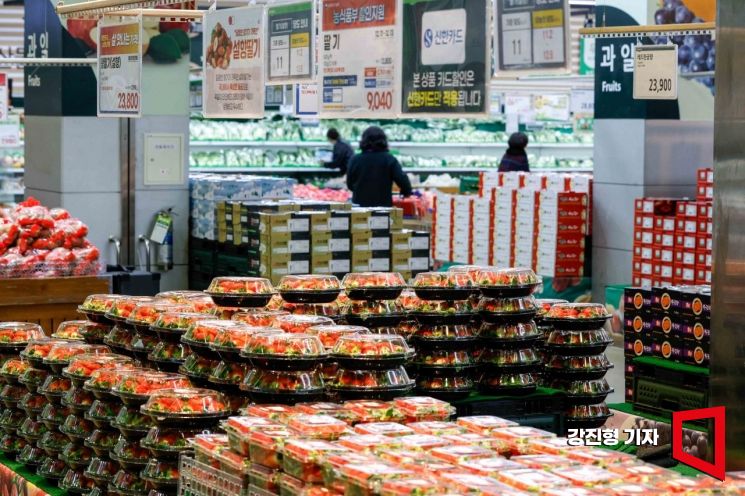 As this year’s abnormal weather conditions have led to poor crop yields, the prices of domestic seasonal fruits such as apples, pears, and persimmons are soaring to unprecedented heights. On the 12th, a customer visiting the Hanaro Mart Yangjae branch in Seocho-gu, Seoul, was seen browsing the fruit section. Photo by Kang Jin-hyung aymsdream@
On the 12th, Professor Park Ki-young of Yonsei University attended a joint symposium held by the Bank of Korea and the Korea Economic Development Association at the Bank of Korea annex building's 2nd-floor conference hall in Jung-gu, Seoul, themed "The Economic Impact of Climate Change and Responses, and the Role of Central Banks," where he presented an analysis titled "The Impact of Climate Risk on the Macroeconomy."
Professor Park pointed out, "Compared to overseas, South Korea started research on the macroeconomic impacts of climate change relatively late, and especially lacks economic studies related to physical risks," adding, "We developed an 'Extreme Climate Index' that quantifies the frequency and intensity of extreme weather by region to analyze the impact of climate risk on macroeconomic factors such as inflation and industrial production," explaining the background of the research.
The analysis showed that climate risk significantly raised inflation. Since the 2000s, with the increase in frequency and intensity of extreme weather centered on heatwaves, price volatility in agricultural, livestock, and fishery products has increased, and energy price shocks have occurred, acting as supply-side factors that raised inflation.
On the other hand, the impact of climate risk on industrial production was found to be unclear. This is interpreted as a result of the manufacturing-centered industrial structure, where indoor work predominates, and the industry’s flexible response to climate change through improvements in heating and cooling facilities, adjustment of working hours, and adoption of energy efficiency technologies.
Professor Park suggested, "As extreme weather events are expected to increase in the future, policies to respond to the inflationary impact of climate risk must be prepared," emphasizing, "In particular, customized policies are needed that reflect the fact that heatwaves have a significant impact on inflation and that the effects of climate change vary by industry."
© The Asia Business Daily(www.asiae.co.kr). All rights reserved.
![Clutching a Stolen Dior Bag, Saying "I Hate Being Poor but Real"... The Grotesque Con of a "Human Knockoff" [Slate]](https://cwcontent.asiae.co.kr/asiaresize/183/2026021902243444107_1771435474.jpg)















