Individual Still Selling... 420 Billion Won Selling Dominance
Foreigners Who Bought the Previous Day Turned to Selling This Day
Undervalued Appeal Draws Low-Price Buying in KOSDAQ
On the 10th, the KOSPI and KOSDAQ indices rebounded for the first time in five days since the imposition of martial law, but individual investors continued to sell. It appears that the selling pressure from individual investors was absorbed by foreigners and institutions. Foreign investors, who had shown net buying the previous day, initially continued to buy but then switched to selling, showing a fluctuating pattern. Institutions, led by pension funds, maintained buying pressure to support the indices. However, with the second impeachment vote on President Yoon Seok-yeol scheduled for the 14th, changes in investor supply and demand are expected depending on the voting outcome.
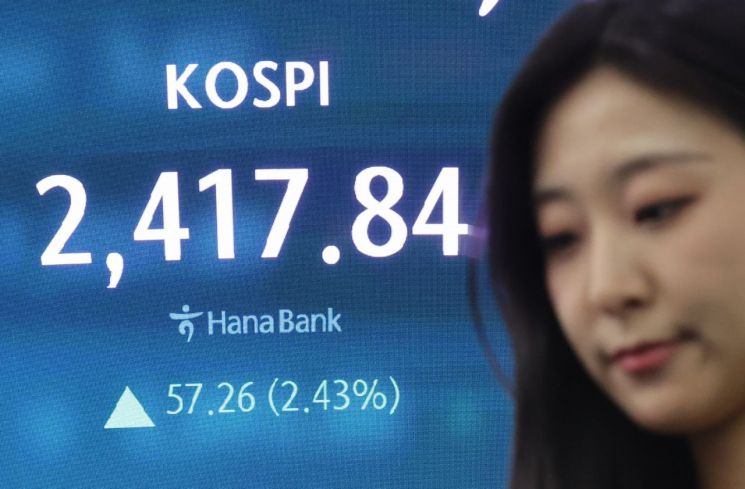
On that day, the KOSPI closed at 2,417.84, up 2.43% from the previous trading day. Institutions played the role of savior again. They bought a net 459.5 billion KRW, propping up the index. Since the martial law incident, institutions are estimated to have net bought about 900 billion KRW.
Individual investors responded by selling, similar to the 9th. While individuals sold 202.2 billion KRW on the previous day in the KOSPI, on the 10th they doubled that amount to a net sale of 421.9 billion KRW. Individual investors had engaged in net buying even on August 5th’s 'Black Monday,' when the market plunged sharply, but as prices fell further than then, they appear to have resorted to stop-loss selling. On August 5th, when the circuit breaker was triggered due to increased market volatility, individual investors had net bought 1.7 trillion KRW in the KOSPI alone.
Researcher Kang Dae-seok of Yuanta Securities analyzed, "After individual investors’ stop-loss selling, the market tends to shift from price adjustment to time adjustment," adding, "It is estimated that stop-loss selling emerged as the stock price fell below the August 5th low."
As individual investors showed a contrasting behavior compared to their steadfast net buying during the crash, Deputy Prime Minister for Economy Choi Sang-mok urged individual investors to "maintain a calm perspective and make judgments."
Foreign investors showed a fluctuating pattern. On the 10th, foreign investors initially showed net buying but switched to net selling around 10 a.m. Foreign investors had recorded net buying of 104.9 billion KRW the previous day but reverted to selling on this day. Although foreign investor sentiment has not fully recovered, they showed net buying of 291.1 billion KRW in the KOSDAQ market. The securities industry analyzed that ‘bottom-fishing’ buying interest flowed in as small and mid-cap stocks in KOSDAQ reached their lowest price levels in about 4 years and 8 months. Since the KOSDAQ experienced a larger drop during the downturn, there is potential for a bigger rise during the rebound. Foreign investors showed selling dominance on the 4th and 5th after the lifting of martial law but switched to buying from the 6th onward, purchasing 205.3 billion KRW worth on the 9th.
Lee Kyung-min, a researcher at Daishin Securities, analyzed the supply and demand movements by investor type, saying, "Individuals are showing stop-loss disappointment selling, institutions are seeing program buying inflows due to December seasonality, and foreign investors are buying attracted by undervaluation."
Although political uncertainty remains ahead of President Yoon’s second impeachment vote this weekend, experts advise against rash selling driven by fear.
Researcher Park Seung-young of Hanwha Investment & Securities said, "Individual net selling is because they are disappointed with the Korean market and moving to the U.S. market, and because accumulated price declines have caused credit shortages," adding, "You should buy when others don’t want to sell, and sell when others don’t want to buy. Now, buying is a more appropriate response than selling."
However, Park viewed immediate buying as not the best timing. He said, "Buying can be delayed until positive candlesticks with closing prices higher than opening prices accumulate," noting that since 2020, the market has shown such accumulations before entering an upward trend. Although the stock market entered an excessive fear phase on the 9th, the selling power of the public was still strong. It is better to confirm when their strength wanes before buying."
© The Asia Business Daily(www.asiae.co.kr). All rights reserved.
![Clutching a Stolen Dior Bag, Saying "I Hate Being Poor but Real"... The Grotesque Con of a "Human Knockoff" [Slate]](https://cwcontent.asiae.co.kr/asiaresize/183/2026021902243444107_1771435474.jpg)















