Prosecutors, Police, and Corruption Investigation Office Consider Forced Investigation
Search Warrants Difficult if Investigation Uncooperative
Debate Over Job Suspension Upon Detention
As the prosecution, police, and the High-ranking Officials' Crime Investigation Division (PACC) each begin investigations into the December 3 emergency martial law incident, attention is focused on how a forced investigation against President Yoon Seok-yeol will be conducted. In the legal community, the prevailing opinion is that search and seizure or arrest of the president is possible if charges of insurrection are applied, but since the investigation involves a sitting president, various variables are expected.
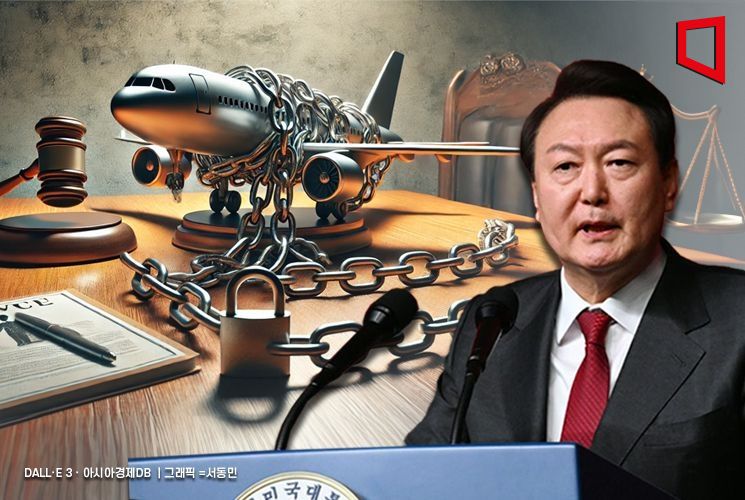
All three agencies?the prosecution, police, and PACC?are considering forced investigations against President Yoon. On the 9th, the Prosecution's Special Investigation Headquarters on Emergency Martial Law (headed by Park Se-hyun, Chief Prosecutor of the Seoul High Prosecutors' Office) requested an arrest warrant for former Minister of National Defense Kim Yong-hyun on charges of engaging in important duties related to insurrection and abuse of authority, explicitly stating a conspiracy relationship with President Yoon. The Police National Investigation Headquarters' Special Investigation Unit also stated, "If conditions are met, (President Yoon) can be urgently arrested," adding, "It is necessary to review whether the conditions are met." The PACC, meanwhile, has banned President Yoon from leaving the country and expressed that "all legal measures will be reviewed" regarding the possibility of urgent arrest.
Forced Investigation of the President Theoretically Possible... Variables in Interrogation and Search and Seizure
Since the president is the ultimate decision-maker in the emergency martial law incident, forced investigation against President Yoon is inevitable. If the prosecution secures custody of former Minister Kim, the focus is expected to immediately turn toward President Yoon. Although a sitting president has immunity from prosecution, this immunity does not apply in cases of insurrection or treason.
Professor Kim Seon-taek of Korea University Law School said, "In theory, all forced investigations such as arrest and issuance of an arrest warrant against the president are possible." Professor Kim Dae-hwan of the University of Seoul Law School also added, "Urgent arrest is also possible in this matter."
Typical investigations proceed in order of securing evidence through search and seizure, followed by questioning suspects and witnesses, and then deciding whether to indict. If there are indications of serious crimes during this process, the suspect’s custody can be secured through arrest or detention. Search and seizure of the presidential office is essential for evidence collection, but the Criminal Procedure Act stipulates that "places requiring military secrets cannot be searched or seized without the consent of the person responsible." This means that if the president, who is still the commander-in-chief, is uncooperative with the investigation, search and seizure itself will be difficult.
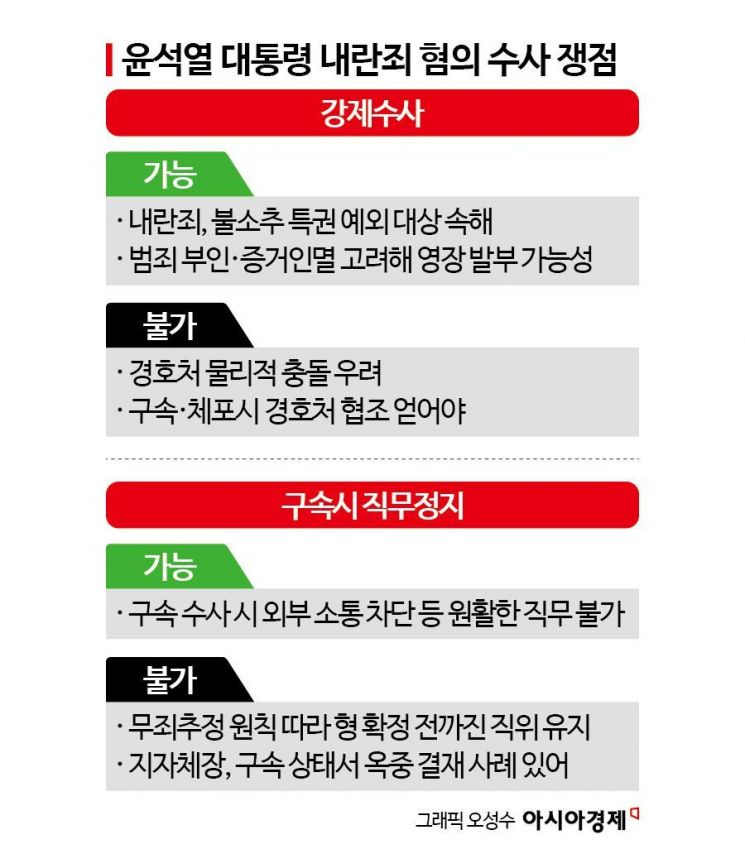
Summoning President Yoon for questioning is also expected to be difficult. In principle, suspects must appear directly before investigative agencies for questioning, but there is a possibility that the president may refuse summons citing security concerns. Former President Park Geun-hye repeatedly refused face-to-face questioning and only appeared before the prosecution after the Constitutional Court upheld her impeachment, that is, after losing the presidency.
Interrogations may be conducted face-to-face or in writing at a third location, but this has the disadvantage of making thorough investigation difficult. Professor Kim Seon-taek said, "There is a possibility of conflict with the security office during the process of issuing an arrest warrant or urgent arrest of the president," adding, "Search and seizure may be feasible, but cooperation from the security office will likely be necessary for forced investigations."
Ultimately, the investigation can only proceed swiftly if President Yoon sincerely acknowledges responsibility for the emergency martial law incident and actively cooperates with the investigation. Professor Lim Ji-bong of Sogang University Law School predicted, "Considering that President Yoon denies the crime and the possibility of evidence destruction, an arrest warrant may be issued."
Presumption of Innocence Principle... Disagreement Over Suspension of Duties
There is debate over whether the president’s duties would be suspended if he is arrested or detained. Article 71 of the Constitution stipulates that if the president is unable to perform duties due to vacancy or accident, the Prime Minister or others act on their behalf. The issue is whether the president’s arrest or detention can be considered a vacancy or accident. Vacancy refers to the president’s death or removal, leaving the office empty. Accident refers to inability to perform duties due to illness, overseas stay, or other reasons.
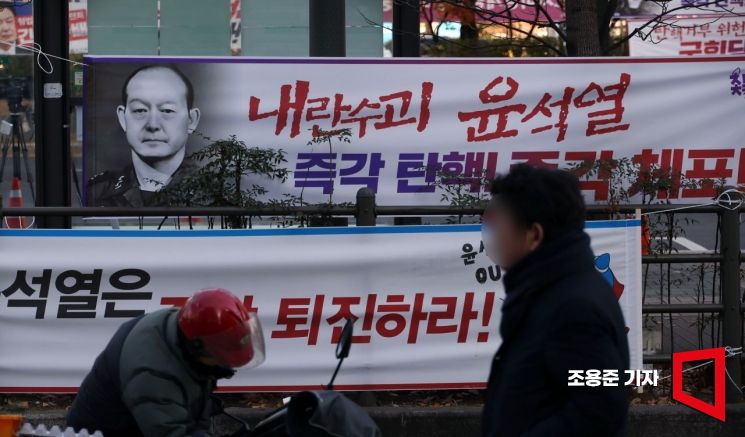 A banner urging impeachment was hung in front of the National Assembly in Yeouido, Seoul, on the afternoon of the 9th, as the impeachment motion against President Yoon Seok-yeol failed to pass due to a lack of quorum caused by the collective absence of People Power Party lawmakers from the vote. Photo by Jo Yong-jun
First, since our Constitution and Criminal Procedure Act clearly state the "presumption of innocence," there is an interpretation that the presidency must be maintained until a guilty verdict is finalized. Professor Jang Young-soo of Korea University Law School said, "The presumption of innocence applies until a final Supreme Court ruling is made," adding, "Even if the president is arrested or detained, it can be seen that he is still in a position to perform duties normally." Professor Kim Seon-taek noted, "Former Gyeonggi Province Governor Lim Chang-yeol, who was detained on bribery charges, insisted on approving documents from prison."
On the other hand, there is an argument that the president’s detention should be regarded as an ‘accident’ state in which smooth performance of duties is practically impossible. Professor Han Sang-hee of Konkuk University Law School explained, "Being detained means being subject to forced investigation and being cut off from communication with the outside," adding, "The president must be able to communicate smoothly with the outside, so detention means it is impossible to perform duties." Professor Kim Dae-hwan emphasized, "Detention means the president committed a serious crime that does not qualify for immunity, so it should be seen as a state where smooth performance of duties is impossible."
"Realistically, Impeachment Is Necessary"
Experts believe that since the suspension of duties provision is highly contentious, the situation should ultimately be resolved through impeachment by the National Assembly. Professor Han said, "If the situation has reached the point where detention is necessary, it can be considered that the grounds for impeachment of the president are effectively met."
Professor Jang pointed out, "(If President Yoon is indicted and sentenced to imprisonment) automatic dismissal may occur, but realistically, impeachment is a faster way to suspend duties," adding, "It takes a long time to wait for a Supreme Court ruling."
© The Asia Business Daily(www.asiae.co.kr). All rights reserved.
![Clutching a Stolen Dior Bag, Saying "I Hate Being Poor but Real"... The Grotesque Con of a "Human Knockoff" [Slate]](https://cwcontent.asiae.co.kr/asiaresize/183/2026021902243444107_1771435474.jpg)

















