'2024 Construction Market and Construction Industry Policy Diagnosis Seminar' Held
To revitalize construction investment and stabilize the construction market, it was pointed out that aging public infrastructure should be improved and regulations in the private market should be eased.
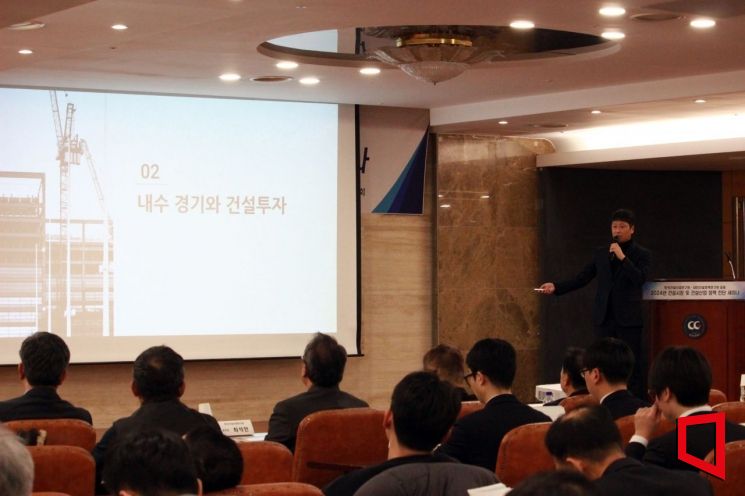 On the 9th, at the Construction Hall, Na Kyung-yeon, Head of the Economic, Financial, and Urban Research Division at the Construction Industry Research Institute, is presenting at the "2024 Construction Market and Construction Industry Policy Diagnosis Seminar." Provided by the Construction Industry Research Institute
On the 9th, the Korea Construction Policy Institute and the Korea Construction Industry Research Institute held the "2024 Construction Market and Construction Industry Policy Diagnosis Seminar" at the Construction Hall in Nonhyeon-dong, Seoul. This seminar was organized to diagnose the crisis situation in the construction industry and to explore policy directions for market stabilization and revitalization of the construction industry.
Na Kyung-yeon, Research Director at the Construction Industry Research Institute, gave a presentation on the topic "Paradigm Shift and Response Direction in the Construction Market." Construction investment turned to a decline (-0.5%) starting from the second quarter this year. The number of construction industry employees is also on a decreasing trend, with 2.05 million people projected for 2024 compared to the same month last year. Last year, the building start area recorded 75.7 million square meters, a 31.7% decrease from the previous year, and the decline in orders last year has led to decreases in sales and employment. Construction orders are expected to fall by 0.4 percentage points to 206.7 trillion KRW this year compared to the previous year.
He stated that construction investment is a means for short-term domestic demand stimulation and long-term growth engine preparation. Research Director Na explained, "When 1 trillion KRW of new construction investment is made, the backward linkage effect to other industries reaches 860 billion KRW, creating 10,500 jobs, and resulting in ripple effects such as increased household income (525 billion KRW) and private consumption (340 billion KRW)."
Research Director Na emphasized that to stabilize the market, the public sector should expand budgets for community-based SOC (social overhead capital) and increase improvements to aging infrastructure to prepare for disasters. He stated that the SOC budget level should be maintained in proportion to GDP growth rate, and government support for regional infrastructure facilities should also be increased. He predicted that replacement investment demand for aging SOC, which began construction in the 1970s, will become full-scale from 2025. The number of buildings over 30 years old is expected to increase from 139,244 at the end of 2022 to 166,366 by 2030.
In the private construction market, it was also pointed out that profitability should be improved through innovations in floor area ratio systems and funding for contributions to activate redevelopment projects. There were also opinions that a cooperative structure among ministries and industries should be established to stabilize construction costs, and support should be provided for the passage of laws included in government measures and early resolution of unsold units. Additionally, alternatives such as expanding exemption reasons for responsibility completion guarantees were suggested to improve the structure where risks are concentrated on contractors. Research Director Na stressed, "It is time for a paradigm shift involving comprehensive innovation in the construction 'market-institution-finance' to stimulate domestic demand and stabilize the construction market."
Kim Tae-jun, Research Director at the Construction Policy Institute, gave a presentation on "Risks and Response Strategies According to Changes in the Construction Industry Environment." Director Kim diagnosed that the construction industry is facing a crisis due to structural problems entering a decline phase, compounded by the COVID-19 pandemic and the Ukraine war. In the short term, profit-centered strategies and advanced risk management models are necessary, while in the mid-to-long term, reconstruction of role models for each construction company and establishment of change management systems are required, according to Director Kim's recommendations.
He predicted that with the re-election of the Trump administration, financial risks such as interest rates and exchange rates are becoming prominent, making it difficult to resolve operational risks such as construction materials. Director Kim explained, "An approach to temporarily avoid the crisis in the construction industry will only lead to a bigger crisis, and cooperation among all stakeholders based on mid-to-long-term solutions is necessary."
© The Asia Business Daily(www.asiae.co.kr). All rights reserved.
![Clutching a Stolen Dior Bag, Saying "I Hate Being Poor but Real"... The Grotesque Con of a "Human Knockoff" [Slate]](https://cwcontent.asiae.co.kr/asiaresize/183/2026021902243444107_1771435474.jpg)















