A Childhood Poem Found in a Shoebox
Han Kang Reflects on the Questions That Shape Her Novels
“Language Is the Thread That Connects Us”
Where does love reside? It is within my heart, beating vividly.
What is love? It is the golden thread that connects our hearts together.
This is a poem written by novelist Han Kang in 1979, when she was eight years old. In January of last year, while organizing a storage room in preparation for a move, Han Kang discovered a poem she had written at the age of eight. Inside an old shoebox, she found a poetry book she had made herself as a child.
The booklet, which she had carefully bound by stapling together five sheets of A5-sized paper and even labeled “Poetry Collection” on the cover, contained eight poems. Eight-year-old Han Kang, about to move to Seoul, had lovingly compiled and preserved her treasured poems. In January 1980, Han Kang moved from Gwangju to Seoul at the age of eight.
On the afternoon of December 7, 2024 (Korean time), Han Kang, recipient of the 2024 Nobel Prize in Literature, began her commemorative lecture at the Swedish Academy by sharing the story of discovering the poem she wrote at age eight while moving last year. Reflecting on the words she used as a child, she said, “I felt that some of the words that eight-year-old girl used are still connected to who I am today.”
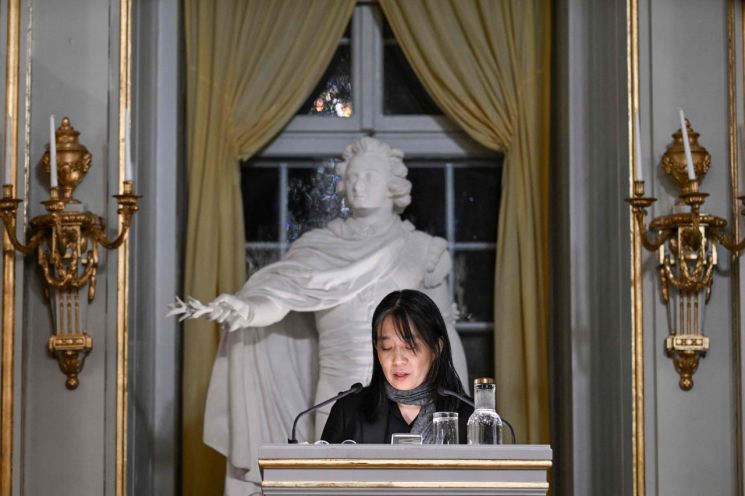 Novelist Han Kang is giving a commemorative lecture for winning the 2024 Nobel Prize in Literature at the Swedish Academy on the afternoon of the 7th (local time).
 Photo by AFP Yonhap News
During the lecture, Han Kang calmly read from a prepared manuscript titled “Light and Thread.”
In the lecture, which lasted about 30 minutes, Han Kang introduced the process and stories behind writing her five novels: “The Vegetarian,” “Let’s Go, The Wind Is Blowing,” “Greek Lessons,” “Human Acts,” and “I Do Not Bid Farewell.”
Han Kang said that while she enjoys writing poetry and short stories, she finds the process of writing novels-sometimes taking as little as a year, sometimes as long as seven years-especially captivating. She explained that, while working on a novel, she lives within her questions.
She said, “Writing a novel means exchanging a significant period of my personal life,” and added, “I find it meaningful to immerse myself in questions that are so important and urgent that I am willing to make that exchange.” She continued, “Each time I write a novel, I endure those questions and live within them. It is not when I find the answers, but when I reach the end of those questions that the novel is completed.”
Han Kang explained that from 2003 to 2005, while writing her third novel, “The Vegetarian,” she lived within questions such as: “Is it possible for a person to become a completely innocent being?” “How deeply can we refuse violence?” and “What happens to someone who, for that reason, refuses to belong to the human species any longer?”
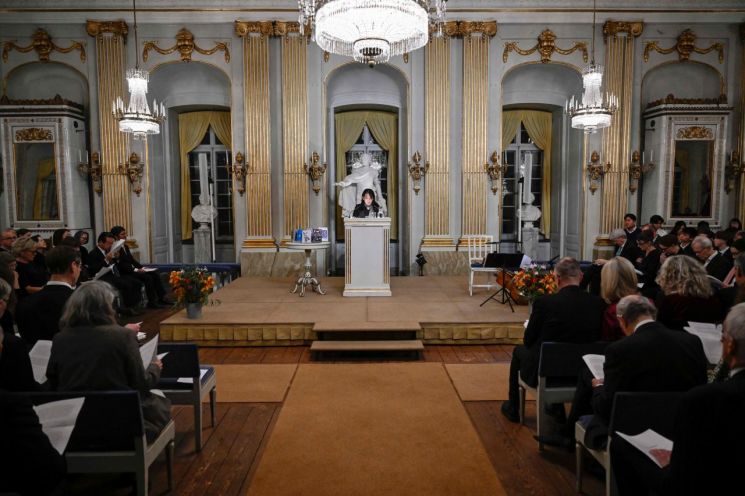 Novelist Han Kang is giving a commemorative lecture for winning the 2024 Nobel Prize in Literature at the Swedish Academy on the afternoon of the 7th (local time).
 Photo by AFP Yonhap News
Han Kang reflected that perhaps, from her first novel to her most recent, the deepest layer of all her questions has always been directed toward love. Just as her eight-year-old self wrote that love resides in the personal place of her heart, she wondered if that was the most enduring and fundamental lesson in her life.
Han Kang concluded her lecture by saying, “I am deeply grateful to everyone who has been connected to that thread, and to all who will be connected, for in the moments when I realize that language is the thread that connects us, and that my questions are connected to that thread through the light and current of life.”
© The Asia Business Daily(www.asiae.co.kr). All rights reserved.
![Clutching a Stolen Dior Bag, Saying "I Hate Being Poor but Real"... The Grotesque Con of a "Human Knockoff" [Slate]](https://cwcontent.asiae.co.kr/asiaresize/183/2026021902243444107_1771435474.jpg)
















