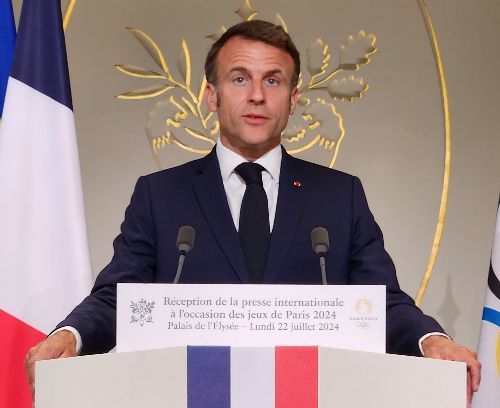
French President Emmanuel Macron (photo), facing a cabinet collapse crisis after the passage of a no-confidence motion against the government for the first time in 62 years, declared on the 5th (local time) that he would not yield to opposition pressure to resign. He also announced that he would appoint a successor to Prime Minister Michel Barnier within a few days.
In a nationally televised address that evening, President Macron expressed regret, saying, "Despite Prime Minister Michel Barnier's concessions to all parliamentary groups, the government was no-confidence voted," and criticized, "The far-right and far-left have formed an anti-republican front to bring down the budget and the French government."
The French National Assembly voted on a no-confidence motion against the government, proposed by the left-wing coalition New Popular Front (NFP), the previous day. The motion was passed with votes in favor from the NFP, the far-right National Rally (RN), and their sympathizers. Consequently, Prime Minister Barnier and his cabinet are expected to resign en masse, inevitably causing political turmoil in France.
In response, President Macron emphasized that the responsibility for the national turmoil lies with the left-wing and far-right camps. He also clearly drew a line regarding the opposition's demand for his resignation. He stressed, "The authority you have democratically entrusted to me is for five years, and I will fully exercise that authority until the end."
Furthermore, he stated that the priority for the next government is the "budget," and requested parliamentary cooperation by saying, "A special law will be submitted to the parliament before mid-December to ensure the continuity of public services and the state."
President Macron said, "I will appoint a successor prime minister within a few days," adding, "I will entrust him to form a government that represents the common interest." He explained, "I will entrust him to form a government that represents the common interest," and said, "This government will be composed of political forces that can participate in the government or at least promise not to no-confidence vote against it."
Currently, candidates for the next prime minister include Defense Minister S?bastien Lecornu, former Prime Minister Bernard Cazeneuve, and Fran?ois Bayrou, leader of the Democratic Movement (MoDem).
At 38 years old, Defense Minister Lecornu is the youngest among the prime minister candidates. Originally a member of the Republicans, he left the party after the 2017 presidential election and declared support for President Macron. Recently, he has overseen military issues such as increased French defense spending and military support for Ukraine. Former Prime Minister Cazeneuve, who served the shortest term in the Fifth Republic, left the Socialist Party ahead of the 2022 National Assembly elections. He was also mentioned as a prime minister candidate in September. Additionally, Bayrou previously served as Minister of Justice in the ?douard Philippe cabinet but resigned after one month due to allegations of falsely employing aides. He was later acquitted of all charges.
© The Asia Business Daily(www.asiae.co.kr). All rights reserved.
![Clutching a Stolen Dior Bag, Saying "I Hate Being Poor but Real"... The Grotesque Con of a "Human Knockoff" [Slate]](https://cwcontent.asiae.co.kr/asiaresize/183/2026021902243444107_1771435474.jpg)















