Achieving 100% Paternity Leave
Set KPI Targets
Japan MUFG Paternity Leave Rate 98%
Top 5 Domestic Commercial Banks
Basic System Exists but No Incentive Programs
"Establishing a Family-Friendly Culture is a Prerequisite"
To address the low birthrate issue, global financial companies are actively introducing systems to support work-family balance. In particular, there is a growing opinion that systems aimed at changing workplace culture, such as negative perceptions from managers and colleagues, are necessary. While basic systems like flexible working hours have been introduced in domestic commercial banks, systems to establish a work-family balance culture, such as encouraging paternity leave, are found to be insufficient.
Kim Hye-seon, a senior researcher at Woori Financial Research Institute, recently stated this in the report "Global Financial Companies' Work-Family Balance Systems." Researcher Kim pointed out that although the Korean government is preparing various systems including work-family balance policies, actual usage rates are low, requiring corporate participation. For example, the combined parental leave period for men and women, guaranteeing 100% of average income, ranks 8th among 38 OECD countries, but the actual number of parental leave users per 100 births ranks 19th out of 23 countries that disclosed data, indicating low utilization.
The low usage rate is due to a workplace culture where employees feel burdened by colleagues' increased workload, making it difficult to take parental leave. According to the 2022 Ministry of Employment and Labor's work-family balance survey, the top reason for not using leave systems was the burden on colleagues and managers. This was followed by the workplace atmosphere and culture that discourages taking parental leave. Researcher Kim evaluated that financial companies in other countries like Japan, which faced low birthrate issues earlier than Korea, experienced similar problems but successfully established work-family balance systems through policies aimed at changing culture.
Global financial companies have begun to normalize flexible working hours themselves. When employees with children use flexible working arrangements such as remote or reduced hours during childcare periods, flexible work policies have been expanded to all employees to prevent social pressure. Germany’s Deutsche Bank allows general employees up to two days of remote work. It operates a "working hours reduction account" where overtime hours can be accumulated and later used for leave or reduced working hours. To ensure that parents taking parental leave do not feel guilty toward colleagues, financial incentives are provided to surrounding employees, and education is conducted. Japan’s MSI (Mitsui Sumitomo Insurance) pays up to 100,000 yen (about 940,000 KRW) per person to departments with employees on parental leave. Mizuho Bank in Japan conducts education to improve understanding of work-family balance among managers.
Global financial companies are making efforts to increase mandatory use of systems or share usage cases to strengthen a culture of shared childcare responsibilities, considering the special situation of male employees who find it difficult to take parental leave due to gender role stereotypes. Japan’s MUFG (Mitsubishi UFJ Financial Group), which owns the world’s 9th largest bank by total assets, has set achieving 100% male parental leave usage as a key performance indicator (KPI) and reflects leave usage in manager evaluations. This is the "10+10" system introduced in 2019, which encourages male employees with children under two years old to take 10 business days of short-term paid parental leave and 10 business days of paid annual leave. As a result, MUFG Bank’s male parental leave usage rate was 83% last year and reached as high as 98% in 2022.
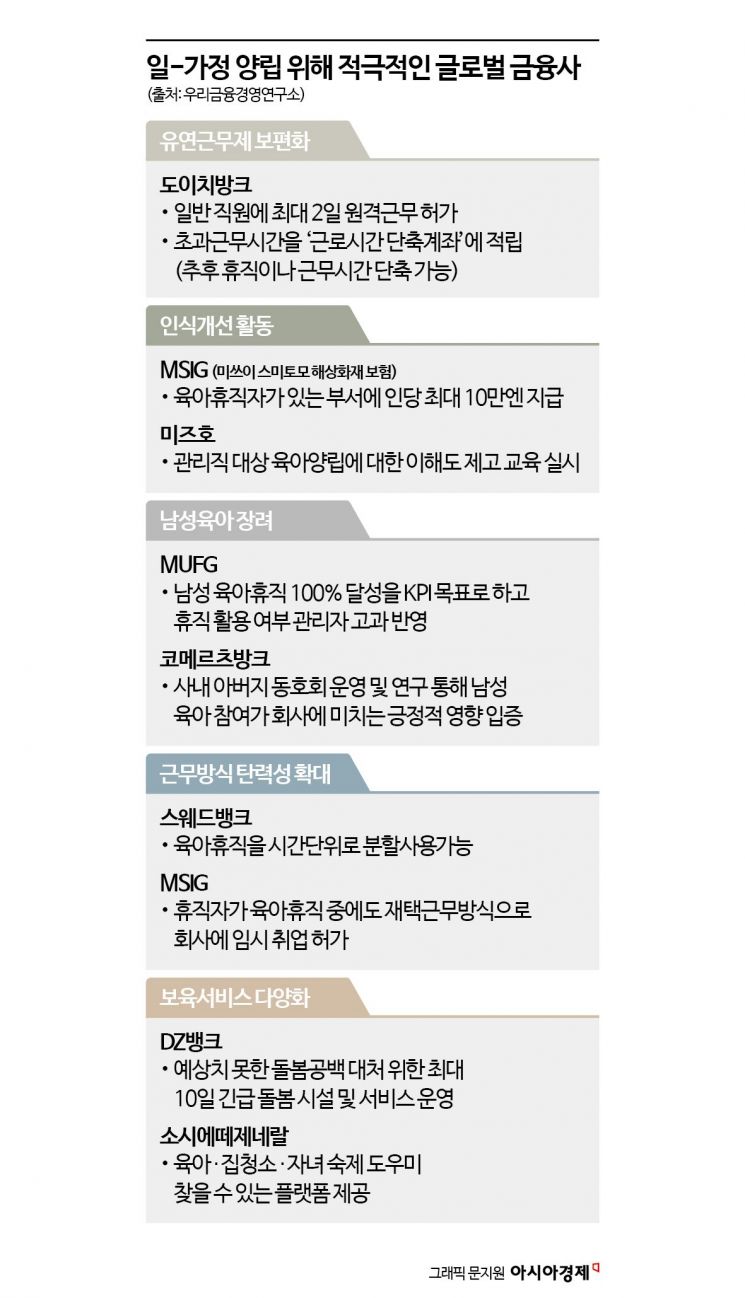
Some financial companies allow flexible division of leave periods or part-time work during leave. Sweden’s Swedbank allows parental leave to be used in hourly increments, and Japan’s MSIG permits employees on leave to temporarily work remotely. To help employees quickly reintegrate into work after returning, childcare facilities are provided, and external childcare services are linked to minimize care gaps. Germany’s DZ Bank offers up to 10 days of emergency childcare facilities and services to cope with unexpected care gaps.
The five major domestic commercial banks (KB Kookmin, Shinhan, Hana, Woori, and NH Nonghyup) are also making efforts for work-family balance by introducing reduced working hours systems and establishing on-site daycare centers. However, it was found that systems to create a culture where parental leave is encouraged are lacking. In particular, none of the five banks have systems that encourage male parental leave, even if they have the leave system itself. Hana Bank and Nonghyup Bank allow parental leave to be split into two periods. KB Kookmin Bank and Woori Bank implement conditional rehire parental retirement. Employees with children under seven years old or before elementary school enrollment are given opportunities to be rehired as new experienced employees after 2 years and 6 months of parental retirement, recognizing their personnel evaluation history before retirement.
Researcher Kim said, "For the systems established within companies to work well, establishing a 'family-friendly culture' in the workplace is a prerequisite," adding, "To this end, companies should not only strive to prepare work-family balance systems for employees with children but also work to improve the awareness of managers and colleagues and reduce the burden caused by employees taking leave."
© The Asia Business Daily(www.asiae.co.kr). All rights reserved.
![Clutching a Stolen Dior Bag, Saying "I Hate Being Poor but Real"... The Grotesque Con of a "Human Knockoff" [Slate]](https://cwcontent.asiae.co.kr/asiaresize/183/2026021902243444107_1771435474.jpg)















