The share of rail transport in inland companies is around 30-40%
Additional 4,000-5,000 won per ton for cement land transport
As the National Railway Labor Union began an indefinite general strike on the 5th, the cement industry is closely monitoring the situation due to concerns over transportation disruptions. If freight train operations decrease or stop during the strike, additional land transportation will be required, increasing cost burdens.
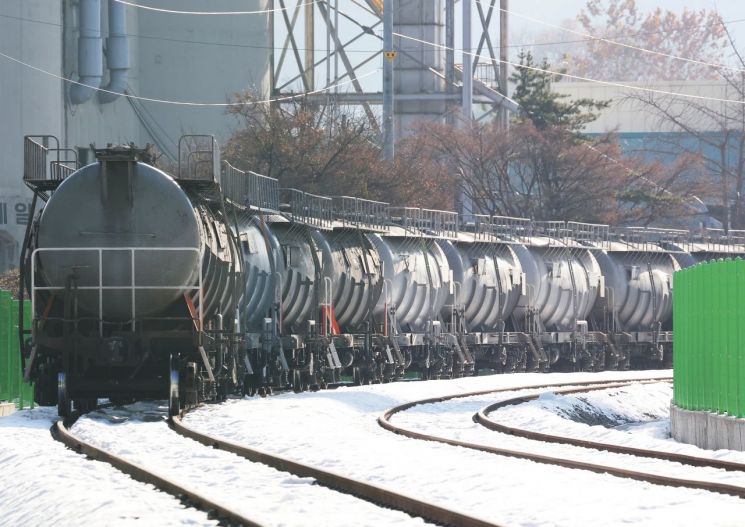 On the 5th, a cement transport train is stopped at Obong Station in Uiwang-si, Gyeonggi-do, as the National Railroad Workers' Union launched a general strike demanding wage increases and resolution of wage arrears. Photo by Yonhap News.
According to the Ministry of Land, Infrastructure and Transport on the 6th, as of 3 p.m. the previous day, freight trains operated at 40.9% of their normal rate. Freight trains transport cement, coal, containers, and other goods. Korea Railroad Corporation plans to maintain freight train operation rates at about 22% of normal levels during the strike.
Within the cement industry, inland companies such as Hanil Cement, Asia Cement, and Sungshin Cement, whose production facilities are located inland, are particularly tense. These companies transport cement by rail to the Seoul metropolitan area and then move it to construction sites by truck. The rail transportation share for inland companies is about 30-40%. Coastal companies like Ssangyong C&E, Halla Cement, and Sampyo Cement, which are located near ports, have a rail transportation share of less than 10%, so they are relatively less affected by the railway union strike.
If freight trains decrease, bulk cement trailers (BCT) must be used more to deliver cement to sites, which increases transportation costs. Transporting cement by BCT instead of freight trains adds about 4,000 to 5,000 KRW per ton from the Chungcheong region, where many inland companies are located, to the major trading area of the Seoul metropolitan area. An industry insider explained, “One freight train can move about 1,040 tons at once, while a BCT can carry up to 27 tons, so if one freight train is unavailable, 38 to 39 BCTs are needed. Since there are only about 2,700 vehicles dedicated solely to transporting cement nationwide, it is difficult for BCTs to fully compensate for the volume handled by freight trains.”
Since the railway union strike was anticipated, companies have already stocked cement quantities in silos nationwide via freight trains. There will be no immediate impact for a few days, but the reserves are expected to be depleted within about three days to a week in the Seoul metropolitan area.
The problem is that the railway union strike is likely to be prolonged. The government’s “emergency decree” could have administrative repercussions affecting negotiations with the railway union. If key decisions are delayed, the confirmation of next year’s labor cost guidelines could also be postponed. The cement industry suffered sales losses of about 71.2 billion KRW and 860,000 tons in volume due to a 72-day railway union strike in 2016.
Another cement industry official said, “If the strike continues, we will have to rely more on BCTs, but since other companies are in the same situation, it is expected to become difficult even to secure vehicles, so we are closely monitoring the situation with concern.” He added, “If the strike prolongs, logistics costs will rise, and transportation delays could impact construction sites as well.”
© The Asia Business Daily(www.asiae.co.kr). All rights reserved.
![Clutching a Stolen Dior Bag, Saying "I Hate Being Poor but Real"... The Grotesque Con of a "Human Knockoff" [Slate]](https://cwcontent.asiae.co.kr/asiaresize/183/2026021902243444107_1771435474.jpg)
















