Political Uncertainty Grows Amid Emergency Martial Law Situation
Yoon Government's Housing Policy Shaken
Ruling and Opposition Parties Indefinitely Postpone Bill Due to Disagreements
"Loan Interest Rate Hike May Trigger Transaction Freeze"
As the political sphere plunges into severe turmoil due to the state of emergency martial law, there are forecasts that the real estate market could contract further. Analysts suggest that if financial markets are shaken by political uncertainty, the repercussions could spread to the real estate market. With transaction volumes already declining due to loan regulations and an economic downturn, the addition of financial instability could trigger a severe freeze in transactions. Amid expectations that supply shortages will become apparent from next year, concerns have been raised that the government's housing supply policies may also lose momentum.
Loan interest rates may rise again... If turmoil prolongs, buying could 'come to a complete halt'
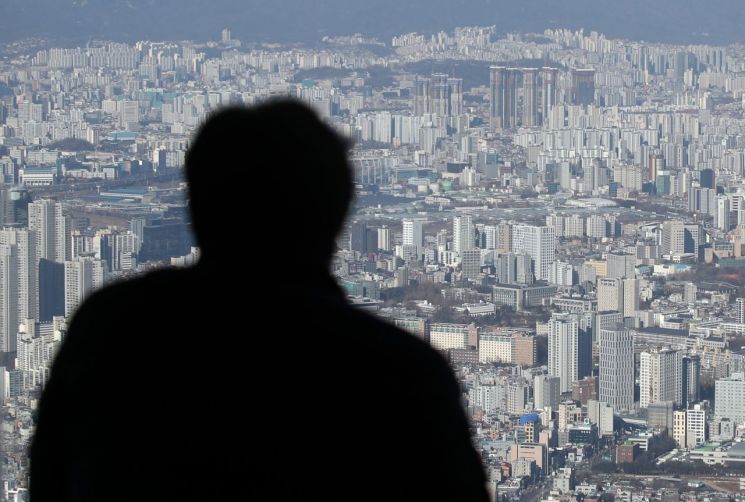
Experts widely agree that the current situation could further dampen real estate buying sentiment. With loan regulations from financial authorities causing Seoul apartment transactions to fall to the 3,000-unit range for two consecutive months, the already sluggish real estate market is now facing added political instability, which may lead more people to delay their purchase timing. A real estate expert who requested anonymity said, "Overall, a wait-and-see attitude is deepening, making a contraction in transactions inevitable."
There are also forecasts that loan interest rates could rise again. Mortgage loan rates have been on a downward trend as the Bank of Korea cut its base rate twice. However, with the declaration and lifting of martial law expanding uncertainty in financial markets, bond yields have begun to rise again. As of the 4th, the 3-year government bond yield recorded 2.626%, up 4.1 basis points from the previous day. When government bond yields rise, the linked financial bonds (bank bonds) yields also increase, which can push loan interest rates back up.
An increase in loan interest rates could further suppress already sluggish transactions. Ko Jong-wan, president of the Korea Asset Management Research Institute, said, "Housing purchase sentiment is bound to decline," adding, "There is a high possibility that real estate purchases will be postponed, and in the long term, this could lead to a decline in sale prices." Yoon Ji-hae, chief researcher at Real Estate R114, said, "The sustainability of the impact is more important than the immediate effects of people rushing to put properties on the market or stopping purchases," adding, "If this situation persists for more than a month, it could have a negative effect on the real estate market."
Current government's housing policy momentum weakens... Supply disruptions possible
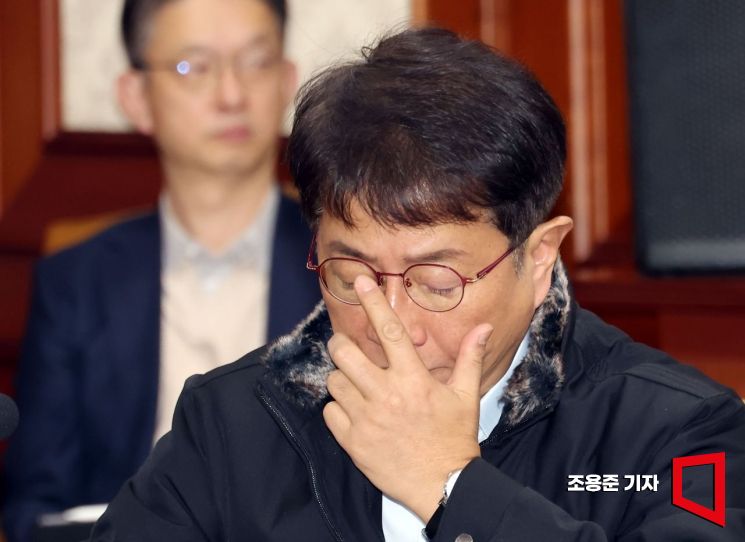 On the 5th, at the Government Seoul Office in Jongno-gu, Seoul, Park Sang-woo, Minister of Land, Infrastructure and Transport, is deep in thought during the first Economic Relations Ministers' Meeting held after the cabinet members expressed their resignation. Photo by Jo Yong-jun
Housing supply has become an even greater source of concern. As domestic politics move toward an impeachment crisis, it is becoming difficult for the Yoon Seok-yeol administration to accelerate various housing policies it has introduced. In particular, bills that have divided opinions between ruling and opposition parties or require parliamentary approval are likely to be indefinitely delayed.
The government is pushing for amendments to special laws to promote reconstruction and redevelopment projects. These include simplifying the procedures for maintenance projects and relaxing floor area ratio and height restrictions to speed up projects. The government also sought to abolish the Reconstruction Excess Profit Recovery System (재초환). All these require legislative amendments and opposition party consent, but with the parliament entering an impeachment crisis, the passage of these laws has become unpredictable.
Housing supply policies such as the reconstruction of first-generation new towns and the release of greenbelt areas have also become more uncertain. The problem is that the domestic housing supply situation could worsen from next year. According to Real Estate R114, the number of housing units available in Seoul next year is expected to decrease by more than 10,000 units compared to the average year. Doo Sung-kyu, head of the Mokmin Economic Policy Research Institute, said, "With the main players responsible for supply unable to perform their roles, the market could become unstable," adding, "The political sphere may also lose its institutional capacity to support this unstable situation, which could exacerbate supply-demand imbalances."
Construction companies also closely monitoring... Will sales be delayed?
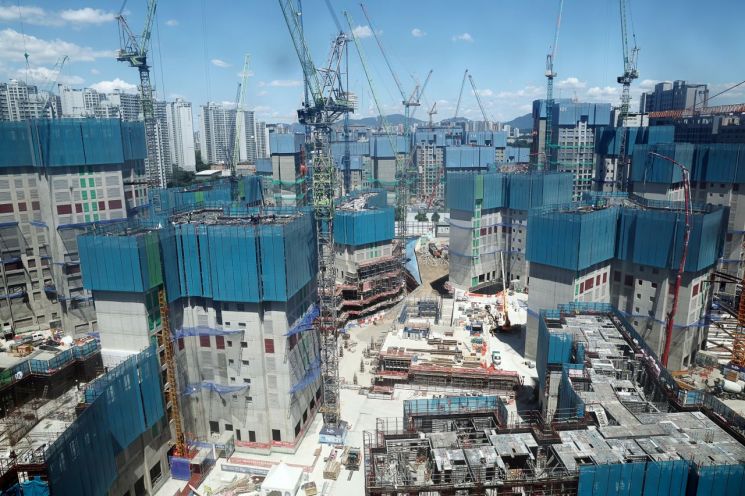
Construction companies are also closely monitoring the situation and reassessing their project schedules. Projects with confirmed sales schedules plan to proceed as planned. However, future sales schedules may be delayed depending on domestic political developments. In fact, one construction company is planning sales within the year but has yet to set a subscription date. A company official said, "The political situation is unsettled, so we are struggling to fix a date."
Unstable exchange rates could further raise raw material costs, potentially leading to future construction cost increases. If construction costs rise, conflicts with maintenance project associations may slow project progress, and a sharp deterioration in cost ratios could negatively affect financial structures. A construction company official lamented, "Exchange rates are beyond our control. It is linked to external credibility."
There are also concerns that overseas order activities may shrink. A construction company official said, "We are explaining to clients that 'there is no problem with the national system, and the company is operating normally,'" adding, "Although the martial law situation ended quickly and was overcome for now, it is true that prolonged political uncertainty is not beneficial."
Future political direction is more important... "Market impact depends on shock intensity and duration"
Experts agree that unlike finance or securities, the real estate market does not immediately fluctuate due to short-term economic changes or political influences. They are focusing on what happens next. The impact on the real estate market will vary depending on when and how the political turmoil triggered by the martial law situation is resolved.
Yoon Soo-min, a real estate specialist at NH Nonghyup Bank, said, "For now, the concern is financial market instability, but if there is a regime change, real estate policies could be completely overturned, such as re-strengthening property taxes," adding, "In that case, the policy changes could cause considerable confusion in the real estate market for some time." Another real estate expert predicted, "The impact on the real estate market depends on the intensity and duration of the shock caused by political turmoil," adding, "If the turmoil prolongs, the damage to the real estate market will deepen."
© The Asia Business Daily(www.asiae.co.kr). All rights reserved.
![Clutching a Stolen Dior Bag, Saying "I Hate Being Poor but Real"... The Grotesque Con of a "Human Knockoff" [Slate]](https://cwcontent.asiae.co.kr/asiaresize/183/2026021902243444107_1771435474.jpg)

















