Treaty Signed, Troop Dispatch, and Ratification Exchange Completed in 6 Months
'Automatic Military Intervention' Clause Revived... Military Alliance Restored
North Korea Claims "Compliance with International Law," Possibility of Official Troop Dispatch
North Korea and Russia have exchanged ratification documents for the 'Comprehensive Strategic Partnership Agreement,' which specifies all-around cooperation. The government is closely monitoring the possibility that North Korea may officially link troop deployment to Russia.
According to the Korean Central News Agency on the 5th, the two sides exchanged ratification documents for the treaty on comprehensive strategic partnership in Moscow the day before. On the North Korean side, Kim Jong-gyu, Vice Minister of Foreign Affairs, and on the Russian side, Andrey Rudenko, Deputy Foreign Minister, signed the protocol for the exchange of ratification documents. With this, the new North Korea-Russia treaty has come into effect.
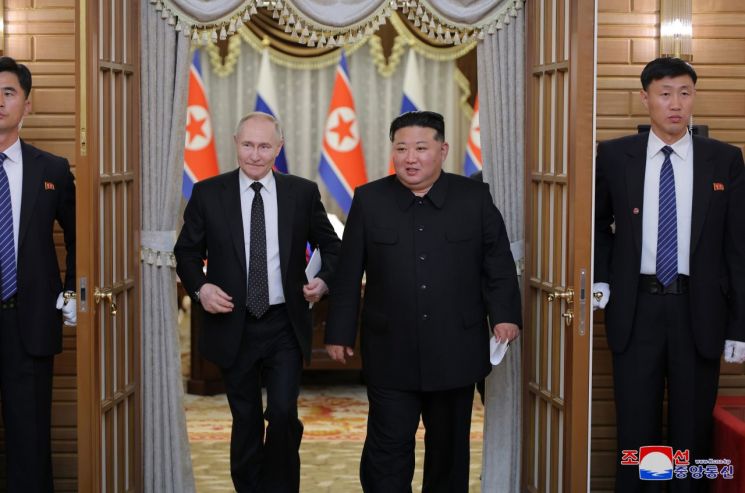 In June this year in Pyongyang, Russian President Vladimir Putin and North Korean Supreme Leader Kim Jong-un met. The photo shows the two moving to the Geumsusan Guesthouse for their talks. Photo by Yonhap News
It has been less than six months. Chairman Kim Jong-un and President Vladimir Putin signed the treaty in mid-June this year in Pyongyang. With the revival of the Soviet-era 'automatic military intervention' clause, analysts say the relationship has effectively been elevated to the level of a military alliance. The Korean Central News Agency described the exchange of ratification documents as "a legal foundation that enables the realization of the grand vision of the national leadership and the aspirations of the people of both countries," and evaluated it as "a powerful security guarantee mechanism that eases regional tensions and ensures international strategic stability."
The close cooperation between the two sides, leading to the signing of a treaty restoring a 'military alliance' and the deployment of North Korean troops, is akin to a 'risky' honeymoon. Rather than a shared-value alliance, it appears to be a partnership formed based on immediate interests.
Russia seems to be aiming to end the attrition warfare in the Kursk region by involving North Korea. North Korea is highly likely to attempt to neutralize UN Security Council sanctions against it based on Russian support. Domestically, it appears North Korea will try to block the influx of external trends centered on jangmadang (marketplaces) and the spread of capitalism by securing capital through Russia. Above all, it is widely assessed that North Korea aims to obtain advanced military technologies necessary for the development of its nuclear forces, such as intercontinental ballistic missiles (ICBMs) and military reconnaissance satellites, as compensation for troop deployment to Russia.
The government is closely watching the possibility that North Korea will link this treaty to troop deployment. North Korea has already claimed in October that if such deployment occurs, "it would be an action in accordance with international legal norms."
© The Asia Business Daily(www.asiae.co.kr). All rights reserved.
![Clutching a Stolen Dior Bag, Saying "I Hate Being Poor but Real"... The Grotesque Con of a "Human Knockoff" [Slate]](https://cwcontent.asiae.co.kr/asiaresize/183/2026021902243444107_1771435474.jpg)















