Korea Investment & Securities analyzed on the 5th that there is a high possibility of increased short-term volatility due to the aftermath of the martial law.
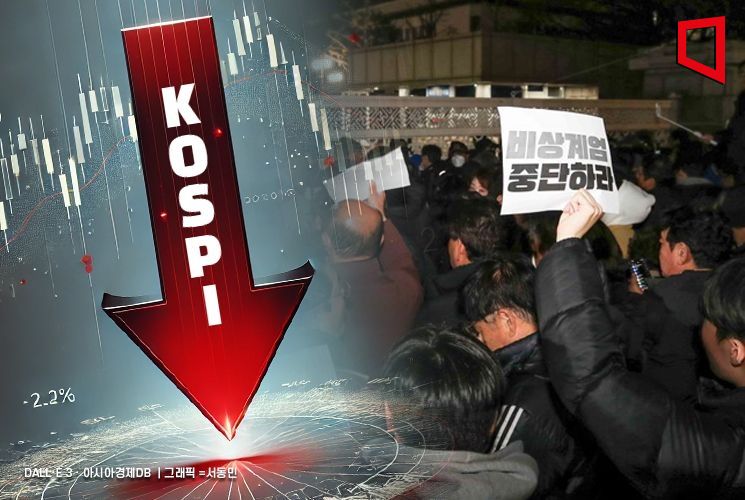
On the 3rd of this month, around 10:30 PM, President Yoon Seok-yeol declared martial law with the purpose of eradicating pro-North Korean anti-state forces and maintaining constitutional order. Martial law, which is declared in times of war, armed conflict, or equivalent national emergencies according to the constitution, was imposed for the first time in 45 years since 1979. However, when the National Assembly passed a resolution demanding the lifting of martial law with the approval of 190 members, a majority of the total members, the declaration was accepted and martial law was lifted six hours after it was proclaimed.
As a result of this aftermath, the KOSPI opened at 2,450.76 points, down 1.97% from the previous trading day. Kim Dae-jun, a researcher at Korea Investment & Securities, explained, "Concerns that political uncertainty would spread throughout the economy adversely affected investor sentiment. However, the decline in the KOSPI was limited as financial authorities including the Ministry of Economy and Finance, the Financial Services Commission, the Financial Supervisory Service, and the Bank of Korea announced emergency measures."
However, he predicted that the KOSPI could be exposed to downward pressure going forward. Researcher Kim said, "Political and economic uncertainties have a negative impact on the country's credit rating in the medium to long term. The likelihood that credit rating agencies will change their outlook on Korea has increased due to this incident." He added, "So far, Korea has maintained an ‘Aa2’ rating, the third highest according to Moody’s, but if there is a change in this rating, the perspective of foreign investors on Korean stocks could also change."
He also forecasted that the trend of foreign investors avoiding the Korean stock market would continue. He evaluated, "Coincidentally, foreign investors have been net sellers of the KOSPI for 14 consecutive weeks, with the scale reaching approximately 19 trillion won. In a situation where credit ratings may fluctuate and the won is rapidly weakening, the avoidance of the Korean stock market by foreign investors could continue."
He analyzed, "Since 2000, when examining the exchange rate, foreign trading trends, and stock returns, net selling by foreigners and index declines have accompanied phases where the exchange rate exceeded 1,400 won. Especially with concerns that the won’s weakening trend will continue for some time, overseas funds are highly likely to withdraw from the domestic stock market."
However, he recommended buying at low prices from a medium to long-term perspective as the KOSPI has become cheaper in terms of valuation. He explained, "It is true that the Korean market has become cheaper in terms of price. Over the past 10 years, the KOSPI’s 12-month forward price-to-earnings ratio (PER) has fluctuated around 10.4 times, but the current valuation multiple is 8.7 times, which is considerably low."
He advised, "Although political uncertainty exists and foreign trading trends are negative, it may be worth attempting to buy at low prices from a medium to long-term perspective. If the index falls below the 2,400 level, gradual buying should be considered."
© The Asia Business Daily(www.asiae.co.kr). All rights reserved.
![Clutching a Stolen Dior Bag, Saying "I Hate Being Poor but Real"... The Grotesque Con of a "Human Knockoff" [Slate]](https://cwcontent.asiae.co.kr/asiaresize/183/2026021902243444107_1771435474.jpg)















