Legislation Committee Debates Ministry of Justice and Prosecutor's Office Audit Request
Joo Jin-woo: "Democratic Party Decides Whether to Prosecute"
Park Ji-won: "How Was Punishment Handled When Police Bureau Was Established?"
As the ruling Democratic Party leads the vote on the impeachment motion against Audit Chief Choi Jae-hae, Seoul Central District Prosecutor Lee Chang-soo, and two other prosecutors in the National Assembly plenary session on the 4th, the ruling party fiercely opposed it, saying it "drives the country into a state of anarchy." The ruling party defined this as a constitutional violation and retaliatory impeachment, and announced a protest rally for the following day. The opposition party countered, calling it "a means to correct abnormality."
On the morning of the 3rd, Jeong Cheong-rae, chairman of the National Assembly Judiciary Committee from the Democratic Party, submitted a request for an audit on the Ministry of Justice, the Prosecutor's Office, and prosecutors for violations of the Constitution and laws at the plenary meeting of the Legislative and Judiciary Committee. This audit request aims to investigate whether prosecutors who opposed the impeachment motion violated their duty of political neutrality.
Earlier, when the Democratic Party-led impeachment motion against the Audit Chief and three prosecutors was reported to the plenary session the previous day, even rank-and-file prosecutors publicly criticized the impeachment as unfair. It is known that they are also considering applying for a suspension of the motion's effect at the Constitutional Court if the impeachment motion passes in the National Assembly.
Joo Jin-woo, a member of the People Power Party, criticized, "If prosecution is done according to the Democratic Party's taste, there is no problem, but if there is no indictment or prosecution, and that is said to be a violation of the prosecutor's duty of diligence, isn't it the same as the Democratic Party deciding whether to prosecute or not?" He added, "The grounds for impeachment (against the Audit Chief and prosecutors) are unprecedentedly excessive in constitutional history."
Joo said, "In the past, prosecutors voluntarily gathered to express opinions to maintain political neutrality, and there was no particular problem with that," and "I think the prosecutors legitimately raised their opinions, and it is very strange to demand an audit."
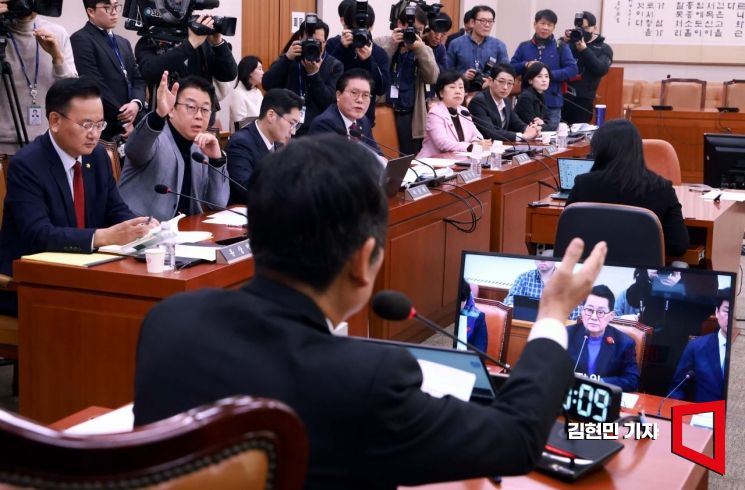 On the 3rd, ruling party lawmakers requested a point of order from Chairman Jeong Cheong-rae during the Legislation and Judiciary Committee plenary session held at the National Assembly. Photo by Kim Hyun-min
In response, Park Ji-won, a Democratic Party lawmaker, said, "All responsibility lies with the president. I have never seen the presidential office and the ruling party harshly threaten and criticize the opposition ahead of the budget National Assembly," and "When the Ministry of the Interior and Safety established the Police Bureau, and the nationwide police chiefs' meeting was held with police opposition, how did the government punish them? I think this collective action by prosecutors is wrong."
Earlier, the government placed former Police Chief Ryu Sam-young, who led the police chiefs' meeting during the establishment of the Police Bureau at the Ministry of the Interior and Safety, on standby, and the Ministry of Education announced a strict response to teachers commemorating Seo Yi-cho. However, it is explained that there are no special measures against the prosecutors' collective action.
The Democratic Party insists that impeachment by the National Assembly is a constitutional authority and a means to correct abnormality, and plans to push forward with the vote on the prosecutors' impeachment motion at the plenary session the next day. According to the National Assembly Act, an impeachment motion must be voted on within 72 hours after 24 hours of reporting to the plenary session, and with the Democratic Party holding a majority of seats, approval is expected. The People Power Party plans to hold a protest rally at the National Assembly the next day and attempt to block the vote.
© The Asia Business Daily(www.asiae.co.kr). All rights reserved.
![Clutching a Stolen Dior Bag, Saying "I Hate Being Poor but Real"... The Grotesque Con of a "Human Knockoff" [Slate]](https://cwcontent.asiae.co.kr/asiaresize/183/2026021902243444107_1771435474.jpg)















