Yoon Han-hong, Chairman of the Political Affairs Committee, Proposes Government Bill on Capital Markets Act
Shift from Concurrent Government Bill on Commercial Act to Amendment of Capital Markets Act
Inevitable Logical Clash with Opposition Emphasizing Amendment of Commercial Act
The government has finalized and disclosed an amendment to the Capital Markets and Financial Investment Services Act (Capital Markets Act) that protects common shareholders. The core of the amendment is to impose 'pinpoint' regulations on issues related to physical division or mergers and acquisitions (M&A). It is expected that a fierce logical battle will unfold between the ruling and opposition parties, as the ruling Democratic Party of Korea (DPK) has proposed comprehensive shareholder protection measures through amendments to the Commercial Act, which differs in approach.
According to the People Power Party (PPP) on the 3rd, Yoon Han-hong, chairman of the Political Affairs Committee (PPP member), will propose an amendment to the Capital Markets Act that includes the complete abolition of valuation standards in mergers between affiliates, mandatory evaluation and disclosure by external appraisal agencies for mergers, and preferential allocation of 20% of public offering new shares to common shareholders when a subsidiary is re-listed after a physical division.
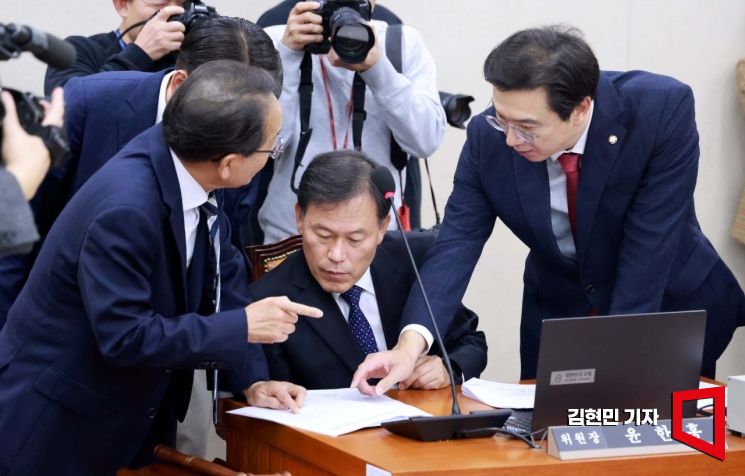 Yoon Han-hong, Chairman of the National Assembly's Political Affairs Committee, along with Kang Min-guk of the People Power Party and Kang Jun-hyun of the Democratic Party, the floor leaders of both parties, are conversing at the full meeting of the Political Affairs Committee held at the National Assembly on the 12th. Photo by Kim Hyun-min
According to our comprehensive reporting (October 15 issue), the government initially internally organized a legislative direction that included a 'duty of effort' in the Commercial Act and supplemented the Capital Markets Act. However, the direction was changed due to concerns from the business community and the ruling party. The ruling party expressed concerns that if the duty of effort were included in the Commercial Act, the number of applicable companies would be 1.02 million, which is far broader than the 2,407 listed companies (as of the end of last year) covered by the Capital Markets Act. Additionally, there were worries that ambiguous provisions would inevitably cause confusion until Supreme Court precedents are established.
Accordingly, the duty of effort, which was intended to be included in the Commercial Act, was redirected to be included in the Capital Markets Act only for cases such as 'mergers or business and asset transfers' to ensure shareholder interests are protected. Most measures to protect shareholder interests, such as abolishing valuation standards during mergers, have been maintained and are included in Chairman Yoon's proposal. In political circles, it is viewed that the ruling party's focus on amending the Capital Markets Act also considered the fact that the Political Affairs Committee is chaired by a ruling party member.
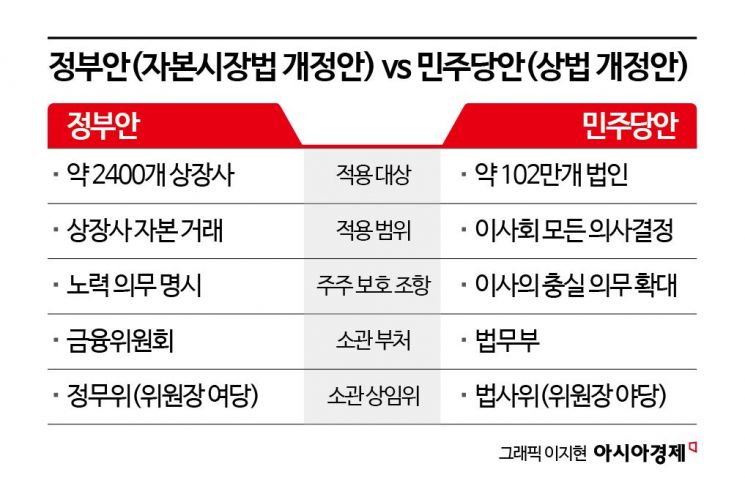
However, the direction of the legal amendment remains uncertain. Above all, the Democratic Party, which holds the key to passing the law, believes that the government’s proposal to amend only the Capital Markets Act has limitations in protecting common shareholders. Kim Nam-geun, a member of the Democratic Party’s 'Task Force (TF) for Revitalizing the Korean Stock Market,' pointed out, "Damage to common shareholders does not occur only in physical divisions or M&A," adding, "The current government proposal alone cannot protect against various types of shareholder damage such as delisting, repaying debt through rights offerings, or controlling shareholders receiving shares at a low price during convertible bond exercises." The Democratic Party currently adopts the amendment to the Commercial Act (proposed by Democratic Party lawmaker Lee Jung-moon) that specifies a 'duty to protect all shareholders' as its party stance. This provision goes beyond expanding directors' duty of loyalty and explicitly mandates the board of directors to make decisions that clearly consider the interests of common shareholders.
The Democratic Party intends to ensure the Commercial Act amendment is passed within the regular session of the National Assembly. The amendment will specify not only the expansion of directors' duty of loyalty but also mandatory cumulative voting for large listed companies with total assets exceeding 2 trillion won, expanded separate election of audit committee members, renaming outside directors as independent directors, and grounds for holding electronic shareholders' meetings. After a closed-door high-level strategy meeting yesterday, Democratic Party chief spokesperson Cho Seung-rae told reporters, "Amending the Commercial Act is essential for revitalizing the domestic stock market," and added, "The government says the Capital Markets Act amendment can resolve stock market issues, but there was consensus that both the Commercial Act and Capital Markets Act need to be amended simultaneously."
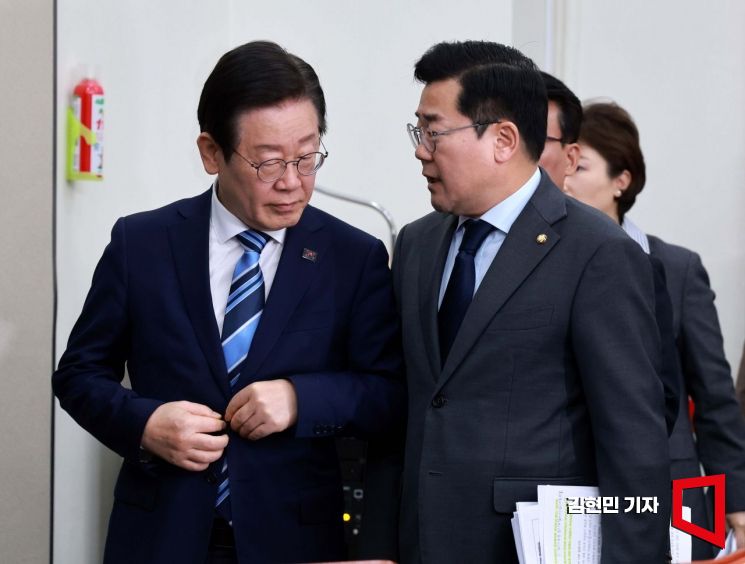 Lee Jae-myung, leader of the Democratic Party of Korea, and Park Chan-dae, floor leader, are attending and conversing at the Supreme Council meeting held at the National Assembly on the 29th. Photo by Kim Hyun-min
Within the Democratic Party, there is also broad consensus on handling the Capital Markets Act, so it is expected that the bill review will proceed on two tracks through the Judiciary Committee and the Political Affairs Committee. The key issue is the extent to which the Commercial Act will be amended. In particular, attention is focused on the choice of Lee Jae-myung, leader of the Democratic Party. At a meeting held on the 28th of last month at the Korea Exchange in Yeongdeungpo-gu, Seoul, Lee stated, "Originally, amending the Capital Markets Act is the correct approach, and it may be desirable to regulate only certain companies," thereby expressing support for amending the Capital Markets Act.
© The Asia Business Daily(www.asiae.co.kr). All rights reserved.
![Clutching a Stolen Dior Bag, Saying "I Hate Being Poor but Real"... The Grotesque Con of a "Human Knockoff" [Slate]](https://cwcontent.asiae.co.kr/asiaresize/183/2026021902243444107_1771435474.jpg)

















