Pat Gelsinger, Effectively Ousted Four Years After Return
Fails to Catch Up with AI Market Competitors
Stagnation Including M&A Deals Mentioned
Also Removed from Dow After 25 Years
Pat Gelsinger, the CEO who was brought in as the savior of the fallen 'semiconductor king' Intel, has ultimately stepped down from his position. During his four-year tenure as CEO, Intel failed to keep pace with competitors amid the artificial intelligence (AI) boom and was even mentioned as a potential merger and acquisition (M&A) target, rapidly descending into decline. It is reported that the board of directors effectively carried out a dismissal-like personnel change.
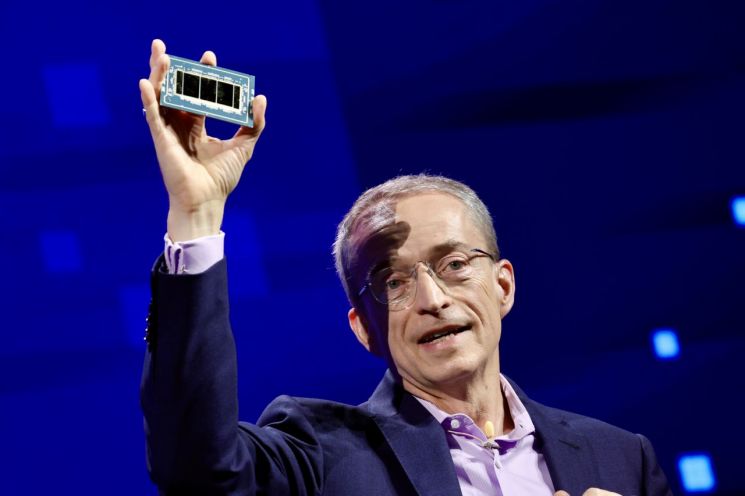
On the 2nd (local time), Intel announced that CEO Gelsinger left the company as of the 1st. Until a new CEO is appointed, Chief Financial Officer (CFO) David Zinsner and Michelle Johnston Holthaus, head of the product division, will serve as interim co-CEOs.
Frank Yeary, the interim chairman of the board, stated, "We know there is much more work to be done at the company," adding, "We are committed to restoring investors' trust."
Bloomberg News, citing sources, reported, "Last week, Gelsinger and the board clashed sharply while discussing plans to regain market share and close the gap with Nvidia," and "Gelsinger had to choose between resigning voluntarily or being dismissed, and was effectively forced out by the board that lost confidence in his plans."
Former CEO Gelsinger is a prominent figure in the semiconductor industry who was brought in as a savior in 2021 to lead Intel's reconstruction. He joined Intel as an engineer at age 18 in 1979, rose to Chief Technology Officer (CTO), and left the company in 2009. After serving as CEO of VMware and other roles, he returned to Intel as CEO in February 2021. He was tasked with rescuing Intel, which had once dominated the semiconductor industry as the top IT company with a 90% market share in personal computer central processing units (CPUs) in the 1990s. However, Intel fell far behind after failing to quickly respond to the market shift toward mobile devices following the introduction of the iPhone in the mid-to-late 2000s. After becoming Intel’s head, Gelsinger invested tens of billions of dollars in the foundry (semiconductor contract manufacturing) business to revive the company but failed to succeed against competitors like Samsung Electronics and TSMC. Even amid the AI boom, Intel could not find opportunities, and its business stagnated.
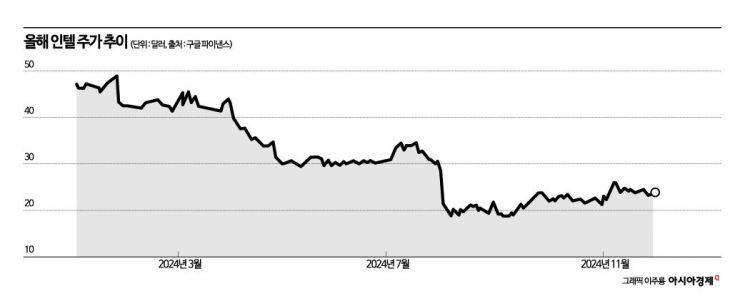
As a result, Intel's stock price plummeted 52% just this year, and the company suffered the humiliation of being removed from the Dow Jones Industrial Average (Dow Index) after 25 years of inclusion.
Intel eventually announced a large-scale restructuring plan, including a 15% workforce reduction next year and $10 billion in cost savings. In the fourth quarter of fiscal year 2024, it will not pay dividends and plans to cut annual capital expenditures by more than 20%. The worsening management difficulties even led to reports in September that Qualcomm might acquire Intel, marking a rapid decline.
One week before Gelsinger’s dismissal, Intel secured a subsidy of $7.86 billion from the Biden administration for factory construction under the CHIPS and Science Act (CSA).
Former CEO Gelsinger said, "This company has been my life for most of my working career," adding, "I made difficult but necessary decisions for Intel in line with current market dynamics. It has been a tough year for all of us."
CNBC reported, "Intel lost market share in its core business and failed to pioneer the AI market, falling into a prolonged slump," and "Once the top semiconductor company in the U.S., Intel’s stock price and market share further plummeted during Gelsinger’s tenure, which ended nearly four turbulent years."
There are also forecasts that Intel will find it difficult to find a successor to former CEO Gelsinger. Bloomberg News stated, "The next CEO will face the same issues that Gelsinger had to fix, including the fallout from wrong decisions made by predecessors," adding, "The next CEO must compete against rivals with more resources, catch up in AI computing, and demonstrate that Intel can once again be a groundbreaking company as it once was." It further noted, "What was once one of the most coveted jobs in the semiconductor industry has now become a position that is almost impossible to maintain."
© The Asia Business Daily(www.asiae.co.kr). All rights reserved.
![Clutching a Stolen Dior Bag, Saying "I Hate Being Poor but Real"... The Grotesque Con of a "Human Knockoff" [Slate]](https://cwcontent.asiae.co.kr/asiaresize/183/2026021902243444107_1771435474.jpg)
















