An analysis has emerged that the core inflation rate next year will stabilize slightly below 2%.
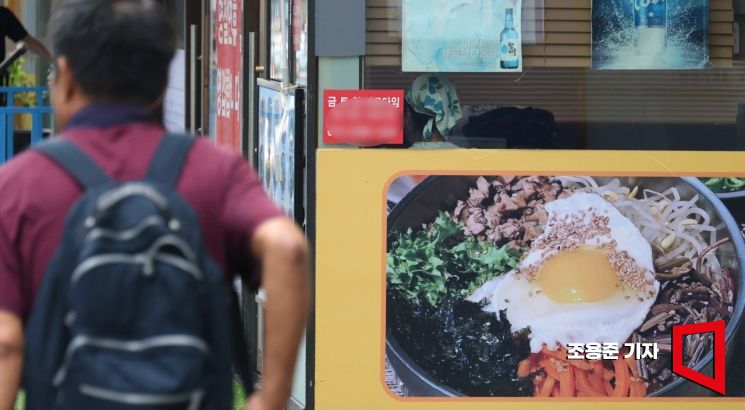 With the rise in prices in the Seoul area, the prices of dining-out menus have been steadily increasing, with representative dishes such as gimbap, bibimbap, and kalguksu rising last month. The photo shows a snack bar in a downtown Seoul shopping district on the 12th. Photo by Jo Yongjun jun21@
According to the report titled 'Future Inflation Trends Seen Through Domestic Demand-Sensitive Prices' released by the Bank of Korea on the 31st, the core inflation rate is expected to maintain a stable trend at the current level without significant deceleration.
Among the components of core inflation, the inflation rate of 'domestic demand-sensitive prices,' which has a high correlation with domestic demand, is expected to gradually increase with a time lag due to consumption recovery, and 'domestic demand-insensitive prices' are also exceeding the target level. Considering that public utility charges, which have been restrained from rising so far, are expected to increase, the core inflation rate next year is analyzed to stabilize slightly below 2%.
Domestic demand-sensitive prices are estimated by including items within core inflation that respond sensitively to changes in domestic consumption. In particular, dining-out items such as chicken, samgyeopsal (pork belly), coffee, and personal services such as academy fees and lesson charges account for a high proportion. Domestic demand-sensitive prices lag domestic consumption by about 1 to 2 quarters, with dining-out items identified as a major factor influencing changes in domestic demand-sensitive prices.
The inflation rate of domestic demand-sensitive prices has continued to slow down, recently dropping to the mid-1% range. This is closely related to the decreased domestic consumption. Domestic consumption showed a significant increase for a considerable period after 2021 but slowed down from the second half of last year as the effects of monetary tightening took hold. This was due to the rapid deceleration of dining-out prices, which have a high weight within domestic demand-sensitive prices. Thus, the recent slowdown in domestic demand-sensitive prices appears to be influenced by reduced domestic demand pressure.
Going forward, the inflation rate of domestic demand-sensitive prices is expected to gradually rise with a time lag as consumption recovers. Private consumption, which had been sluggish, is expected to recover around 2% as household consumption capacity improves, and accordingly, domestic demand-sensitive prices are also expected to stabilize at a higher level than currently. The price inflation rates of detailed items within domestic demand-sensitive prices have also stabilized around 2% since the beginning of this year.
Bu Yushin, head of the Price Trends Team at the Bank of Korea’s Research Department and author of the report, stated, "The core inflation rate is expected to maintain a stable trend near the current level without further significant deceleration," and evaluated that "the core inflation rate next year will stabilize slightly below 2%."
© The Asia Business Daily(www.asiae.co.kr). All rights reserved.
![Clutching a Stolen Dior Bag, Saying "I Hate Being Poor but Real"... The Grotesque Con of a "Human Knockoff" [Slate]](https://cwcontent.asiae.co.kr/asiaresize/183/2026021902243444107_1771435474.jpg)















