Blame Game Outside Standing Committee Chair
Speaker Designates 35 Supplementary Bills for Revenue Budget Bill
The National Assembly's Strategy and Finance Committee held a tax subcommittee and a full meeting on the 29th to process tax law amendments related to the budget bill, but the sessions were disrupted due to differences of opinion over the postponement of virtual asset taxation.
According to the National Assembly on the 29th, the Strategy and Finance Committee's tax subcommittee, which was scheduled to be held in the morning, did not take place, leading to the subsequent cancellation of the full committee meeting.
Under current law, virtual asset taxation is set to begin in January next year. The government proposed a bill to postpone it by two years, and the People Power Party submitted a bill to delay it by three years. However, the Democratic Party opposed the postponement and instead proposed raising the deduction amount from 2.5 million won to 50 million won, but ultimately the two sides failed to reach an agreement.
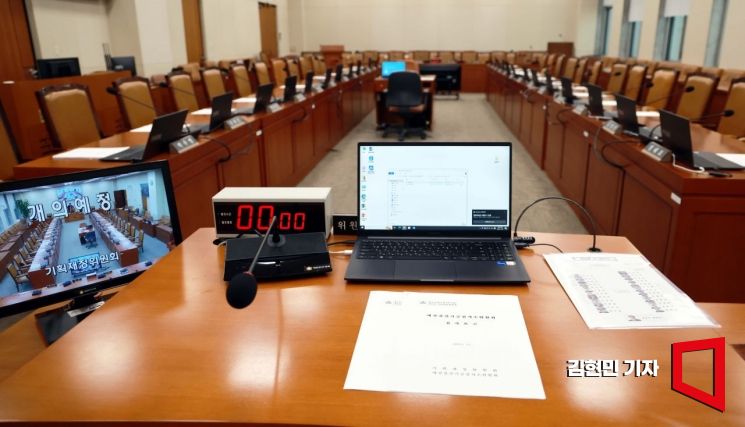 The National Assembly's Planning and Finance Committee meeting room was empty on the 29th. On this day, the committee was scheduled to hold a tax subcommittee and a plenary session to handle tax law amendments related to the budget bill, but it could not be held due to disagreements between the ruling and opposition parties. Photo by Kim Hyun-min
The ruling and opposition parties engaged in a blame game at the National Assembly's communication office rather than at the standing committee chair's office. Democratic Party lawmakers, including Jeong Tae-ho, the opposition whip of the Strategy and Finance Committee, held a press conference at the National Assembly and criticized, "The meeting could not be held due to the ruling party's unilateral cancellation of the agreement."
Jeong explained that he had negotiated with Park Soo-young, the People Power Party whip, until late the previous evening on 13 tax laws, stating, "Through the tax subcommittee and consultations between the whips, it was finally agreed that agreed matters would be included in the Strategy and Finance Committee's alternative, and matters not agreed upon would not be included in the committee's alternative, and based on this agreement, the administrative office prepared the committee's alternative for the 13 bills." He added that the alternative was to be submitted to the plenary session as a supplementary bill to next year's budget and approved at the committee meeting that day, but the People Power Party notified that they could not hold the meeting because the content they wanted was not included.
Jeong also emphasized, "As a result, the Strategy and Finance Committee could not approve the 13 tax laws, making it impossible to submit the committee's alternative to the plenary session," and recalled, "Previously, the ruling party unilaterally passed tax laws in just 1 minute and 20 seconds without the participation of Democratic Party lawmakers."
On the other hand, the People Power Party claimed that the Democratic Party paralyzed the standing committee by refusing to process livelihood bills such as the postponement of virtual asset taxation.
People Power Party lawmakers, including Park Soo-young, the whip of the Strategy and Finance Committee, held a counter press conference at the National Assembly communication office, criticizing, "The major opposition party's forceful tactics have started again ahead of the passage of key livelihood bills such as the abolition of the financial investment income tax." Park said, "After November 30, supplementary revenue bills will be automatically submitted to the plenary session, and no further discussion can take place in the Strategy and Finance Committee," emphasizing, "The majority party, the Democratic Party, is paralyzing the standing committee by saying that no bills can be processed in the committee unless the government and ruling party follow their desired direction."
Park claimed that regarding three bills?the Income Tax Act (postponement of virtual asset taxation), the Inheritance and Gift Tax Act (inheritance tax relief), and the Restriction of Special Taxation Act (separate taxation of dividend income)?"For two days, the People Power Party tried to persuade the Democratic Party to process the 11 tax laws without disputes at the standing committee today, even if the three bills were to be negotiated between the floor leaders of both parties, but the Democratic Party rejected even this."
Song Eon-seok, chair of the Strategy and Finance Committee from the People Power Party, held a press briefing and said, "Even at this moment, if an agreement is reached between the whips on the tax laws, the full committee meeting can be held at any time. Physically, all possibilities are open."
Chairman Woo Won-sik Designates 35 Supplementary Bills Related to Income Tax Act and Budget Bill
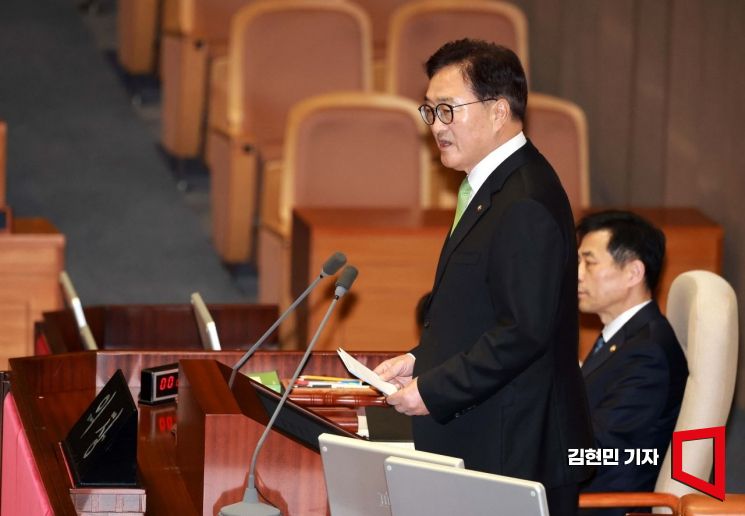 Speaker Woo Won-shik is speaking ahead of the policy speech on the 2025 budget proposal and fund management plan held at the National Assembly on the 4th. Photo by Kim Hyun-min
In response, Woo Won-sik, Speaker of the National Assembly, designated 13 tax law amendments submitted by the government, including the Income Tax Act, Corporate Tax Act, and Restriction of Special Taxation Act, along with 22 bills proposed by lawmakers, totaling 35 supplementary bills related to the 2025 revenue budget. These were notified to six relevant standing committees, including the Strategy and Finance Committee, and the Legislation and Judiciary Committee. If the Strategy and Finance Committee fails to review and approve them by the 30th of this month, they will be automatically submitted to the plenary session on the 1st of next month along with the original government budget bill.
The Income Tax Act amendments designated by Speaker Woo include the abolition of the financial investment income tax, tax exemption for corporate childbirth support funds, and a two-year postponement of virtual asset taxation. The amendments to the Inheritance and Gift Tax Act include lowering the top inheritance tax rate from 50% to 40% and raising the child deduction from 50 million won to 500 million won. Additionally, the Industrial Technology Innovation Promotion Act, aimed at strengthening competitiveness in materials, parts, and equipment (SoBuJang), is also included.
Speaker Woo emphasized the importance of the relevant standing committees' review of the supplementary revenue bills and urged, "Even after these bills are submitted to the plenary session, both ruling and opposition parties should continue negotiations to ensure they can be passed in the plenary session within the constitutional deadline (December 2nd). Please do your best."
© The Asia Business Daily(www.asiae.co.kr). All rights reserved.
![Clutching a Stolen Dior Bag, Saying "I Hate Being Poor but Real"... The Grotesque Con of a "Human Knockoff" [Slate]](https://cwcontent.asiae.co.kr/asiaresize/183/2026021902243444107_1771435474.jpg)
















