Impact of Weakened Trump Trade on Dollar Strength
Effect of Bank of Korea Governor Lee Chang-yong's Commitment to Managing Exchange Rate Volatility
Concerns Over Long-Term Weakening of Won Value
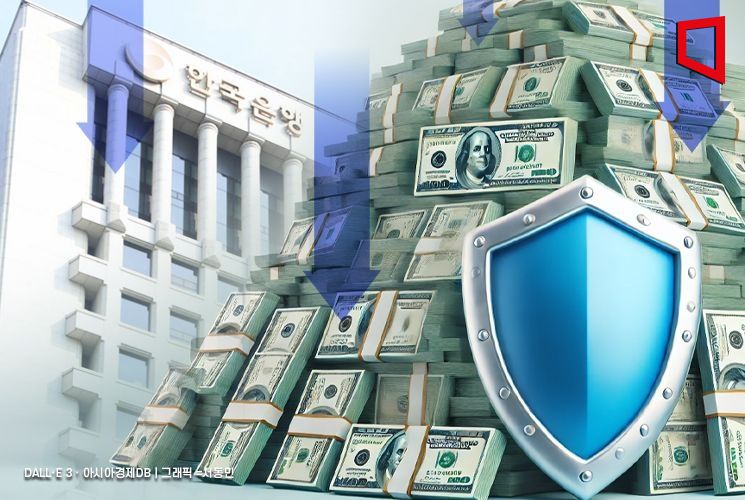
Despite the Bank of Korea's surprise interest rate cut, the won-dollar exchange rate has fallen, showing stability in the foreign exchange market. This is interpreted as a result of the recent pause in the dollar's strength and the Bank of Korea's strong expression of its intention to manage the exchange rate. However, as the Bank of Korea hinted at further rate cuts, concerns remain that the won-dollar exchange rate could surpass 1,400 won again at any time, increasing foreign exchange volatility.
On the 29th, in the Seoul foreign exchange market, the won-dollar exchange rate opened at 1,394.4 won, down 1.2 won from the previous trading day. The exchange rate, which was in the 1,402 won range on the 25th, has fallen for four consecutive trading days from the 26th to the 29th and is currently fluctuating in the mid-1,390 won range.
Contrary to market expectations that the base rate would be held steady, the exchange rate remained stable despite the Bank of Korea cutting the base rate by 0.25 percentage points the previous day. Initially, both the Bank of Korea and the market identified the exchange rate as the biggest risk factor of the rate cut. There were concerns that lowering the rate would widen the interest rate gap with the U.S., causing dollar outflows and pushing the exchange rate higher.
The reason the foreign exchange market has remained stable contrary to expectations is analyzed to be due to the recent lull in the so-called "Trump Trade," a phenomenon where assets flow into the U.S., which has weakened the dollar's strength. The dollar index, which measures the dollar's value against six major currencies, rose about 4% after former U.S. President Donald Trump's election earlier this month but has recently declined for two consecutive days, tempering the dollar's strength. Park Sang-hyun, a specialist at iM Securities, evaluated, "The recent pause in the Trump Trade has led to a weakening of the U.S. dollar, which appears to offset the impact of the Bank of Korea's rate cut."
Many also assess that the release of export companies' negotiation volumes (dollar sales) ahead of the month-end settlement has limited the rise in the exchange rate. Min Kyung-won, an economist at Woori Bank, predicted, "With the month-end approaching, export companies' negotiation volumes are expected to dominate supply and demand in the foreign exchange market," adding, "Since there is a large volume of pending transactions, the exchange rate rise will not be significant."
The Bank of Korea's strong indication of managing foreign exchange market volatility is also a factor limiting the exchange rate increase. Bank of Korea Governor Lee Chang-yong emphasized at a press conference the previous day, "We have sufficient foreign exchange reserves to manage exchange rate volatility," and added, "We are discussing expanding the amount and extending the duration of the foreign exchange swap with the National Pension Service, which will also help manage exchange rate volatility."
However, there are also claims that the Bank of Korea's faster-than-expected rate cuts could lead to increased exchange rate volatility in the future. In particular, since the Bank of Korea forecasted next year's economic growth rate at 1.9%, below the potential growth rate, signaling low growth, some analysts believe a decline in the won's value is inevitable.
Lee Min-hyuk, an economist at KB Kookmin Bank, stated, "The Bank of Korea's projection of South Korea's economic growth rate for next year and the year after below the potential growth rate of 2% means that the fundamentals of the Korean economy and the won are declining in the long term," and added, "I expect the exchange rate to remain at a high level at least until the first half of next year."
Specialist Park also pointed out, "Since the trend of rate cuts is expected to continue, upward pressure on the exchange rate has clearly strengthened, and there is a possibility of increased volatility in the future."
© The Asia Business Daily(www.asiae.co.kr). All rights reserved.
![Clutching a Stolen Dior Bag, Saying "I Hate Being Poor but Real"... The Grotesque Con of a "Human Knockoff" [Slate]](https://cwcontent.asiae.co.kr/asiaresize/183/2026021902243444107_1771435474.jpg)















