Ecopro BM Submits Application for Listing Transfer
Posco DX, L&F, Paradise to Transfer to KOSPI This Year
Significant Stock Price Decline After Listing Transfer
Stock Price Can Rise Post-Transfer Only with Strong Fundamentals
EcoPro BM, the second-largest company by market capitalization on KOSDAQ, has initiated the process of transferring its listing to the KOSPI market. It is expected to enter the KOSPI as early as February next year. Given that the stock prices of companies that previously transferred listings have significantly underperformed expectations, attention is focused on whether EcoPro BM can show a different trend.
According to the Korea Exchange on the 29th, EcoPro BM closed at 144,400 KRW, up 6.8% from the previous day. This stock price increase appears to reflect expectations for the transfer listing to the KOSPI market.
EcoPro BM submitted a preliminary review application for the transfer listing to the Korea Exchange on the 27th. Earlier, at the shareholders' meeting in March, EcoPro BM had resolved to proceed with the transfer listing. Although the initial plan was to complete the transfer within this year, delays have pushed the transfer to next year.
According to regulations, the Korea Exchange must complete the listing review within 45 business days after receiving the preliminary review application for the transfer listing, and considering that the listing occurs about one week after the review is completed, EcoPro BM is expected to enter the KOSPI market as early as February next year.
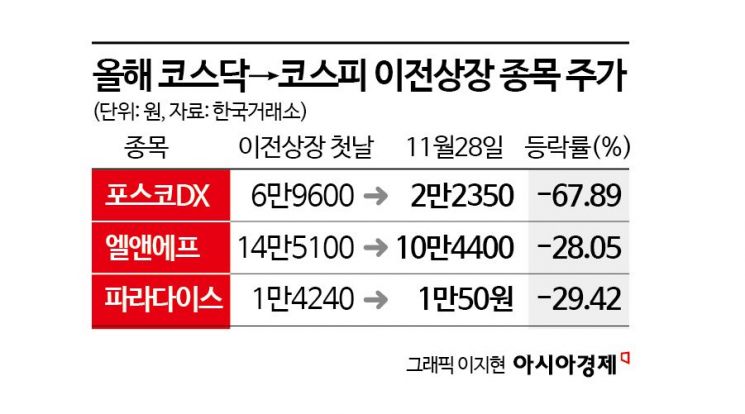
While the stock price has risen due to expectations of the transfer listing, it is difficult to guarantee a strong stock price after the transfer. This is because the stock price trends of companies that transferred earlier this year have fallen short of expectations.
Posco DX, which entered the KOSPI market on the first day of this year, saw its stock price drop by 67.89% after the transfer listing. The stock price, which was approaching 70,000 KRW at the time of transfer, has now fallen to the 20,000 KRW range. Similarly, L&F, which moved at the end of January, is in a similar situation. The stock price, which exceeded 200,000 KRW at the beginning of the year, has halved to the 100,000 KRW range, falling 28.05% after the transfer listing. Paradise, which entered the KOSPI market in June, dropped 29.42% after the transfer listing. The stock price, which was in the 14,000 KRW range, has continuously declined since the transfer. On the 15th of this month, it even fell to 9,000 KRW during trading, marking a 52-week low. Although it rebounded after hitting the low and has recently maintained an upward trend, it has not escaped the low 10,000 KRW range.
Generally, moving from KOSDAQ to KOSPI is considered positive for stock prices due to expected benefits such as corporate value re-evaluation and expanded investor base leading to improved supply and demand. However, recently, the news of transfer listings has acted as a short-term positive before the transfer, but stock prices have mostly been weak after the transfer. Bae Cheol-kyo, a researcher at NH Investment & Securities, analyzed, "There are several supply and demand advantages to KOSPI listing, such as inclusion in the KOSPI 200 index and demand from pension funds. Since the supply and demand effect from KOSPI transfer listing is perceived as positive, stocks pursuing transfer listings tend to show favorable stock price trends before listing, but recently transferred stocks have tended to underperform KOSPI after listing." He added, "There is also a tendency for short-term profit-taking selling to occur immediately after listing in proportion to transfer listing expectations."
Expectations for the transfer listing may only have a short-term impact, so ultimately, the company's fundamentals are important. Kim Dong-young, a researcher at Samsung Securities, said, "The transfer listing does not change the company's internal financial or stock structure; it is purely an event of changing the market affiliation, so it should be remembered as a purely supply and demand event. While supply and demand issues are important in the short term, looking at the stock price trend from a long-term perspective, it can be confirmed that it is more linked to the company's fundamental factors."
In fact, secondary battery stocks such as Posco DX and L&F have experienced poor performance this year due to a downturn in the industry. Posco DX recorded sales of 318.6 billion KRW and operating profit of 26.3 billion KRW in the third quarter of this year, representing decreases of 10.1% and 18.3%, respectively, compared to the same period last year. L&F posted an operating loss of 72.4 billion KRW in the third quarter, turning to a deficit. Sales dropped 72% to 351.6 billion KRW.
Paradise's third-quarter sales were 268.2 billion KRW, down 6.1% year-on-year, and operating profit decreased by 36.6% to 36.2 billion KRW.
EcoPro BM is also experiencing poor performance, so the possibility that it will follow the path of previously transferred stocks cannot be ruled out. EcoPro BM recorded an operating loss of 41.2 billion KRW in the third quarter, turning to a deficit. Poor performance is expected to continue into the fourth quarter. Joo Min-woo, a researcher at NH Investment & Securities, said, "EcoPro BM's fourth-quarter sales are expected to be 438.4 billion KRW, down 63% year-on-year, and operating loss of 23.2 billion KRW, falling short of consensus (average securities firm forecast). Due to inventory adjustments by upstream customers, sales volume is expected to decrease by 9%, and prices to fall by 8%. Lithium price stabilization is expected to begin from the second quarter of next year, and the price and profitability of cathode materials are expected to stabilize from the third quarter of next year."
© The Asia Business Daily(www.asiae.co.kr). All rights reserved.
![Clutching a Stolen Dior Bag, Saying "I Hate Being Poor but Real"... The Grotesque Con of a "Human Knockoff" [Slate]](https://cwcontent.asiae.co.kr/asiaresize/183/2026021902243444107_1771435474.jpg)















