Advanced Semiconductor Mass Production-Linked Mini Fab Infrastructure Project Passes Preliminary Feasibility Study
Scheduled for Installation at SK Hynix Yongin Semiconductor Cluster
Expected to Strengthen Competitiveness of SoBuJang Companies
A 'minifab' where domestic material, parts, equipment, and semiconductor-related companies jointly develop advanced semiconductors and conduct performance verification will be established for the first time in Korea. It is expected to be an important turning point for expanding the competitiveness of the Korean semiconductor industry.
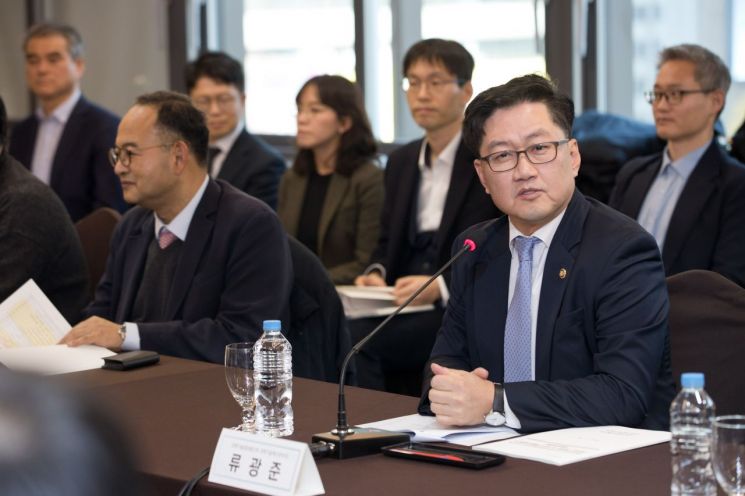 Ryu Gwang-jun, Director General of the Science and Technology Innovation Bureau at the Ministry of Science and ICT, is presiding over the "8th National Research and Development Project Evaluation Committee" held on the afternoon of the 28th at the Koreana Hotel in Jung-gu, Seoul. Photo by Ministry of Science and ICT
On the 28th, the Ministry of Science and ICT held the '8th National Research and Development Project Evaluation General Committee of 2024,' chaired by Ryu Gwang-jun, Director of the Science and Technology Innovation Headquarters, and confirmed the preliminary feasibility study (PFS) pass of the 'Advanced Semiconductor Mass Production-Linked Minifab Infrastructure Construction Project,' which was selected as the 4th PFS target in 2023, as well as the selection results of eight projects for the 3rd National Research and Development (R&D) project PFS in 2024.
The 'Advanced Semiconductor Mass Production-Linked Minifab Infrastructure Construction Project' by the Ministry of Trade, Industry and Energy, which passed the PFS, involves installing a minifab at the SK Hynix semiconductor cluster in Yongin, Gyeonggi Province. It will establish process and measurement equipment used in semiconductor mass production and provide continuous support for performance verification, evaluation, and consulting of products developed by material, parts, and equipment companies.
The goal is to build infrastructure that supports all demonstration work so that technologies and products developed by material, parts, and equipment companies can be rapidly applied to semiconductor mass production.
Although the confirmed project budget was about half of the initially requested amount, at 446.9 billion KRW, the Ministry of Science and ICT explained that this was because the calculation did not include private sector contributions to protect corporate trade secrets. Including the private sector portion, the project is expected to proceed at the original scale.
The Korean-style hydrogen reduction steelmaking demonstration technology development project and the pan-government advanced medical device R&D project were selected as targets for preliminary feasibility studies.
The Korean-style hydrogen reduction steelmaking demonstration technology development project is the world's first to demonstrate 300,000 tons-class hydrogen reduction steelmaking based on a spectroscopic hydrogen fluidized reduction furnace to achieve carbon neutrality in the steel sector.
This technology applies a method of injecting powdered iron ore and hydrogen reducing agents into a fluidized reduction furnace multiple times instead of charging iron ore and coke into a blast furnace.
The pan-government advanced medical device R&D project aims to reduce overseas dependence by supporting the entire lifecycle of advanced medical device development through collaboration among the Ministry of Science and ICT, Ministry of Trade, Industry and Energy, Ministry of Health and Welfare, and Ministry of Food and Drug Safety.
Meanwhile, the General Committee decided to select and conduct preliminary feasibility studies on unique mission-type continuous projects that scale up small fragmented projects pursued by ministries into program projects, in accordance with the R&D innovation plan announced by the government last year. The eight projects selected for PFS will undergo about seven months of investigation before deciding on implementation.
On this day, the General Committee also approved institutional improvements to expand the application of specific evaluations for changes in PFS project plans to all projects that pass PFS, allow year-round rolling submissions, and shorten evaluation periods for minor changes.
Ryu Gwang-jun, Director of the Science and Technology Innovation Headquarters at the Ministry of Science and ICT, said, "We have newly selected urgent projects responding to national issues and program-type projects requiring continuous government investment as PFS targets. We will conduct rapid investigations to ensure that large projects proceed on schedule, and we will also proceed without delay with the abolition of R&D PFS and the establishment of follow-up systems."
© The Asia Business Daily(www.asiae.co.kr). All rights reserved.
![Clutching a Stolen Dior Bag, Saying "I Hate Being Poor but Real"... The Grotesque Con of a "Human Knockoff" [Slate]](https://cwcontent.asiae.co.kr/asiaresize/183/2026021902243444107_1771435474.jpg)















