Passed with 171 out of 272 members present in favor
If review is not completed by November 30
The chairperson must agree with the negotiation group representative
The National Assembly is expected to abolish the 'automatic referral system for budget bills to the plenary session,' which automatically refers the budget bill to the next plenary session if the review of the budget bill and related tax bills is not completed by November 30.
On the 28th, the National Assembly passed a partial amendment to the National Assembly Act containing this provision with 171 votes in favor and 101 against out of 272 members present.
According to the current law, the National Assembly must complete the review of the budget bill by November 30, and if the review is not completed by the deadline, the government's original bill is immediately referred to the plenary session the next day.
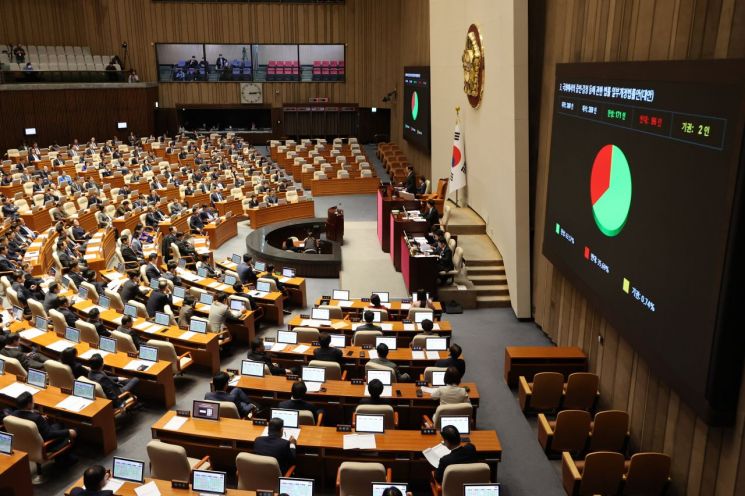
In 2014, as part of the National Assembly Advancement Act to prevent late processing of the budget bill, a system was introduced whereby if the ruling and opposition parties fail to complete the budget review by November 30, the original budget bill and related bills such as tax law amendments submitted by the government are automatically referred to the National Assembly plenary session. Although the Constitution stipulates that the National Assembly must complete the budget bill process by December 2, which is 30 days before the start of the next fiscal year, the budget bills for 2013 and 2014 were barely processed on January 1 of the following year, and the year-end tug-of-war over the budget became routine, repeatedly causing quasi-budget formation crises. With the passage of the amendment, the Speaker will now be able to refer the budget bill and others to the plenary session by agreement with the representatives of each negotiation group.
The People Power Party opposed the amendment, calling it a law that promotes unconstitutionality. Bae Jun-young, the senior deputy floor leader of the People Power Party, said during the debate, "The National Assembly can prevent the budget from becoming a hostage to political negotiations through the automatic referral of the budget and related bills, pass it in a timely manner to resolve uncertainty, and regain the trust of the people," adding, "The ruling Democratic Party's forced amendment to the automatic referral system is an attempt to return to the darkness of 10 years ago."
Bae further criticized, "Since the inauguration of the Yoon Seok-yeol government, the Democratic Party, seemingly unable to accept defeat in the presidential election, has repeatedly delayed the budget approval date to December 21 and 24, obstructing national stability," and said, "Now, entering the 22nd National Assembly, they are going further by abolishing the system, completely ignoring the constitutional deadline for budget approval and trying to shake the country." He added, "The National Assembly is instead obstructing the budget process, undermining the principle of the rule of taxation law, and threatening to halt the nation's finances," and pointed out, "This is a law that effectively promotes unconstitutionality by violating the National Assembly's obligation to comply with the budget approval institution stipulated in Article 54 of the Constitution and deciding budget approval at its own discretion."
On the other hand, the opposition parties argued that the government budget and tax laws are a 'free pass' system, and since the president's veto power is not recognized, it is inappropriate that the national budget for the next year is finalized solely by the National Assembly plenary session's resolution. Im Kwang-hyun, a member of the Democratic Party of Korea, said, "The so-called National Assembly Advancement Act amended in 2012 improved physical clashes in the National Assembly but weakened the National Assembly's review authority over the budget and tax laws," and criticized, "The government and ruling party, keeping automatic referral in mind, consistently take a defensive and passive attitude during the tax law review process, and the expedited procedure tends to result in the review proceeding according to the government's intentions."
© The Asia Business Daily(www.asiae.co.kr). All rights reserved.
![Clutching a Stolen Dior Bag, Saying "I Hate Being Poor but Real"... The Grotesque Con of a "Human Knockoff" [Slate]](https://cwcontent.asiae.co.kr/asiaresize/183/2026021902243444107_1771435474.jpg)















