Expansion of Support for the Birth of Quintuplet Premature Babies
Presidential Office: "First Ever Specialized Measures for Premature Babies"
Medical Expenses Up to 20 Million KRW, Increased Medical Staff Fees
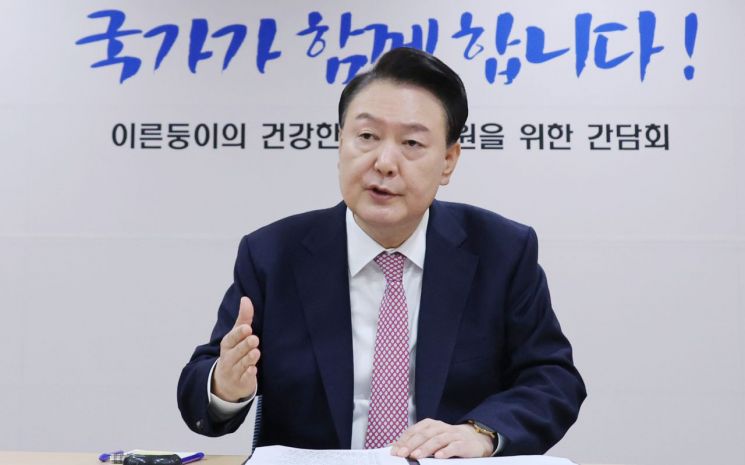 President Yoon Suk-yeol is speaking at the 'Meeting to Support the Healthy Growth of Premature Infants' held on the 28th at Seoul St. Mary's Hospital. Photo by Yonhap News
The Presidential Office recently decided to significantly increase support for premature infants, prompted by the birth of the country's first naturally conceived quintuplets. Two new central severe maternal and neonatal medical centers will be established to treat critically ill mothers and newborns, and medical expense support will be expanded up to 20 million KRW, doubling the current maximum.
On the afternoon of the 28th, Yoo Hyemi, the Chief of Low Birthrate Policy at the Presidential Office, held a briefing at the Yongsan Presidential Office and announced a customized support plan for premature infants.
Chief Yoo said, "This year, prompted by the quintuplets, we have prepared a comprehensive plan covering the entire process of safe delivery, treatment, development, and care of premature infants," adding, "This plan is the first-ever low birthrate policy specialized for premature infants."
Premature infants refer to babies born before 37 weeks of gestation or weighing less than 2.5 kg at birth. As of last year, there were about 28,000 premature births, accounting for approximately 12.2% of all births.
Earlier that day, President Yoon Suk-yeol visited Seoul St. Mary's Hospital, where the quintuplets are hospitalized, and promised to greatly strengthen support for the entire process of premature birth, treatment, and care.
Chief Yoo conveyed, "The President himself was born as a premature infant weighing 2.3 kg and said he feels especially heartfelt when seeing premature babies," adding, "Ensuring that children grow up healthy is the most fundamental responsibility of the nation and society, and the government will significantly expand various investments going forward."
First, the Presidential Office will strengthen integrated treatment infrastructure for high-risk mothers and newborns. Currently, there are 20 integrated treatment centers for high-risk mothers and newborns and 50 neonatal intensive care regional centers in operation, but there have been many criticisms about the lack of an integrated treatment system.
Chief Yoo said, "Going forward, we plan to strengthen integrated treatment infrastructure in three stages?primary regional centers, secondary regional centers, and tertiary central severe centers?based on the risk and severity levels of mothers and newborns," adding, "Two new central severe medical centers will be established to provide treatment for the most critically ill mothers and newborns."
Chief Yoo also stated, "Neonatal intensive care centers will be reorganized as regional centers, adding maternal delivery functions in addition to neonatal treatment functions," and "Additionally, operational support will be expanded so that high-risk mothers and newborns can receive high-quality treatment at appropriate medical institutions when needed."
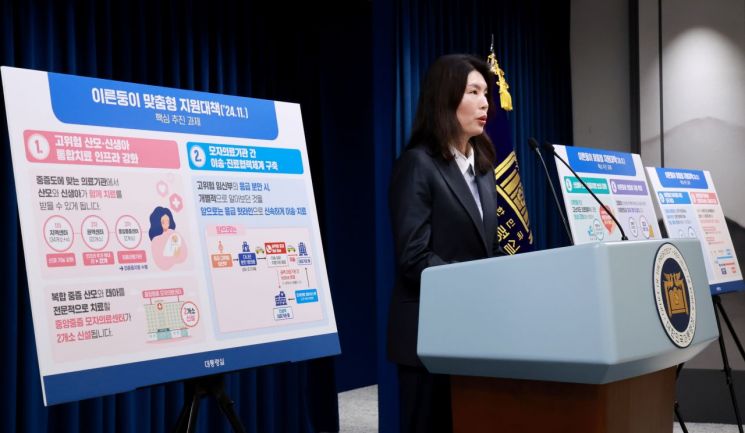 Yoo Hyemi, Chief of Low Birthrate Response, is briefing on the 'Customized Support Measures for Premature Babies' at the Presidential Office building in Yongsan, Seoul, on the 28th. Photo by Yonhap News
Support for medical expenses for premature infants will also be increased. Currently, medical expenses are supported from 3 million KRW to a maximum of 10 million KRW depending on the infant's weight, but this will be raised to 4 million KRW to a maximum of 20 million KRW. The quintuplets, born weighing less than 1 kg, will be eligible for up to 20 million KRW in medical expense support.
Compensation for neonatal and maternal intensive care will also be strengthened.
Chief Yoo explained, "This year, we raised the hospitalization fees for neonatal intensive care units and the fees for dedicated hospitals, and significantly increased fees for high-difficulty surgeries for newborns, but there are still opinions that compensation for treating high-risk newborns and pregnant women is insufficient, which exacerbates difficulties in obstetrics and pediatrics departments, so we decided to strengthen compensation for frontline medical staff."
Furthermore, a program where experts continuously monitor the growth and developmental status of premature infants after hospital discharge will be expanded nationwide from next year, starting from some local governments. Currently, pilot projects are underway in six regions including Seoul and Busan, and next year this will expand to 17 cities and provinces nationwide.
In addition, the benefit period for neonatal health and welfare services will be adjusted based on the expected delivery date. Currently, it is based on the birth date, which has been criticized for causing disadvantages to premature infants who are hospitalized long-term in intensive care units and miss out on benefits.
© The Asia Business Daily(www.asiae.co.kr). All rights reserved.
![Clutching a Stolen Dior Bag, Saying "I Hate Being Poor but Real"... The Grotesque Con of a "Human Knockoff" [Slate]](https://cwcontent.asiae.co.kr/asiaresize/183/2026021902243444107_1771435474.jpg)
















