Temporary Traffic Suspension on Some Roads in Seoul
As record-breaking heavy snowfall fell in Seoul and the metropolitan area for the first time in 117 years, some roads in parts of the metropolitan area were closed, and schools at the frontline were ordered to close.
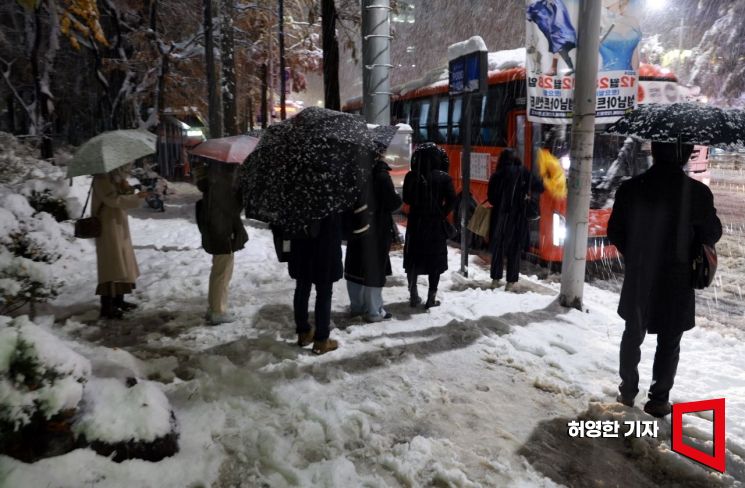 On the 28th, after a night of heavy snowfall in the central region, residents are waiting for the bus at a bus stop in Seongnam-si, Gyeonggi-do, on their way to work early in the morning. Photo by Heo Young-han
According to the Korea Meteorological Administration as of 8 a.m. on the 28th, most areas in the metropolitan area saw snow accumulation up to adult knee height, including 47.5 cm in Baegam-myeon, Cheoin-gu, Yongin, Gyeonggi Province, 43.0 cm in Suwon, 42.4 cm in Geumjeong-dong, Gunpo, 41.2 cm in Gwanak-gu, Seoul, and 40.7 cm in Manan-gu, Anyang, Gyeonggi Province. Heavy and wet snow was forecasted to fall at a rate of 1 to 3 cm per hour, mainly in the central region. Up to 15 cm of heavy snow was expected in the mountainous areas of Jeju Island and Chungbuk region. Particularly, a heavy snow warning was issued for Seoul and Incheon, while a heavy snow advisory was in effect for northern Gyeonggi and the central inland areas.
The wet snow that fell this time is 2 to 3 times heavier than dry snow, and typically, when 50 cm of snow accumulates over an area of 100㎡ (approximately 30.25 pyeong), it weighs about 5 tons. Since a large amount of snow has already accumulated and snowfall continues, combined with low temperatures that will prevent the snow from melting and cause it to freeze, special precautions must be taken against damage such as collapse accidents.
Meanwhile, as snow concentrated in Seoul and Gyeonggi, where the resident and floating populations are high, commuters experienced significant inconvenience. On the morning commute, Seoul City closed six roads including Waryong Park-ro, Bukaksan-gil, Inwangsan-gil, Samcheong Tunnel, Seodal-ro, and Heukseok-ro. Removal work was carried out in these sections due to roadside street trees falling over and other reasons.
Trains on both directions of the Suin-Bundang Line experienced some delays. Snow accumulated on the tracks and in the train depot, requiring snow removal operations. Air and sea routes were also blocked. Passenger ships on 76 routes with 99 vessels, including the Incheon-Baengnyeong route, were suspended, and 93 flights were canceled.
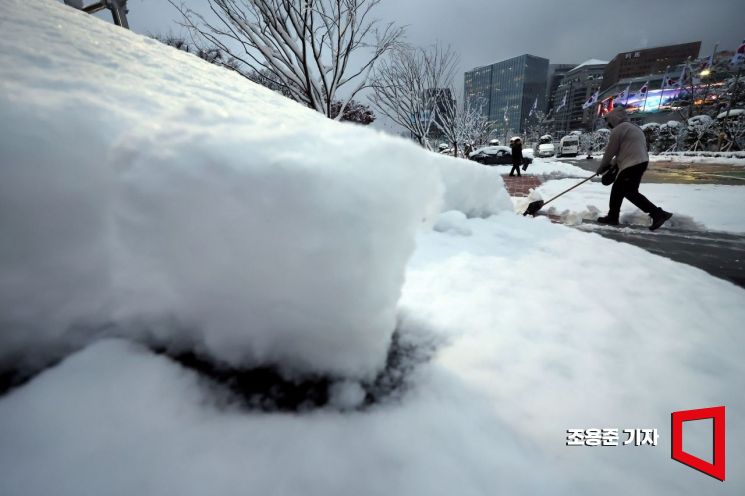 On the 28th, when a large amount of snow fell for two consecutive days in Seoul and the metropolitan area, an official from the Government Seoul Office in Jongno, Seoul, was conducting snow removal work. Photo by Jo Yong-jun
Schools in the Gyeonggi area also took measures such as school closures or adjusting school start times. The Gyeonggi Provincial Office of Education actively recommended school closures to about 4,700 kindergartens, elementary, middle, and high schools in the area due to the record snowfall. Disaster-related school closures are possible at the discretion of school principals. Especially in schools in the Yongin area, parents were notified via the e-Alimi system about the school closures and that both after-school care and after-school classes would not be operated.
In an urgent official letter sent to frontline schools on the morning of the day, the Gyeonggi Provincial Office of Education stated, “To all principals of all levels of schools including elementary, middle, high, special, and various schools in Gyeonggi Province, we strongly recommend closure today to prevent safety accidents and casualties during students’ commutes.”
Due to the heavy snow, residents in some areas of Gyeonggi had to evacuate to village halls and other shelters. A total of 56 people from 36 households stayed in temporary housing facilities or relatives’ homes. A total of 1,280 fire department activities related to safety measures and rescues occurred due to the heavy snow.
From the afternoon of the 26th until the morning of the 28th, 71,639 tons of de-icing agents were spread on roads nationwide. A total of 14,937 personnel and 6,900 pieces of equipment were deployed for snow removal operations. The Ministry of the Interior and Safety and local governments urged through disaster alert messages, “Please refrain from outdoor activities and driving, and use public transportation during commutes.”
© The Asia Business Daily(www.asiae.co.kr). All rights reserved.