Passed Seoul City Dokaewi Review
First Application of Current Floor Area Ratio... 58 More Sale Units
Secured Public Dormitories... Implemented Landscape Suitable for Hilly Areas
The area around Seogye-dong 33 in Yongsan-gu, located on the west side of Seoul Station, will be transformed into a large complex with 2,700 households. This is the first case to apply the 'Recognition of Existing Floor Area Ratio' standard introduced by the Seoul Metropolitan Government to revitalize redevelopment and reconstruction, improving project feasibility and increasing the number of units for sale.
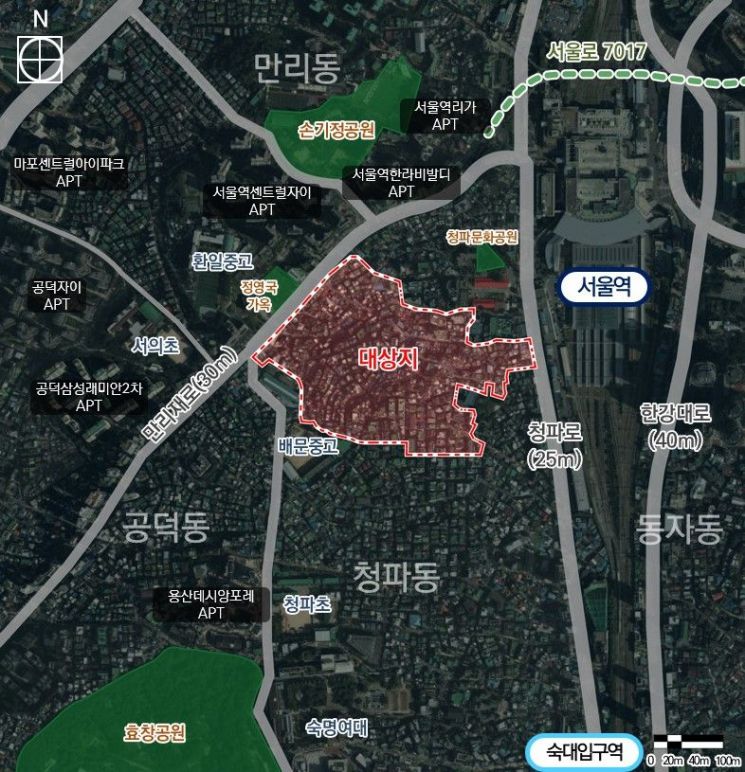
On the 26th, Seoul City held the 12th Urban Planning Committee's delegated subcommittee and announced on the 27th that the agenda for the 'Redevelopment Project of Seogye-dong 33 Area in Yongsan-gu' was approved with modifications.
The target site was the first to apply the 'Recognition of Existing Floor Area Ratio' system, which has been in effect since September. This system recognizes the existing floor area ratio as the standard floor area ratio for areas where many buildings exceed the current ordinance floor area ratio, causing low project feasibility. Applying this system allows for a higher floor area ratio.
In the Seogye-dong 33 area, the standard floor area ratio was raised by 40 percentage points from the original 150% to 190% by applying the existing floor area ratio in the Type 1 General Residential Area, which accounts for nearly 50% of the total area. On average across the entire district, the standard floor area ratio increased by about 27%. The mixed-use zones of Type 1, 2, and 3 General Residential Areas were also upgraded to Type 2 and 3 General Residential Areas and Semi-Residential Areas. As a result, the number of units available for sale increased by 58 compared to the public inspection plan. Due to improved project feasibility, the estimated burden per union member is expected to decrease by about 32 million KRW on average.
With the approval of this review, the Seogye-dong 33 area will be reborn as a large complex with up to 39 floors and 2,711 households through redevelopment.
Parks will be placed along Manrijaero and Cheongparo, where pedestrian and activity concentrations occur. An east-west green pedestrian path connecting the Manrijaero Park to Cheongparo Park will be created within the complex. A north-south three-dimensional pedestrian path connecting Seoul-ro, Manrijaero, the target site, and Hyochang Park will also be established. At the center of the complex, where the east-west and north-south pedestrian routes meet, a symbolic space called Seogye Green Healing has been designed.
Considering the terrain difference of up to 40 meters, elevators and ramps for pedestrians with mobility difficulties will be installed within the complex. Narrow and poor roads interrupted by steep slopes will be improved to connect the east-west traffic system from Cheongparo to Manrijaero. Cultural and leisure facilities such as libraries will also be expanded. Additionally, public dormitories for university students and youth will be planned within the site.
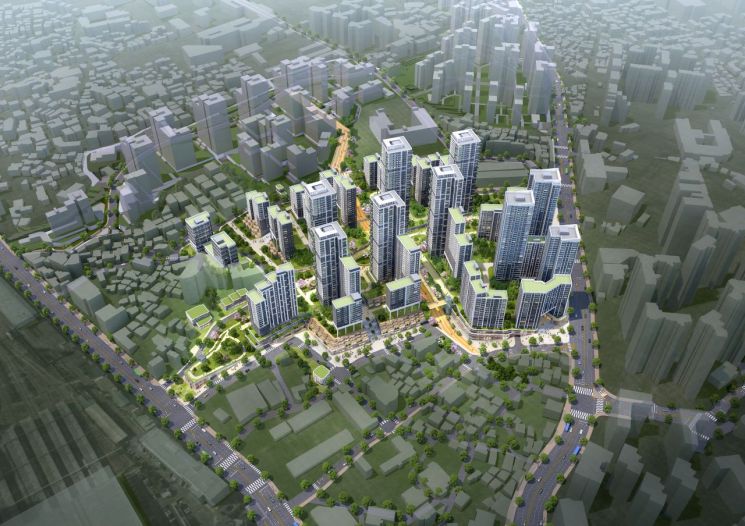
Although the target site is a residential area adjacent to Seoul Station, located at the entrance to downtown Seoul, redevelopment had been slow due to the division of east and west areas by the above-ground Gyeongbu Line railroad and the terrain differences of the hilly area, which lowered project feasibility. However, with the approval of this maintenance plan, it is expected to be developed into a representative hillside residential complex in the city center enjoying views of Namsan.
Han Byung-yong, Director of the Housing Office of Seoul City, said, "We have taken the first step in the project by applying the Recognition of Existing Floor Area Ratio system, which was carefully prepared by the city, and through reasonable adjustments of land use zones. We will actively support future procedures so that the project can gain momentum and be developed into a representative residential complex in downtown Seoul."
© The Asia Business Daily(www.asiae.co.kr). All rights reserved.
![Clutching a Stolen Dior Bag, Saying "I Hate Being Poor but Real"... The Grotesque Con of a "Human Knockoff" [Slate]](https://cwcontent.asiae.co.kr/asiaresize/183/2026021902243444107_1771435474.jpg)
















