Trump "25% Tariffs on Mexico and Canada Products"
"Will Sign Necessary Documents in January Next Year"
Mexico as Export Hub Targeting North American Market
Electronics, Automotive, and Refining Industries Status Checked
Ministry of Industry Also Closely Monitoring Trump Developments
Donald Trump, the President-elect of the United States, announced on his first day in office that he would impose a 25% tariff on Mexico, prompting Korean companies operating in Mexico to heighten their alertness and begin preparing countermeasures.
The Ministry of Trade, Industry and Energy, the main export-related government agency, is also closely monitoring the tariff policy level that the second Trump administration will introduce and is considering response strategies.
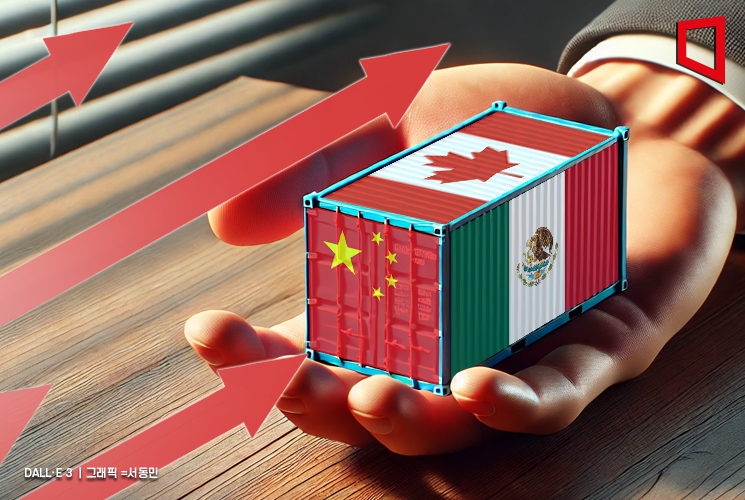
According to industry sources on the 26th, Trump stated on the 25th (local time) in a post on his social media platform 'Truth Social' that "One of the first executive orders on January 20 (next year) will be to sign the necessary documents to impose a 25% tariff on all products entering the United States from Mexico and Canada."
Mexico has been evaluated as an optimal location for export bases targeting the North American market due to its low labor costs and benefits from the United States-Mexico-Canada Agreement (USMCA). Korean companies have also used Mexico as a forward base. As of last year, South Korea ranked 11th in foreign direct investment (FDI) in Mexico.
However, uncertainty has increased following Trump's remarks, causing Korean companies that have established production bases in Mexico to become tense. Internally, they are analyzing product cost competitiveness and discussing ways to diversify production locations supplying products within the U.S. after tariffs are imposed.
In the electronics industry, Samsung Electronics operates a home appliance factory in Quer?taro and a TV factory in Tijuana. LG Electronics also operates production bases in Reynosa (TV), Monterrey (refrigerators), and Ramos (automotive parts). LS Cable & System, which recently started construction of a new factory in Mexico, is closely monitoring the situation and preparing response plans. LS Cable & System began construction in August of a bus duct factory for high-capacity power distribution systems and an electric vehicle battery parts factory in Quer?taro.
The automotive industry is also on alert. Kia is the only automaker currently operating production plants in Mexico, producing 250,000 units annually in Monterrey. Kia exports about 150,000 of these units to the United States, so the imposition of tariffs is expected to have an impact. Hyundai Mobis and Hyundai Transys also operate production plants in Monterrey. Hyundai Mobis Mexico supplies modules and lamps to Kia's Mexico plant, Hyundai Motor's Alabama plant, and Kia's Georgia plant. However, the volume supplied to U.S. plants is known to be very small. Since tariffs would be imposed on finished vehicles equipped with Mexican parts rather than on the parts themselves, the impact on parts suppliers is expected to be less significant than anticipated.
The refining industry is concerned that the 'tariff bomb' from the second Trump administration could lead to stagnation in global oil demand. Under protectionism, reduced trade demand between countries and continents could decrease demand for transportation fuels, thereby affecting overall global oil demand. A decline in oil demand would lower refining margins, a key profitability indicator for the refining industry, potentially leading to decreased operating profits and worsening business conditions across the sector.
Meanwhile, the Ministry of Trade, Industry and Energy is closely monitoring the movements of the Trump transition team and is assessing the impact of the tariff bomb by monitoring the reactions of domestic export companies with production bases in Canada and Mexico.
Earlier, on the 22nd, the ministry held a 'Meeting with Companies Operating in Mexico' attended by representatives from Kia, HL Mando, LG Innotek, Hyundai Mobis, and others to preemptively assess the impact on Korean companies operating in Mexico and discuss response measures in preparation for changes in U.S. trade policy toward Mexico under the new administration.
At this meeting, Jung In-kyo, Director General of Trade Negotiations at the Ministry of Trade, Industry and Energy, stated, "We will actively work to minimize management uncertainties for our companies by establishing and operating cooperation channels with the Mexican federal government as well as state governments where many of our companies have established operations."
© The Asia Business Daily(www.asiae.co.kr). All rights reserved.
![Clutching a Stolen Dior Bag, Saying "I Hate Being Poor but Real"... The Grotesque Con of a "Human Knockoff" [Slate]](https://cwcontent.asiae.co.kr/asiaresize/183/2026021902243444107_1771435474.jpg)















