Demands for Relaxation Surge from Business and Management Sectors
Ruling and Opposition Parties to Discuss Further in Industry Committee
Three Flexible Scenarios for the 52-Hour Workweek System
Debate over the 'flexibilization of the 52-hour workweek,' which is highly demanded by the industry, has ignited in the National Assembly. The National Assembly is drafting a Semiconductor Special Act to strengthen the competitiveness of the semiconductor industry. Lawmakers from both ruling and opposition parties agree on the overall necessity of the Semiconductor Special Act. However, there is a significant difference in opinion regarding the clause that exempts high-income research and development personnel from the 52-hour workweek.
According to the current Labor Standards Act, workers can work up to 40 legal working hours per week plus 12 hours of overtime, totaling 52 hours. This was implemented following the 2018 amendment under the Moon Jae-in administration, which reduced the weekly working hours from 68 to 52. Under the Yoon Seok-yeol administration, attempts have been made to introduce flexibility in working hours. In November last year, the Ministry of Employment and Labor announced, "While maintaining the current framework of the 52-hour workweek, we will promote improvements to the system that allow labor and management to choose not to limit overtime management units to one week for necessary industries or occupations."
Ruling and Opposition Clash... What About Semiconductor R&D Personnel?
The Subcommittee on Industry, Trade, and Intellectual Property of the National Assembly’s Industry, Trade, Small and Medium Venture Committee (Industry Committee Subcommittee) began discussions on the Semiconductor Special Act on the 21st. Both ruling and opposition lawmakers have each introduced the Semiconductor Special Act as their party’s bill, confirming consensus on industrial promotion and pushing for joint approval. The major point of contention is whether to include the clause exempting the 52-hour workweek. The People Power Party insists on including this clause in the Semiconductor Special Act. The Democratic Party, despite having many 'opposing' members within the party, plans to continue discussions within the Industry Committee for now.
People Power Party lawmaker Ko Dong-jin and Democratic Party lawmaker Kim Seong-hwan, both members of the Industry Committee Subcommittee, stated in a phone call on the 25th that they "plan to discuss further" regarding the clause exempting the 52-hour workweek. This clause exempts high-income professionals from the application of the Labor Standards Act and is also known as the 'white collar exemption.' With the decision to continue discussions on this clause, the processing of the Semiconductor Special Act is expected to extend beyond this month.
While the People Power Party, which had been accelerating the bill as a party platform, has eased off the 'accelerator,' it has secured time to narrow the gap on the key issue of exempting the 52-hour workweek. Additional discussions in the Industry Committee are scheduled for December, so the possibility of including the clause is not completely ruled out. The chairperson of the National Assembly’s Industry Committee is Lee Cheol-gyu, a member of the People Power Party.
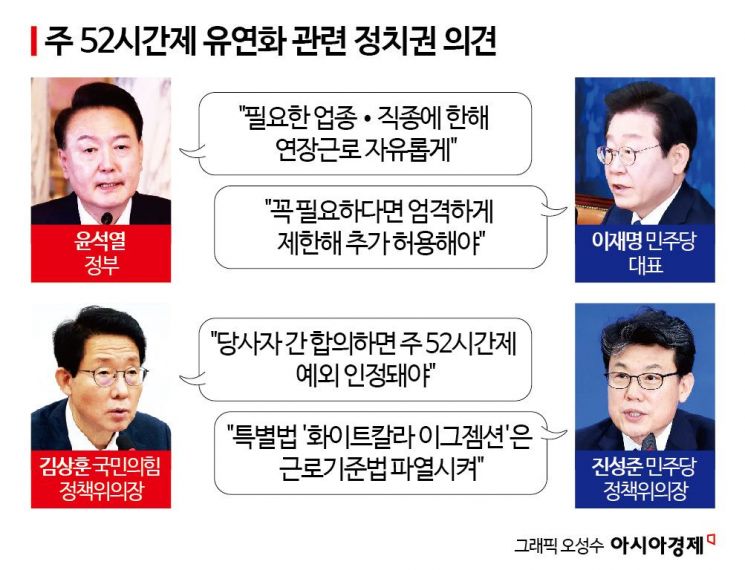
Within the Democratic Party, the majority opinion is that "the Labor Standards Act should not be bypassed through a special act." The Democratic Party’s Policy Committee previously drafted a five-page report opposing the People Power Party’s Semiconductor Special Act. Policy Committee Chair Jin Seong-jun stated, "If only the semiconductor industry receives special treatment, other industries will also request the same," and drew a clear line by saying, "It is problematic to try to break the Labor Standards Act." Park Hong-bae, a lawmaker with a background in the Financial Union, said, "Working hours should gradually be reduced," and added, "We should not blame the crisis caused by the government’s economic and industrial policy failures on working hours."
However, Democratic Party leader Lee Jae-myung has expressed a flexible stance on this issue, attracting attention. On the 20th, during a meeting with the Korea International Trade Association’s chairpersons, Lee said, "If flexibilization is practically necessary, it should be strictly limited and additionally permitted." Kwon Chil-seung, a former Minister of SMEs and Startups, also stated in a phone call, "Since each industry has different characteristics, exemption from the 52-hour workweek should be allowed."
"Lift Working Hours Regulations"... Flood of Demands from Business and Management Circles
Demands to lift the 52-hour workweek regulation are pouring in from business and management circles. Son Kyung-sik, chairman of the Korea Employers Federation (KEF), met with Lee Jae-myung on the 11th and urged, "It is urgent to guarantee workers’ choice regarding working hours to increase labor market flexibility," recommending improvements to flexible work systems and the introduction of the 'white collar exemption.'
Earlier this year, KEF released a report titled 'Status and Trends of Long-Hour Workers: An International Comparison,' which concluded that Korea is no longer a country of long working hours. The report stated that the proportion of people working over 50 hours per week in Korea is around 10.3?12%, similar to the OECD average of 10.2%. It also claimed that the proportion of workers working over 60 hours per week is about 2.7?3.2%, which is lower than the OECD average of 3.8%. In other words, since Korea is no longer a country of long working hours, it needs systems that enhance flexibility and productivity rather than regulations restricting working hours.
There are also criticisms that Korea’s working hours regulation barriers are higher compared to major advanced countries. The US, Germany, and the UK set legal working hours on a weekly or daily basis. Korea restricts working hours on both daily (8 hours) and weekly (40 hours) bases, imposing dual limits.
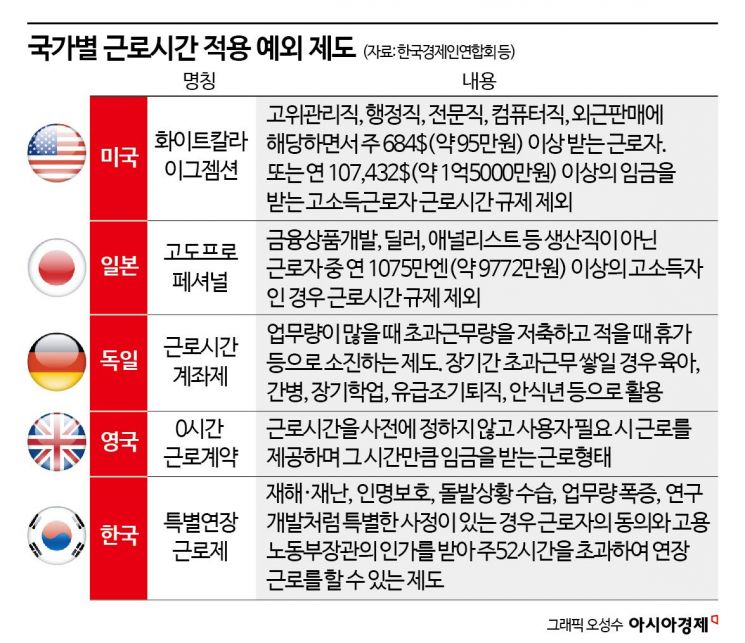
The US and Japan operate systems that exclude high-income professionals from working hours regulations. Germany runs a working hours savings account system, allowing workers to save overtime hours and use them freely for vacations or rest when needed. Korea also allows up to 64 hours per week under the special overtime work system provided in the current Labor Standards Act for special circumstances such as disasters, emergencies, or sudden workload surges. However, the conditions and procedures for approval are strict, and the period is limited to within 4 weeks per instance and 90 days per year.
Seo Ji-yong, a professor of Business Administration at Sangmyung University, said, "There is no need to regard the 52-hour workweek as 'golden and sacred.' Since each industry and company has different business goals, it does not seem appropriate to uniformly bind working hours."
Three Scenarios for Flexibilizing the 52-Hour Workweek
If the 'white collar exemption' clause cannot be included in the Semiconductor Special Act due to opposition from the Democratic Party, three scenarios can be considered for flexibilization. The Democratic Party’s opposition to this clause is mainly based on two reasons. First, they fear that shaking the principle of the '52-hour workweek' solely through a special act would render the Labor Standards Act meaningless. Second, they argue that since there is already a special overtime work window in the current system, further relaxation is unnecessary.
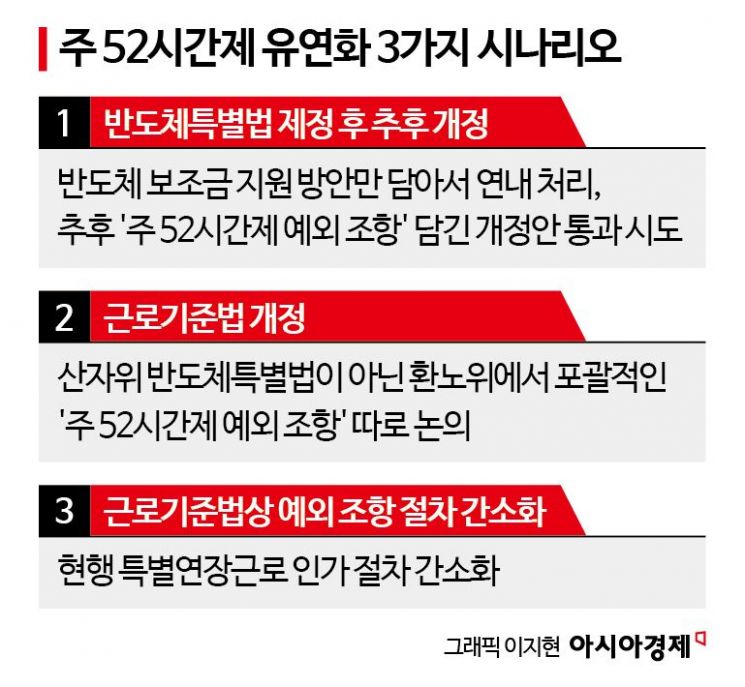
Ko Dong-jin, a People Power Party lawmaker who holds the 'key' to the enactment of the Semiconductor Special Act and a former president of Samsung Electronics, aims to pass the act within this year. He could first enact the Semiconductor Special Act, which guarantees subsidies and is agreeable to the Democratic Party, and then add the clause later through an amendment.
The second option is to include a comprehensive '52-hour workweek exemption clause' in the Labor Standards Act, which is considered the 'mother law' of working hours regulations. Amending the Labor Standards Act is legally regarded as the most appropriate approach. However, the standing committee responsible for the Labor Standards Act is the Environment and Labor Committee (Environment and Labor Committee), where many Democratic Party lawmakers with labor union backgrounds are concentrated.
Alternatively, the Democratic Party’s claim that the current system is sufficient could be addressed by utilizing the special overtime work approval procedure under the Labor Standards Act. This system is known to be difficult to use in the industrial field. According to the Ministry of Employment and Labor, as of October this year, there have been 5,230 cases using this system, accounting for only 0.7% of domestic workplaces with five or more employees subject to the Labor Standards Act. The maximum working hours allowed are 64 hours per week. Last year, the government designated R&D for materials, parts, and equipment (SoBuJang) under the 'SoBuJang Special Act' as eligible for special overtime work.
© The Asia Business Daily(www.asiae.co.kr). All rights reserved.
![Clutching a Stolen Dior Bag, Saying "I Hate Being Poor but Real"... The Grotesque Con of a "Human Knockoff" [Slate]](https://cwcontent.asiae.co.kr/asiaresize/183/2026021902243444107_1771435474.jpg)

















