Blur restoration technology used in scanning electron microscopes in semiconductor processes has been developed domestically. Blur refers to the blurred images that appear in scanning electron microscopes and similar devices.
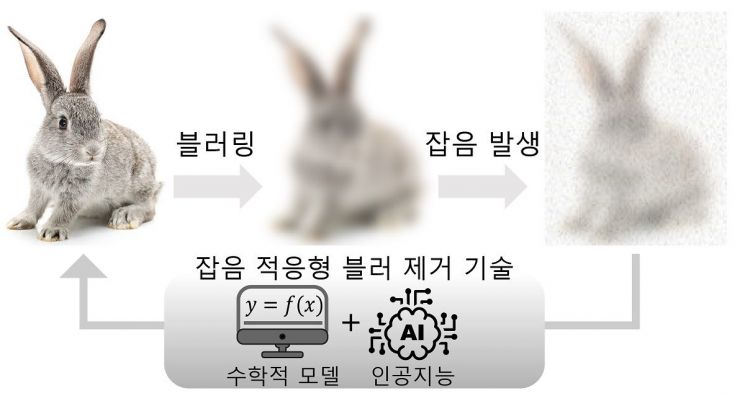
KAIST announced on the 26th that Professor Jang Museok’s research team from the Department of Bio and Brain Engineering, in collaboration with Samsung Electronics DS Division’s Semiconductor Research Laboratory Next-Generation Process Development Team, has developed a technology to restore medical and industrial images with distortion and strong noise.
According to the joint research team, the problem of correcting image blur and distortion commonly seen in smartphone camera photos is called deconvolution or deblurring, which is a technique to restore clear images using only the blurred image information, known as blind deconvolution. Among these, the deconvolution problem occurs commonly not only in daily life but also in various fields such as biological research and the semiconductor industry.
For example, fluorescence microscopes visualize fine structures at the cellular and molecular levels, so the measured fluorescence signals are blurred due to effects such as scattering, diffraction, and aberrations, making the correction process using deconvolution techniques essential.
In the semiconductor industry, scanning electron microscopes are used during the process improvement phase to detect micro process errors that may occur through inspection and measurement technologies during thousands of production processes, and to improve process yield. However, due to the instability of the electron beam, images tend to blur, making the correction process indispensable.
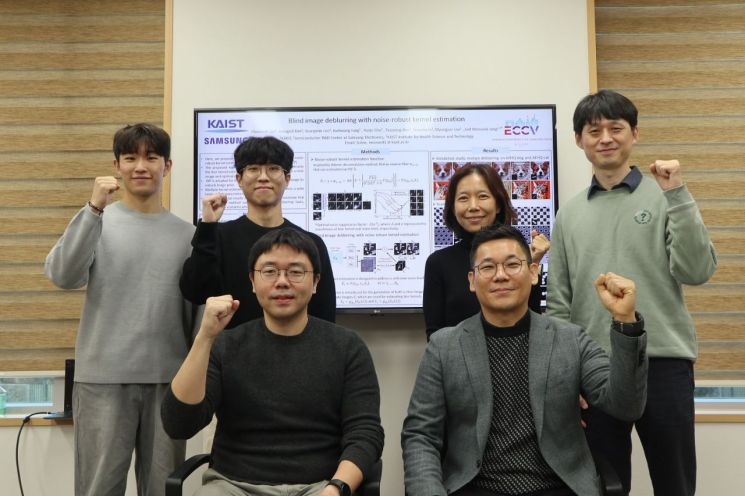 (Back row from left) Seungmin Lee, Master's student, Department of Bio and Brain Engineering, KAIST; Chanseok Lee, Ph.D. student; Yenny Im, Researcher, Next-Generation Process Development Team, Semiconductor Research Laboratory, Samsung Electronics DS Division; Cheolmu Kang, Team Leader; (Front row from left) Museok Jang, Professor, Department of Bio and Brain Engineering, KAIST; Myungjun Lee, Executive Director, Next-Generation Process Development Team, Semiconductor Research Laboratory, Samsung Electronics DS Division. Provided by KAIST
The joint research team judged that although there are various causes of image blurring such as movement, light scattering, and electron instability, a mathematically identical approach can be applied under the common premise of ‘eliminating image blur.’
In particular, focusing on the importance of balancing the process of effectively suppressing noise and restoring clear images by removing blur effects in images with high noise levels, they developed an image restoration approach based on Wiener deconvolution.
Wiener deconvolution is a traditional method that restores distorted images based on an inverse filter. The joint research team combined this with an adaptive noise suppression parameter and a generative artificial intelligence model to suppress noise that may occur during the image restoration process and enhance image clarity.
The joint research team experimentally demonstrated that the developed technology can be effectively applied to semiconductor inspection and measurement by successfully restoring clean and focused nanometer-scale semiconductor structure images from distorted images measured by noise-sensitive scanning electron microscopes.
Chanseok Lee, a doctoral researcher in the Department of Bio and Brain Engineering at KAIST, said, “This research solved the challenging problem of restoring distorted images amid strong noise. While this study focused on developing image restoration technology to overcome random noise, future research will focus on developing image restoration technologies that overcome non-uniform image restoration and various types of damage.”
Meanwhile, this research, with doctoral researcher Chanseok Lee as the first author, was presented at the 18th European Conference on Computer Vision held in Milan, Italy, on the 1st of last month.
© The Asia Business Daily(www.asiae.co.kr). All rights reserved.
![Clutching a Stolen Dior Bag, Saying "I Hate Being Poor but Real"... The Grotesque Con of a "Human Knockoff" [Slate]](https://cwcontent.asiae.co.kr/asiaresize/183/2026021902243444107_1771435474.jpg)
















