Story of Derek Pape (30) Living in Michigan
58 Facial Reconstruction Surgeries Over 10 Years Followed by Face Transplant
An American man who tried to take his own life by shooting himself in the face 10 years ago has regained his face after a successful facial transplant surgery.
Recently, foreign media including CNN in the United States reported the story of Derek Paff (30), who lives in a small town in Michigan. Ten years ago, when Paff was twenty, he suffered from extreme fatigue due to academic stress and other factors. Eventually, in March 2014, after returning home from school, Paff decided to end his life. He recalled, "I don't remember anything," and said, "I have no memory of anything until the moment I took out the gun, went outside, and shot myself." Paff was discovered by his father, Jerry Paff. Jerry found the gun safe open and, while looking around the house, found his son collapsed next to the garage. Paff was immediately rushed to the hospital and was able to survive, but his condition was so severe that he barely regained consciousness after several weeks.
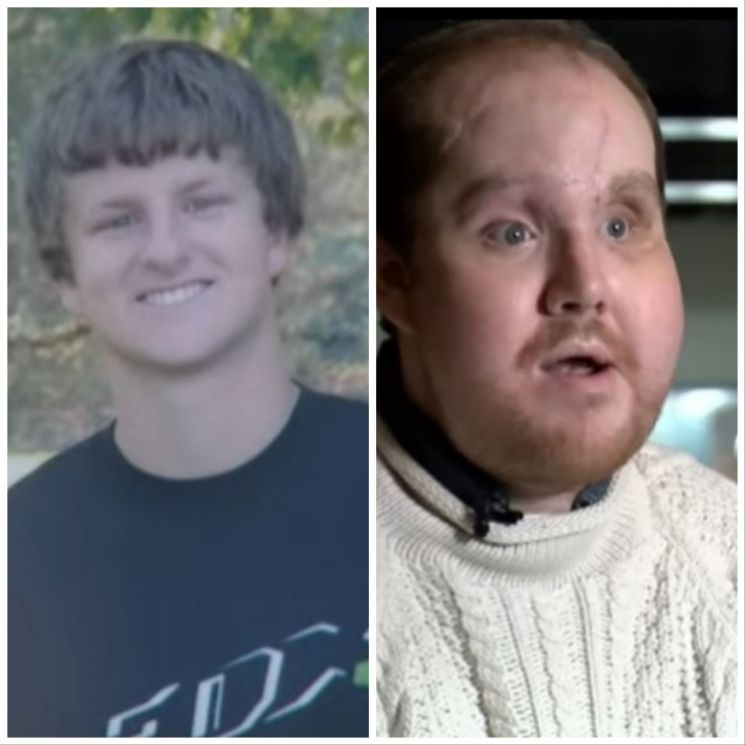 Derek Paff's appearance 10 years ago (left) and his current appearance after facial reconstructive surgery. Mayo Clinic YouTube channel
Because Paff shot himself in the face, he suffered severe damage particularly to the facial area. His nose, lips, teeth, and part of his forehead were gone, making it difficult to perform basic actions such as breathing, chewing and swallowing food, smiling, or closing his eyes. Over several years after the accident, he underwent a total of 58 facial reconstructive surgeries to restore his face. Thanks to the surgeries, some recovery was achieved, but he still had difficulties chewing food or speaking due to the absence of his nose, jaw, teeth, eyelids, and part of his forehead.
Paff's mother, Lisa Paff, recalled, "The medical staff said, 'Eventually, the only option left is a facial transplant,' and that there was no further treatment possible." She added, "My son is usually an active and sociable person, so at first, I was shocked by what he did, and then I felt guilty for not being able to stop him. But when I thought about it calmly, everything happened so quickly like a whirlwind, and the only thing we could do was for the family to come together and get through this period."
Finally, Paff decided to undergo a facial transplant surgery at the Mayo Clinic, one of the world's top hospitals in the United States. About 85% of his face was replaced with donor tissue, and facial muscles and skin from the neck were also transplanted. The medical team even transplanted the donor's tear glands so that Paff could produce tears normally, and connected the facial nerves of the donor and Paff to allow him to express natural facial expressions. In February, Paff underwent the facial transplant surgery, which lasted over 50 hours.
Dr. Samir Mardini, the lead surgeon, thoroughly prepared by running multiple computer simulations of the surgery process with the surgical team. More than 80 medical staff participated in the surgery. Dr. Mardini explained, "Facial transplant surgery is not a 'life-saving surgery' but a 'life-giving surgery.' Only about 50 such surgeries have been performed worldwide so far. Each patient shows different types of damage, so each surgery presents a new case."
After the surgery, Paff had difficulty recognizing his new face. The medical staff provided psychiatric counseling for a month to help him adapt to his new face and the changes. Lisa Paff said, "There were no cameras, cell phones, or iPads in the hospital room. Even the bathroom mirror was covered so Derek could prepare mentally." Exactly 10 years after he pointed the gun at himself, on March 5, Paff finally faced his new face. He said emotionally, "I feel like a person again, like I have been given a second chance." Paff can now speak naturally and make facial expressions. Dr. Mardini said, "Everyone should have seen the smile Paff made. That moment was when I truly felt the surgery was successfully completed."
Paff currently exercises twice a week and is receiving speech therapy. He is also taking immunosuppressants to prevent his body from rejecting the transplant. Regarding his current condition, Paff said, "I feel very good," and added, "I hope people become more aware of the seriousness of suicide." He also emphasized, "A new sun rises tomorrow. No matter how difficult the situation is, you have to know how to overcome it and maintain a positive attitude."
© The Asia Business Daily(www.asiae.co.kr). All rights reserved.
![Clutching a Stolen Dior Bag, Saying "I Hate Being Poor but Real"... The Grotesque Con of a "Human Knockoff" [Slate]](https://cwcontent.asiae.co.kr/asiaresize/183/2026021902243444107_1771435474.jpg)















